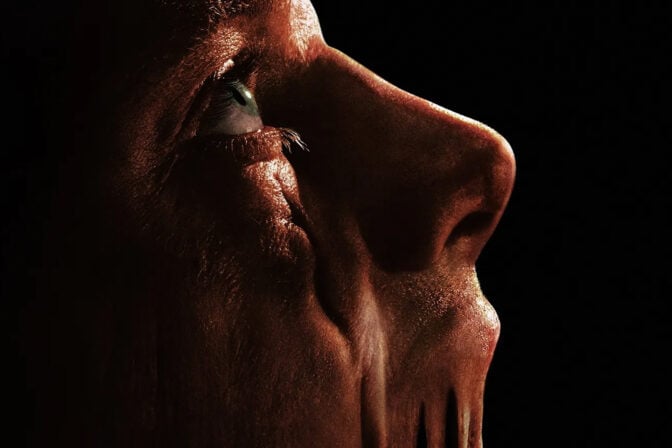
The most frightening thing about Hollywood is not that it turns people into monsters. It is that it can make them feel monstrous long before anything has happened to their bodies.
In Hollywood, a face is a livelihood, a negotiable asset and, when things go wrong, a small personal catastrophe. Clayface takes that arrangement literally. Matt Hagen (Tom Rhys Harries) has made it from Gotham’s streets to movie stardom when an attack disfigures him. A treatment promises to give him back his looks. Instead, according to the studio’s account, it leaves him with a body that will no longer hold its shape. The old comic-book monster has been recast as a man who discovers too late what the industry has taught him to value.
An actor’s face has always belonged partly to other people. It is photographed, insured, lit, retouched and judged by strangers, then presented to its owner as the essential fact of his identity. Matt’s injury ends his career; his colleagues abandon him. The supernatural horror is preceded by a very ordinary professional cruelty.
In most superhero stories, a transformation grants freedom. A timid person discovers strength; an outsider gets a spectacular second identity. Clayface makes the same bargain sound more like a predatory contract. Matt wants back what was taken from him. The technology apparently supplies it, but the terms are never quite the terms he imagined. That is a useful way to approach the old monster: not as a beast born bad, but as someone offered exactly the cure he has been trained to believe he needs.
James Watkins directs from a script by Mike Flanagan and Hossein Amini. Flanagan’s interest in damaged people and haunted memory suggests one route through the material; Watkins’s feel for humiliation and violence suggests another. Whether the film takes either route is a question for the screen, not the promotional synopsis. But a character whose body refuses to obey him hardly needs Gotham to supply additional terrors.
This version of the character seems designed to play on two old cinematic anxieties at once. One is the fear of losing one’s looks. The other is the fear of becoming nothing but one’s looks. A person who can change his face at will ought to have achieved the ultimate Hollywood privilege, the capacity to be anyone. Instead, shapelessness threatens to make identity impossible. In the language of celebrity management, a man with infinite appearances has somehow lost his brand.
It is tempting to call that a contemporary theme, but movies have worried about it for nearly as long as they have manufactured stars. Silent cinema made the human face enormous. Close-ups transformed a glance into an event. Horror quickly discovered the reverse operation: deform the face and you deform the star’s social standing. Lon Chaney’s career was built partly around the spectacle of transformation. The mask and the makeup made an actor newly visible by making him difficult to recognize.
The modern variation is that no physical mask is required. Celebrity already entails a kind of shape-shifting. Stars are expected to be intimate and remote, ordinary and extraordinary, accessible and perfectly managed. Each new franchise asks the performer to be a human being in interviews and a valuable property on posters. The individual must be both authentic and indefinitely adjustable. Matt Hagen’s predicament exaggerates the demand until its cruelty is impossible to ignore.
There is also a more awkward question. Can the conglomerate that thrives on endless transformations make a convincing horror story about the cost of transformation? DC’s publicity calls the film a horror thriller, yet its central character remains intellectual property, a reusable figure from a vast collection of villains, settings, and possible sequels. The business arrangement has an eerie resemblance to the plot. A person loses control of his body; a corporation discovers how many things it might become.
This contradiction need not ruin the enterprise. Genre films often draw energy from the institutions that make them. The studio system gave us bitter studio satires; advertising helped finance attacks on consumerism. A good monster can carry a critique without having to escape the machinery that brought it to life. But the monster has to be allowed an interior life. The old trick of displaying a hideous face, demanding pity, and then returning to noisy spectacle will not do.
An experimental cure is a neat device for a culture accustomed to treating every physical limit as a problem awaiting the correct intervention. Matt asks technology to restore the life that was taken from him. The answer, in this telling, is not a repair but an extravagant loss of control.
The experimental treatment places the film beside another strain of recent anxiety: the faith that technology will relieve us of having to accept limits. Here the body is approached as an engineering problem. Its failure demands a repair, not a reckoning. We have become accustomed to hearing about interventions that promise to halt aging, alter inherited traits, or produce a better version of the self. Fiction has every right to ask the simple follow-up question: better for whom?
None of this proves that Clayface succeeds as cinema. A synopsis cannot disclose pacing, performance, the weight of a silence, or whether an image genuinely disturbs. The relevant question, before declaring victory for a supposedly grown-up comic-book movie, is whether the finished work earns the sadness embedded in its premise. There is a considerable difference between a tragedy about a damaged man and an origin story that merely dresses a franchise asset in tragic clothes.
Still, the film’s central irony is promisingly sharp. Matt Hagen begins by wanting his old face back. Hollywood, the industry that first made his face valuable, has taught him to regard its loss as the loss of himself. A story willing to follow that logic to its unpleasant conclusion would have no need for a caped hero. Its real villain would be the conviction that a person is worth exactly as much as the image he can sell.
Editor’s note: This is a critical essay based on published film information, studio materials and cultural context, not a firsthand screening review. Film details: official/source information.

