There was a time when a movie based on a video game seemed faintly absurd. The attraction of the game was that you could play it. A movie removed that pleasure and offered, in exchange, actors dressed as people you used to control. Hollywood has since decided that familiarity is a more dependable virtue than plausibility.
The latest Street Fighter, directed by Kitao Sakurai, is set in 1993, when the franchise was already the center of a considerable arcade obsession. Andrew Koji plays Ryu, Noah Centineo plays Ken, and Callina Liang is Chun-Li. Jason Momoa appears as Blanka, David Dastmalchian as M. Bison, and Curtis Jackson as Balrog. The studio’s synopsis promises estranged fighters, a tournament and a conspiracy. The cast list has the cheerful improbability of a party assembled by somebody who has never met any of the guests.
A film based on Street Fighter confronts an exceptionally simple problem. What makes the game exciting is not primarily its narrative. It is the act of playing. A fight becomes dramatic because someone is controlling its timing, taking risks, and learning to read another person’s intentions. The player supplies a crucial part of the suspense. When that participation is removed, a film needs another mechanism to make a punch matter.
The official synopsis provides the familiar answer: estranged fighters, personal demons, a dangerous tournament, and a conspiracy with consequences that reach beyond the ring. That is an efficient framework. It gives the audience characters to root for, a reason for enemies to meet, and the promise of escalating stakes. What it cannot guarantee is the peculiar exhilaration that made the property valuable in the first place.
For many players, Street Fighter II was not simply a game. It was a machine in a public place, surrounded by other people. Arcades gave competition an audience and humiliation a geography. You could lose in front of strangers. You could spend your last coins trying to win back a little dignity. Rivalries could begin without a word. The cast’s colorful national identities and improbable moves provided the scenery for something deeply human: the wish to prove oneself while everyone was watching.
Hollywood is adept at selling this sort of recognition. A familiar theme plays, a costume appears, an actor strikes a pose, and an audience gets the little thrill of remembering. Surprise is harder. When a character’s famous move is anticipated before the fight begins, the director must find another way to make it exciting.
Hollywood is particularly good at this sort of substitution. A studio can reproduce an old logo with exquisite accuracy, re-create a costume, and arrange a musical cue that stirs a memory formed thirty years earlier. It can sell recognition with extraordinary confidence. What is harder to reproduce is surprise. When everyone in the audience already knows the signature attacks, the fighter’s entrance may be a punch line delivered before the joke.
A successful adaptation must therefore discover what these figures are like when they aren’t being selected from a character screen. Ryu and Ken are useful opposites: discipline and flamboyance, austerity and privilege, the purity of training and the temptations of public success. The film’s premise makes them estranged allies. That is more interesting than presenting them as walking packages of licensed moves. Their differences could supply an emotional rhythm to the fighting, making a contest about pride, loyalty, and how long a friendship can withstand a competing definition of success.
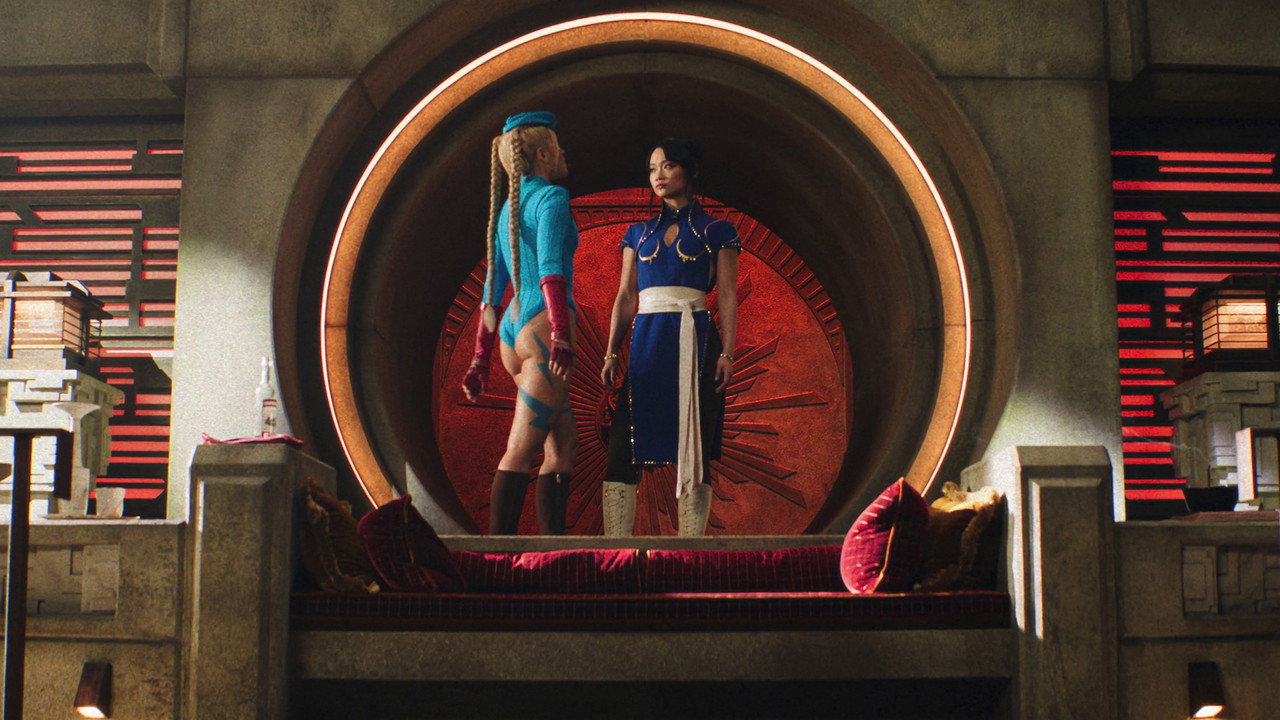
Chun-Li poses another test. The marketing synopsis places her in the role of recruiter, the person who draws the men back into danger. Yet she has long been among the most recognizable characters in the series. A film that treats her chiefly as the mechanism that starts someone else’s adventure would be reproducing an old Hollywood habit rather than finding a fresh reason for its existence.
Then there is the cast, a spectacle in its own right. Professional wrestlers, musicians, comics, and established actors share a roster large enough to resemble a convention program. That mixture need not be fatal. Fighting games have always delighted in improbable combinations of bodies and styles. But a long roll call is a poor substitute for a well-observed relationship. A film cannot make a character important merely by announcing that somebody important is playing him.
The strongest martial-arts cinema understands physical movement as an expression of personality. A fight can be comic, tragic, spiteful, intimate, or strangely tender. A pause before a blow may reveal more than the blow itself. Jackie Chan built entire sequences around the properties of furniture; Bruce Lee made fighting a philosophical and psychological confrontation. Their achievements remain a warning to producers who imagine that greater visual noise necessarily produces greater excitement.
Sakurai’s work in comedy raises the possibility that the film might know how ridiculous this world is. That would be a good beginning. The game has always welcomed extravagance: improbable bodies, impossible blows, personalities drawn in enormous strokes. There is no need to pretend that these people belong in a sober geopolitical thriller.
The presence of Sakurai, whose work has included anarchic comedy, makes that possibility worth considering. But the question is not whether the finished movie is faithful to each costume or move. Fidelity can be measured by a fan wiki. Cinema requires different standards: spatial clarity, comic timing, emotional coherence, and some reason to care what happens between the fights.
None of those qualities can be judged reliably from a cast list or synopsis. Promotional stills establish that the film has reproduced an elaborate visual universe, not whether it has made that universe dramatically persuasive. To mistake the two is to confuse brand maintenance with criticism.
The irony is that Street Fighter began as an invitation to challenge a familiar opponent and discover something unexpected about your own abilities. As an intellectual property, it is now being asked to do almost the reverse: deliver a reassuringly familiar experience on a predictable commercial schedule. The film’s greatest possible victory would be to escape, at least briefly, the machinery of recognition and give audiences the one thing nostalgia cannot provide. Something they haven’t already seen.
Editor’s note: This is a critical essay based on published film information, studio materials and cultural context, not a firsthand screening review. Film details: official/source information.

