Most books are designed to disappear into their contents. The cover opens, the pages turn, and the object itself politely gets out of the way. The Surrealists, naturally, preferred the opposite. They made books that behaved like traps, reliquaries, toys and small private theaters. Some were armored in metal. Others held photographs, collages, feathers, bits of thread or even panes of shattered glass.
Beginning with member previews on Oct. 1 and opening to the public Oct. 4, The Surrealist Book: Tomorrow Lives in Mirrors at the Museum of Modern Art makes the case that one of Surrealism’s liveliest arenas was not the gallery wall but the bound volume. The exhibition, on MoMA’s third floor through Jan. 23, 2027, gathers rare books associated with figures including André Breton, Claude Cahun, Salvador Dalí, Paul Éluard, Max Ernst, Toyen and Unica Zürn.
The timing feels apt. Books have lately been asked to defend themselves against every sort of digital efficiency, from the infinite scroll to the machine-made summary. Here is an exhibition about people who treated the book as inefficient on purpose. For them, a page could conceal something, interrupt something or refuse to behave. Reading could be tactile, inconvenient and a little dangerous.
The show draws heavily on the Helen and Sam Zell Collection, a major gift of artists’ books that MoMA is presenting for the first time. These are not merely illustrated texts. The distinction matters. A conventional illustrated book generally accepts a division of labor: words here, images there. The Surrealist book muddled those borders. Writers, artists, photographers, printers and binders collaborated until it became difficult to say where literature ended and the art object began.
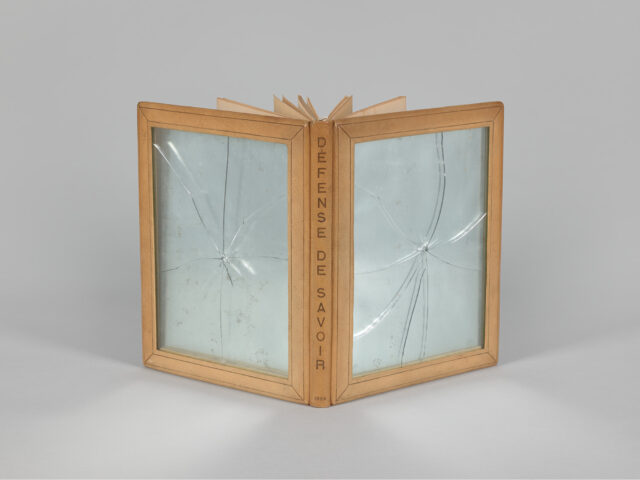
One of the clearest examples is Défense de savoir, a 1928 work by Paul Éluard with a frontispiece after Giorgio de Chirico. Years later, Georges Hugnet and Louis Christy rebound a copy so that sheets of shattered lead glass sat within its covers. The result looks less like something to place gently on a nightstand than an object recovered from a dream about a library after an explosion. Its title translates as Knowledge Forbidden, and the binding makes knowledge seem physically unstable.
That mixture of seduction and threat runs through the exhibition. Breton’s Surrealist Manifesto, published in 1924, appears in a special copy later rebound by Paul Bonet in nickel silver and supplemented with manuscripts and a collage poem. Salvador Dalí, Breton and Éluard converge in L’immaculée Conception, a book whose later binding incorporates photographs, drawings and manuscript material. In these works, the cover is not packaging. It is part of the argument.
Surrealism had always been unusually comfortable with publishing. Its manifestos, poems, magazines and provocations moved through print long before museums turned the movement into a sequence of familiar masterpieces. The book suited a group fascinated by dreams, chance encounters and the destabilizing collision of unrelated things. A bound volume could be intimate and reproducible at once. It could travel. It could be passed hand to hand. It could hide in plain sight.
It could also make collaboration feel natural. Claude Cahun and Marcel Moore’s Aveux non avenus, published in 1930, folds photomontage into a text that already resists straightforward autobiography. Toyen and Jindřich Heisler’s From the Strongholds of Sleep, from 1940, uses staged environments photographed and mounted on metallic paper. The book becomes less a container for images than a sequence of rooms through which a reader moves.
MoMA extends the story beyond the interwar years. Unica Zürn’s 1960 Orakel und Spektakel includes drawings, torn-and-pasted paper, dried plant material, feathers, envelopes, a playing card and thread. Ray Johnson’s roughly contemporary Th Thee for and Lai Book uses irregular pages, cutouts, foldout flaps and pasted papers. By then, Surrealism was no longer simply an organized movement with Paris at its center. It had become a method of permission: a way of allowing the ordinary object to misbehave.
That is one reason the exhibition may feel less historical than its dates suggest. Plenty of contemporary culture depends on jolting unrelated things together, encouraging audiences to move by association rather than sequence. But the Surrealist book reminds us that this way of thinking did not begin with tabs, feeds or algorithmic collage. Artists were doing it with paper, glue, photographs and bindings a century ago, with the crucial difference that the friction was physical. You had to touch the thing.
The exhibition is organized by Jodi Hauptman, MoMA’s Robert Lehman Foundation Chief Curator of Drawings and Prints, and Starr Figura, senior curator, with Kolleen Ku and Emma Kang. A 272-page catalogue edited by Hauptman and Figura accompanies the show. MoMA says the exhibition traces the role of Surrealist books from the 1920s into the 1950s and 1960s, when the movement’s formal organization had loosened but its habits of mind remained potent.
There is an appealing contradiction in seeing these unruly objects at MoMA, one of the institutions that helped turn modernism into a canon. Surrealism often wanted to detonate categories: art and literature, waking and dreaming, high culture and private obsession. Museums, by necessity, label and arrange. Yet the best objects in this show seem to retain a certain resistance to explanation. They look as though they might still be hiding something from the wall text.
That may be the exhibition’s real pleasure. A century after Surrealism’s first manifestos, the books still seem peculiarly alive. Their makers did not treat reading as a frictionless transfer of information. They treated it as an encounter. Open the cover, and something might happen.
The Surrealist Book: Tomorrow Lives in Mirrors is at the Museum of Modern Art, 11 West 53rd Street, from Oct. 4, 2026, through Jan. 23, 2027. Member previews run Oct. 1–3.

