Roy Lichtenstein spent much of his career making paintings that looked as if they had already been reproduced.
The dots were too regular. The colors seemed borrowed from cheap printing. The women looked as if they had been clipped from romance comics, the explosions from war stories, the brushstrokes from advertisements for painting itself. Even when the canvases were large and laborious, they maintained the flat, slightly insolent look of something that had passed through a machine.
That contradiction is the starting point of “Roy Lichtenstein: Like New,” opening Oct. 11 at the Whitney Museum of American Art. The exhibition brings together roughly 130 works made from the early 1940s through the 1990s, including paintings, drawings, sculpture, film, prints and four re-created murals. It is the first New York retrospective of Lichtenstein’s work since 1993.
Its timing could hardly be better. We now live inside the condition that Lichtenstein treated as a subject before it had a name. Pictures are copied, cropped, filtered, scraped, reposted, enlarged, compressed and fed into systems that generate new pictures from old ones. Authorship is argued over in public while images continue moving anyway. What was once a question about comic books and Benday dots has become an ordinary problem of life on a screen.
Lichtenstein’s work has always been easy to recognize and oddly difficult to settle. The style is so familiar that it can obscure the paintings. Look long enough at a Lichtenstein and you begin to notice that the apparent simplicity is full of decisions: how much of the original image to remove, where to shift a line, how to enlarge a face without turning it into a portrait, how to make something look mechanical by hand.
The Whitney’s show, organized by curator Meg Onli and artist Alex Da Corte with Nakai Falcón and David Crane, is built around this problem of translation. Its title comes from a 1962 work, but the phrase feels especially contemporary. Lichtenstein rarely treated an image as fixed. He treated it as material.
A picture after a picture
Most accounts of Lichtenstein begin in the early nineteen-sixties. Abstract Expressionism had made the heroic gesture into a kind of American religion. The artist’s hand mattered. Paint was supposed to announce the presence of the person who had put it there.
Lichtenstein, who had been painting in other styles for years, began moving in the opposite direction. He looked toward the lowly imagery of commercial culture: Mickey Mouse, advertisements, comic panels. He borrowed their visual grammar and magnified it until the disposable became monumental.
One of the breakthrough works, Look Mickey, from 1961, adapted an illustration of Mickey Mouse and Donald Duck from a children’s book. Girl with Ball, also from 1961, came from a newspaper advertisement for a resort. Drowning Girl, from 1963, took a melodramatic panel from a romance comic and transformed it into one of the canonical images of postwar American art.
Copying, however, understates the operation. Lichtenstein cropped, redrew, simplified and changed. He eliminated information. He rearranged speech. He made lines cleaner and shapes harder. The original image became a scaffold from which another image was constructed.
That difference matters because appropriation has always been both the obvious fact of Lichtenstein’s work and the source of its moral unease. The artists whose comic panels he used were rarely famous. Their drawings belonged to industries that treated illustration as work for hire, produced quickly and anonymously enough that the image could circulate without the artist becoming part of the story. Lichtenstein moved those images into galleries, where the market treated them very differently.
That discomfort has not disappeared with time. If anything, it has become easier to understand. Every argument now taking place around generative AI, training data and the difference between influence and extraction has an ancestor in the question hanging over Lichtenstein: What happens when one person’s image becomes another person’s raw material?
The Whitney does not need to turn Lichtenstein into an oracle of artificial intelligence for the connection to be apparent. His paintings are already about circulation. Their intelligence lies partly in recognizing that an image does not remain pure when it moves. It changes scale, audience, context and value.
The handmade machine
A common mistake is to assume that because Lichtenstein’s paintings resemble mechanical reproduction, they were mechanically made.
They were not. The dots, lines and flat areas of color required a great deal of planning and physical labor. Lichtenstein used stencils and other tools to mimic the Ben-Day printing process associated with commercial reproduction, but the result was deliberately handmade. The painting impersonated a print.
That contradiction helps explain why the work survives reproduction so well and why reproduction also betrays it. A Lichtenstein on a phone screen can look almost perfectly at home. The bright primaries, black contours and fields of dots remain legible at thumbnail size. Yet the physical paintings are often much stranger. Scale matters. Surface matters. The labor of making the image pretend not to have a surface becomes visible.
That tension is especially clear in the brushstroke paintings. Abstract Expressionism had turned the brushstroke into evidence of emotional authenticity. Lichtenstein took the brushstroke and rendered it as a sign. The splash and drag of paint became an icon of painterliness, outlined in black and reproduced with graphic precision.
Obvious as the joke is, it is more serious than it first appears. A gesture associated with spontaneity becomes something planned. Expression becomes a logo for expression. The painting asks whether the mark itself carries emotion or whether viewers have simply learned to read it that way.
Visual mistrust remained one of Lichtenstein’s recurring subjects. He made paintings of mirrors that do not reflect anyone. He revisited Cézanne, Picasso, Monet and Matisse through his own vocabulary. He constructed interiors that look like diagrams of rooms rather than rooms. Late in life, he made landscapes in which stylized marks stand in for sky, water and atmosphere.
Subjects change. The mechanism remains. How little information does an image need before we recognize what it is?
The woman in the window
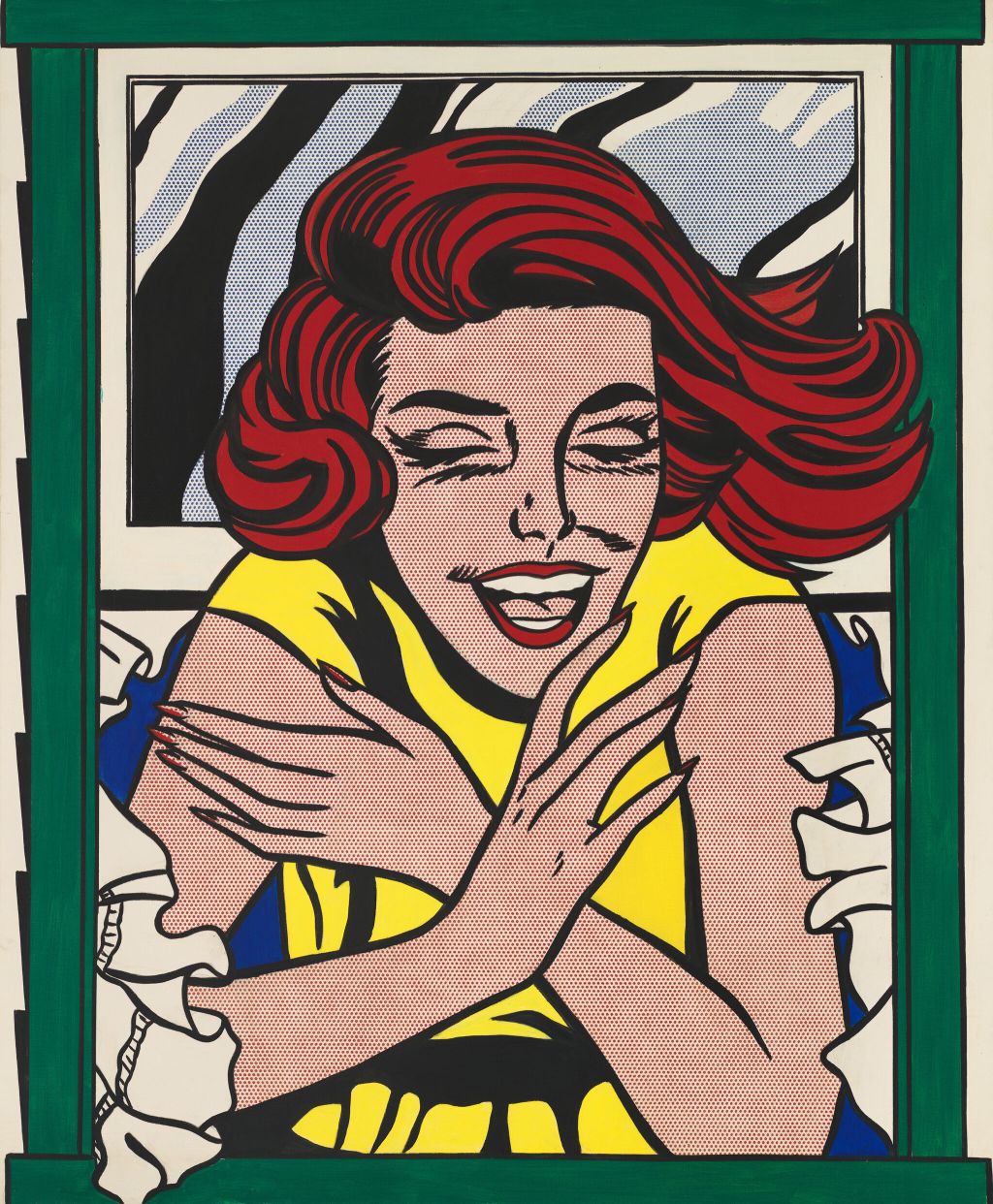
For a principal image of the exhibition, the Whitney chose Girl in Window (Study for World’s Fair Mural), from 1963, and it is easy to see why. A red-haired woman leans into the frame, smiling with her eyes closed. Her skin is a field of red dots. The hair is a set of black curves filled with dark red. Behind her is a green window and a patterned view beyond it.
She is less a person than a perfect system for producing the idea of a person.
Lichtenstein’s women have often been discussed as stereotypes, and they are. Their emotional lives tend to arrive compressed into visual shorthand: tears, parted lips, closed eyes, a telephone receiver, a thought balloon. They emerged from commercial narratives in which melodrama had to be legible immediately.
But the flattening is not merely a limitation. It is also what makes the pictures uncanny. The women seem intensely emotional and completely inaccessible. Their feelings are both exaggerated and sealed off. Everything is visible except the person.
That quality has aged well, perhaps uncomfortably so. The contemporary image economy rewards faces that communicate instantly and endlessly. Emotion becomes a format. A reaction image can stand in for a state of mind. A selfie performs interiority for an audience. Lichtenstein’s women already inhabit a world in which feeling is inseparable from representation.
He did not invent that world. He simply noticed what commercial pictures were already doing and enlarged the evidence.
The problem of originality
By including artists such as Louise Lawler, Richard Pettibone and Sturtevant, the Whitney prevents the exhibition from becoming a sealed retrospective of a famous style. These artists extended, complicated or undermined the idea that originality belongs neatly to one maker.
Sturtevant famously remade the work of other artists, sometimes almost immediately after the originals appeared. Pettibone produced miniature versions of contemporary artworks. Lawler photographed art in collectors’ homes, auction houses and museums, making the work’s context part of the image.
Lichtenstein belongs to that history even though he became much more famous than most artists associated with appropriation. His work insists on a distinction between an image and the conditions under which we encounter it. A comic panel in a cheap printed story is one thing. The same visual structure on a six-foot canvas in a museum is another.
That change is not neutral. The museum confers value. Scale produces authority. The signature creates ownership. A picture that may have begun as anonymous or disposable suddenly becomes permanent enough to require climate control.
Lichtenstein was sufficiently self-aware to make that transformation part of the subject. The paintings often look almost too clean, too deadpan, too indifferent to the aura that museums are designed to produce. They seem to say that if you are going to treat an image as sacred, you should at least notice how ordinary its ingredients are.
The ninety-six-foot problem
“Like New” will also re-create several murals, including a nearly ninety-six-foot version of the Greene Street Mural, a work Lichtenstein made in 1983 for the Castelli Gallery in SoHo.
At mural size, scale becomes impossible to ignore. Lichtenstein’s career is full of acts of enlargement, but at mural size the borrowed visual languages become architectural. A mark stops reading merely as illustration and begins organizing a room.
That was always one of his talents: converting the cheap look of mass culture into something that could hold a wall without becoming solemn. The work can be huge without pretending to be profound in the old manner. It remains cool, funny and faintly suspicious of its own importance.
A particularly New York history is embedded in that gesture. Lichtenstein’s rise coincided with the city becoming the center of the postwar art market. Leo Castelli’s gallery helped turn Pop art into an international phenomenon. SoHo became a neighborhood in which industrial spaces were transformed into places for art and then into places for wealth.
Lichtenstein’s pictures, which themselves transformed cheap printed sources into expensive objects, fit almost too neatly inside that urban history.
What copying means now
Large museum retrospectives often try to rescue an artist for the present. Lichtenstein does not need much rescuing. His imagery never really disappeared. It became part of design culture, advertising, fashion and the shorthand by which almost anyone recognizes Pop art.
What has changed is the world around the images.
When Lichtenstein began appropriating commercial pictures, copying still involved friction. An image had to be photographed, redrawn, printed, projected, traced or physically moved from one medium to another. Each transfer left evidence. Today, copying can be instantaneous and invisible.
Online culture did more than increase the number of images in circulation. It weakened the connection between an image and a stable origin. Screenshots lose captions. Photographs acquire new meanings in different feeds. Memes depend on repetition with variation. AI systems now produce images whose sources may be diffuse, contested or impossible for the viewer to identify.
In that environment, Lichtenstein’s old question feels less like an art-historical curiosity. At what point does changing an image make it yours?
He offered no clean answer. That is one reason the work remains useful. The paintings themselves sit uneasily between theft and transformation, homage and parody, handmade object and simulated reproduction. They refuse the comforting idea that an image has one life.
Whitney curators describe Lichtenstein as understanding that images change as they move through the world. That formulation is almost modest. Images do more than change. They acquire power, lose context, generate money, become symbols, become jokes, disappear and return.
Lichtenstein built an entire style out of watching that happen.
Still looking
Familiarity creates its own danger. The dots can become a brand. The comic-book faces can collapse into Pop wallpaper. His work is easy to reproduce on a tote bag, which is another way of saying that the commercial culture he examined has long since absorbed him.
A retrospective can either reinforce that familiarity or interrupt it.
The Whitney appears to be aiming for interruption. By spanning six decades, restoring murals and placing Lichtenstein in conversation with artists who pursued copying more explicitly, “Like New” is making an argument that the famous style was not the end of the story. The style was a tool for asking what seeing has to do with repetition.
Seen that way, Lichtenstein is far more interesting than the version reduced to dots and blond women.
He was not painting the modern world so much as the modern world’s pictures of itself. He understood that the image of a thing can become more powerful than the thing. A brushstroke can become a symbol of painting. A woman can become a symbol of emotion. A comic panel can become a museum object. A copy can become an original.
Sixty years later, these inversions no longer look like provocations. They look like the ordinary mechanics of culture.
Lichtenstein’s great trick is to make those mechanics visible without making them heavy. The paintings remain bright. They remain funny. They retain the speed of the images they borrowed even when you stand in front of them long enough to see how slowly they were made.
That may be the reason to see them again now. We have become very good at moving images and very bad at stopping to ask what happens to them on the way.
Lichtenstein never stopped asking.
“Roy Lichtenstein: Like New” opens Oct. 11 at the Whitney Museum of American Art, 99 Gansevoort St., and runs through May 10, 2027. Member previews are Oct. 8–10.

