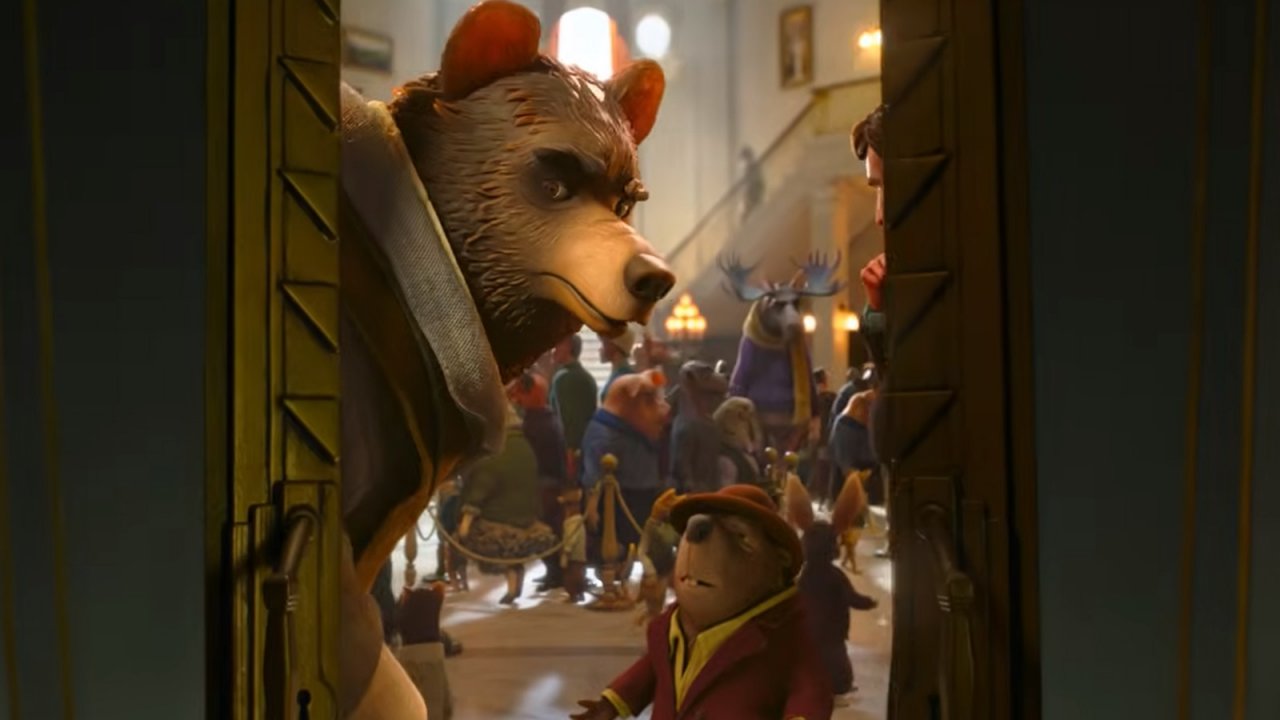
Somewhere in the making of Wildwood, somebody had to decide what a leaf should look like. Then somebody had to make it. The leaf would have to hold its place while a camera recorded one tiny increment of movement, before being adjusted for the next. To make a forest this way is a gloriously impractical enterprise.
LAIKA’s new stop-motion fantasy, adapted from Colin Meloy’s novel, follows Prue, a girl who ventures into the strange wilderness beyond Portland in search of her missing baby brother. The story offers secret societies, dangerous creatures and the old promise that the patch of woods adults warn children about contains something much more interesting than woods. Its method of animation is almost as enticing as its premise.
Stop-motion occupies an eccentric position in cinema. It is animation by means of the physical world, a form of make-believe whose apparatus remains stubbornly real. Puppets have joints. Fabric has a weave. Light falls on surfaces instead of being mathematically persuaded to imitate them. A tiny garment can acquire the weight of an actual garment because, in a rather literal sense, it is one.
The distinction is not that digital imagery cannot be beautiful. It can be astonishing. The difference is in the relationship between an image and the labor that produced it. In stop-motion, a gesture accumulates through innumerable microscopic decisions. The resulting movement can possess a particular hesitancy, a tiny resistance to perfection, that makes its imagined characters seem oddly vulnerable. They inhabit a world that could be touched and broken.
Think of the disquieting domestic details in Coraline, or the peculiar solidity of the creatures in ParaNorman. LAIKA’s figures often seem most alive when they look faintly uncomfortable in their own skins. The films invite the eye to linger on the furniture and fabrics even when the story is hurrying somewhere else.
Wildwood offers another fertile contradiction: an apparently untamed landscape meticulously controlled by artisans. The wilderness is not spontaneous. It is manufactured with fantastic deliberateness. Yet the careful making does not necessarily diminish the impression of wildness. It can deepen it. A constructed world feels convincing not because it looks exactly like reality, but because it obeys its own physical and emotional rules.
The book’s geography gives the project a distinctive starting point. Portland is not the ordinary gateway to the fairy tale. Its damp green spaces and suburban borders already suggest that the civilized world may be a temporary concession to the forest. Meloy’s narrative takes seriously a familiar childhood suspicion: that adults have agreed to ignore the most interesting places, and that the forbidden patch of trees contains a society with all the complications of our own.
Fantasy has always made a complicated promise to children. It offers escape and immediately introduces another set of obligations. Walk into the wood and discover laws, political arrangements, old grievances, and frightening bargains. The secret world turns out to be less a vacation from adult life than an early encounter with it. The best children’s stories understand that enchantment and danger are not opposed. Danger is often the thing that gives enchantment its force.
That is why the question of scale matters. Modern family entertainment frequently inflates every adventure into a struggle for the future of the universe. The intimacy of a child looking for a sibling can be more emotionally compelling than a prophecy about an entire kingdom. The vast forest provides the stage; the missing brother provides the reason to care. If a film loses sight of the latter, even the most beautiful puppet kingdom can become a showroom.
The adaptation also carries an unusual literary inheritance. Meloy is known as the singer and songwriter of the Decemberists, a group whose songs often borrow the apparatus of old ballads: lost children, strange landscapes, dubious narrators, and events that feel half remembered. Ellis’s illustrations have a deliberately antique quality. Together they built a fantasy that seems to have been discovered in a trunk rather than invented for a product launch. Stop-motion is a sympathetic medium for that sensibility because it can resemble an old object suddenly granted life.
There is a danger in admiring the work too much. Stop-motion publicity can turn an animated film into a report on an endurance sport: so many figures, so many hours, so much delicate manipulation. This is impressive, certainly. It doesn’t tell us whether a scene is funny or frightening, or whether we care what happens to Prue.
There is a broader industrial argument here. Hollywood’s fascination with machine-generated imagery has coincided with an appetite for work that visibly resists mass production. The enthusiasm for handmade objects, practical effects, and older photographic processes is sometimes dismissed as nostalgia. Sometimes it is. But it can also be a demand to see evidence of decisions, constraints, and imperfection. The audience does not necessarily want the flawless image. It may want an image with a past.
The theatrical opening of Wildwood is therefore a test of more than one particular fantasy property, though its financial fate should not be made into a referendum on artistic worth. Stop-motion studios face unusual costs and production schedules. They cannot simply produce the next adventure at the pace of a content calendar. Their achievement lies partly in maintaining a different sense of time.
The film itself must be judged through its story, voices, humor, and rhythm, not through admiration for the process alone. Publicity images reveal the richness of its textures, but they cannot tell us whether a character’s fear is persuasive or a scene goes on too long. An audience deserves more than reverence for labor.
Yet the argument for its existence is unusually clear. To create a magical forest one leaf at a time is to insist that imagination need not abolish the material world. It can enter that world, fuss over it, and remake it with extraordinary care. In the best stop-motion, the miracle is not that the puppets appear alive. It is that the people who made them never quite disappear.
Editor’s note: This is a critical essay based on published film information, studio materials and cultural context, not a firsthand screening review. Film details: official/source information.

