
Doménica Feraud grew up in New York with the peculiar advantage of knowing that television was lying about at least one thing. Carrie Bradshaw’s shoes were not practical transportation. The apartments on Friends were absurdly large. The city on television was recognizably New York, but it was also a stage set, tidier and more affordable than the place outside the window.
Other lessons were harder to spot.
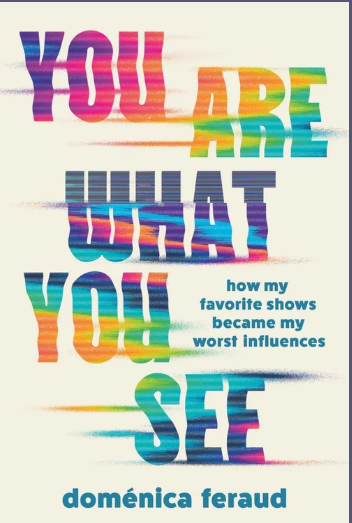
Feraud, a playwright and essayist whose Off-Broadway play Rinse, Repeat was named a New York Times Critics’ Pick, has spent years thinking about the messages hidden inside the shows that helped raise her generation. Her new book, You Are What You See: How My Favorite Shows Became My Worst Influences, turns that private reckoning into a broader argument about the stories women absorb from television, often before they are old enough to recognize them as stories.
The subject is not simply bad behavior on television. Feraud is interested in repetition: the beautiful woman who eats whatever she wants but never gains weight, the ambitious woman made to pay for her success, the dangerous man redeemed because the right woman loves him. A trope, repeated often enough, can begin to look less like fiction than instruction.
For Feraud, that realization arrived with painful clarity when she developed an eating disorder at eighteen. “I realized very quickly that the types of bodies I grew up watching onscreen had had an impact on me,” she told New York Hours in an interview.
She remembers watching Debra Messing’s Grace Adler eat freely on Will & Grace while remaining impossibly thin. The contradiction lodged somewhere deeper than plot. “I couldn’t understand why it was so much harder for me to be thin,” Feraud said, recalling waking at seven in the morning to take a spinning class before school and eating fat-free Greek yogurt for breakfast. Television, she came to believe, did not merely present a narrow ideal. It made the effort required to chase that ideal disappear.

Once she began looking, she saw similar evasions elsewhere. Feraud admires Liane Moriarty, whose novels sometimes include characters with eating disorders. When those books moved to television, she said, the disorders tended to vanish. “It made me wonder what else about the female experience was actively being erased on television.”
The bad boy problem
The most troubling example in the book, for Feraud, comes from Gossip Girl. In its pilot episode, Chuck Bass sexually assaults Jenny and attempts to assault Serena. Yet Chuck eventually becomes one of the show’s central romantic figures and marries Blair Waldorf.
Feraud watched the series as a teenager and, like many fans, rooted for Chuck and Blair. In retrospect, she is disturbed by how easily the show allowed viewers to forget what he had done. “Chuck isn’t held accountable for his behavior in any serious way,” she said. “He’s framed as this bad boy who just needs to be tamed by the right woman.”
What interests her is not the old complaint that fictional characters ought to behave well. She is making a subtler case: that storytelling decides whose pain matters, whose misconduct can be forgiven and what kinds of love audiences are trained to consider romantic. The concern becomes sharper when the intended audience is young.
“Some of these shows were targeted at teenagers,” Feraud said, “who are less easily able to separate fiction from reality.” She is not arguing that viewers imitate everything they see. “If anyone thought manufacturing crystal meth was a good idea after watching Breaking Bad, Vince Gilligan should not be held responsible.” The more important influence, she argues, comes through representation and repetition, through what television makes ordinary.
New York on television
New York complicates Feraud’s argument because it is both her home and one of television’s favorite fantasies. She is a first-generation Ecuadorian New Yorker, and the city she saw onscreen could not completely overwrite the city she already knew.
She understood, for example, that no sensible person wears Carrie Bradshaw heels everywhere. She also found parts of Gossip Girl surprisingly familiar, “minus the whole Brooklyn stigma.” The larger deception may have been economic. “I imagine for people who don’t know New York, who grow up watching Friends and think it’s easy for a waitress and a chef to live in an apartment that size, it’s a bit of a rude awakening when they come here!”
But television’s fantasies about status and romance were harder to dismiss. Feraud points to Miranda Hobbes in Sex and the City, a successful lawyer whose relationship with Steve Brady has long inspired passionate defenses of Steve. Feraud sees a forgotten detail at the center of their story: Steve initially struggles with the fact that Miranda earns more money than he does.
She sees versions of the same pattern in Gossip Girl, where money and male pride repeatedly collide. The lesson, she argues, is that a woman’s success can become a romantic liability, a problem she is expected to manage delicately enough to protect the man beside her.
What comes next
Feraud thinks television has improved in some respects. She sees more complicated depictions of women working in male-dominated worlds, though she also remains skeptical of prestige television’s habit of using violence against women as atmosphere or character development. Her larger worry is that the old shows never really went away. Streaming has turned the television of the late nineteen-nineties and early two-thousands into a permanent library, available to new generations without the historical distance that once came with reruns.
That may be the most interesting tension in You Are What You See. The book is not an argument for throwing away beloved shows, and Feraud has not stopped loving all of them. It is an argument for watching them twice: first for pleasure, and then with enough suspicion to notice what the pleasure is asking us to overlook.
Feraud will discuss the book at Bibliotheque, 54 Mercer Street in SoHo, on Oct. 13 at 6 p.m., and at Café con Libros, 724 Prospect Place in Brooklyn, on Oct. 14 at 7 p.m.
For Feraud, the point is not that television controls its audience. It is that stories help establish the boundaries of what feels normal long before viewers think to interrogate them. “I think the shows we watch can also impact how we view other people,” she said, “and the humanity with which we bestow them.”

