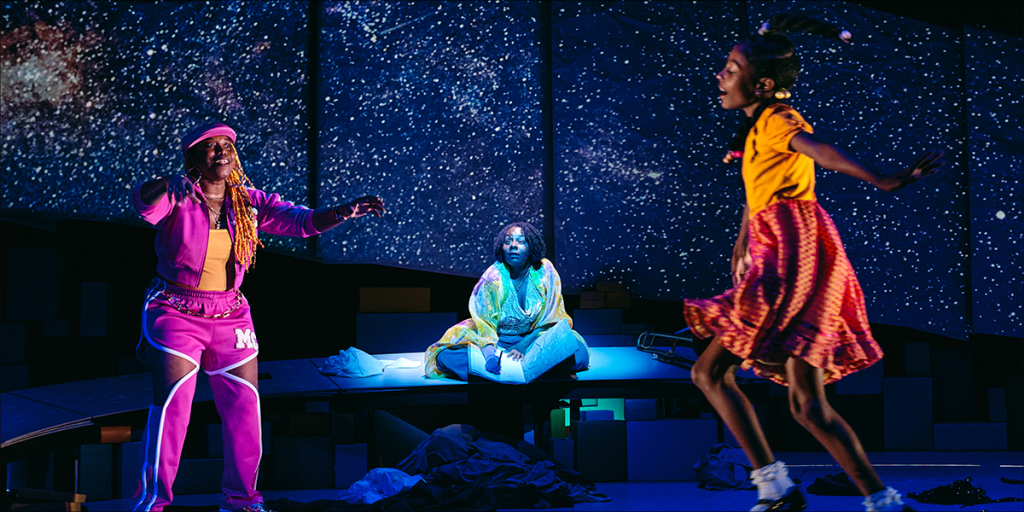
In Mfoniso Udofia’s new play, a woman accustomed to making things happen confronts the limits of her will. The character, known as thegrownwoman, is an artist, a teacher, a daughter and a prospective mother. Fertility treatment has disrupted the future she imagined for herself. creation stories and all the important importants, now at Lincoln Center Theater, follows her through one extraordinary day.
“The question at the center of my play is: what happens when a woman whose entire understanding of herself is rooted in her ability to create, encounters something she cannot simply will into being?” Udofia said in an interview with New York Hours.
At the Claire Tow Theater, her struggle unfolds amid fertility medicine, Nigerian ancestral figures and a voice powered by artificial intelligence. The collision may sound strange, but the playwright sees these worlds as inseparable.
“I am a Nigerian-American woman of a certain age, living in 2026,” she said. “I have intimate knowledge of what the beginnings of an IVF cycle look like.”
For all their convenience, technologies can complicate the feelings they promise to clarify. An AI assistant might supply information, but not necessarily help someone deal with what the playwright calls “doubt, ambiguity … uncertainty.”
Her Nigerian upbringing also informs the play. In Udofia’s account, spirits inhabit the world alongside the living, while past and present need not remain neatly separated. Those beliefs can coexist with a faith in reproductive medicine.
“All I did was expose the fact that these seemingly contradictory truths can exist simultaneously inside one body,” she said.
In the story, thegrownwoman has rejected parts of that spiritual inheritance. Her difficulties prompt her to reconsider them. What once seemed remote begins to offer a way of recognizing herself.
Directed by Tamilla Woodard, the LCT3 production opened October 1 after previews that began September 15. Abigail C. Onwunali plays thegrownwoman. Savannah Commodore portrays the little girl and the uncome, and Donnetta Lavinia Grays plays several figures, including Alexa and Mr. Cornell. The run is scheduled through November 1.
For much of her career, the playwright has worked on an altogether different scale. Her Ufot Family Cycle comprises nine planned plays covering a century of Nigerian-American family life, with stories that can be staged out of chronological order.
The work has roots in Udofia’s own family history. According to a Wheelock Family Theatre account of the cycle, her parents emigrated from Nigeria to Texas in the 1970s before moving to Massachusetts. She grew up in Southbridge and studied at Wellesley College, where an Africana Studies class introduced her to August Wilson’s Gem of the Ocean. His ten-play cycle about Black American life helped inspire her ambition to tell a multigenerational Nigerian-American story. She later earned an MFA in acting from San Francisco’s American Conservatory Theater and helped establish the Nia Project, which brought arts opportunities to local young people.
Her career has since extended well beyond the stage. She has written for television series including Pachinko, A League of Their Own and Lessons in Chemistry, according to the Huntington Theatre. The same company has helped bring the Ufot plays to Boston as part of a citywide undertaking. Her honors include the 2024 Steinberg Playwright Award and a 2025 Elliot Norton Award for The Grove, another work in the cycle.
“For the last 17 years, I’ve been an architectural writer,” Udofia said.
The undertaking demanded years of planning. Each play uses a different theatrical form; together they follow how a family changes after immigration, and how love, habits and trauma pass between generations. A decision made in one play might reveal its consequences in another, decades later.
“I wanted to allow transformation to happen slowly,” she said, “slowly enough that we could actually witness the arc of human transformation on a scale that felt truthful to how human beings actually change.”
After working across so many generations, she asked whether she could give the interior life of one Black woman the same attention. Rather than trace a family through a century, she would examine a single day.
“Could I map a single day in the life of one woman—a Black woman—and insist that her interiority was deserving of the same care and architectural ambition as a 9-play cycle?” she asked.
That ambition explains the play’s shifts among a clinical present, memories and ancestral presences. The woman’s work, art, family obligations and wish for a child cannot be separated into tidy compartments. Neither can the different times in which she lives.
The new work also unsettles the assumption that a calling must produce a result. Thegrownwoman believes in her ability to create, but her deepest desire cannot be fulfilled by effort alone. The play asks what remains of that belief when she cannot control the outcome.
For the playwright, both works belong to the realm of myth. Her family cycle examines the making of a people; this one looks at how a person comes to understand herself.
“Perhaps what I discovered,” she said, “is that the interior life of one Black woman might actually be as epic as one hundred years.”

