
In July, 1979, a group of artists went around São Paulo putting Xs on gallery doors. The marks, made with duct tape, were accompanied by a message in Portuguese: “What is inside remains, what is outside expands.” Brazil was under a military dictatorship. The artists, who called themselves 3NÓS3, had found a way of making a point about culture without waiting to be invited into a cultural institution.
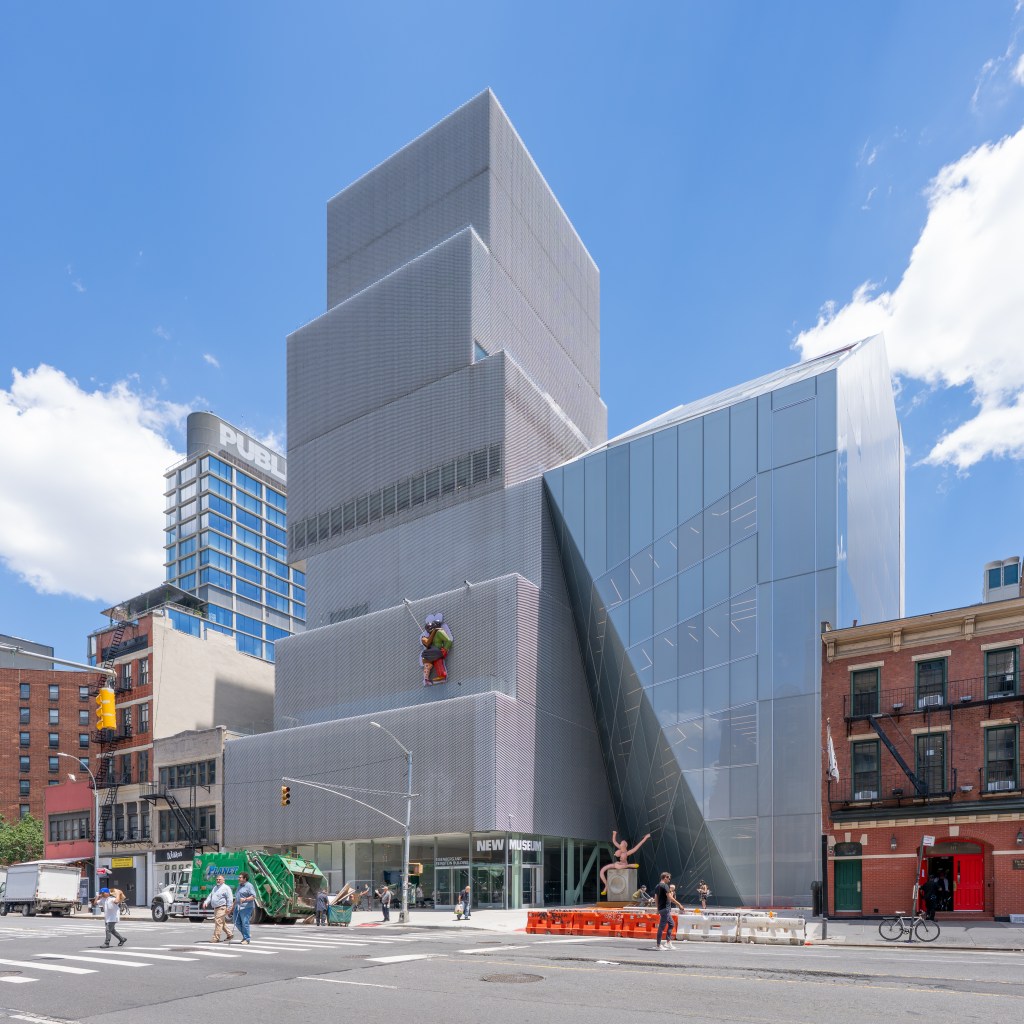
Nearly half a century later, that action has supplied the title for the New Museum’s next Triennial, The Outside Expands. The exhibition, announced this week and scheduled to open in February, will gather thirty-six artists and collectives from thirty-four countries at the museum’s home on the Bowery. It will be the most internationally wide-ranging Triennial the museum has staged, according to its organizers, and the first to occupy the galleries of its new OMA-designed expansion.
There is a pleasing contradiction in the arrangement. An artwork that questioned the authority of galleries is being invoked by a museum with considerably more gallery space than it used to have. The New Museum, which was founded in 1977 as an alternative to established institutions, has become a formidable institution itself. The question is whether an exhibition devoted to the outside can keep some of the outside’s unruliness once it comes indoors.
The Triennial began in 2009, two years after the museum opened its SANAA-designed building on the Bowery. The first edition, Younger Than Jesus, made youth an organizing principle: it presented artists born after 1976. Later editions took more suggestive titles, among them The Ungovernables, Surround Audience, and Songs for Sabotage. They were attempts to describe what younger artists were noticing and making, without pretending that a generation could be reduced to a school or style. The most recent edition, Soft Water Hard Stone, took place in 2021. The five-year gap since then has been unusually long for an event called a Triennial.
This time, the museum is placing particular emphasis on geography. The participating artists and collectives are based in cities including Luanda, Cairo, Istanbul, Seoul, Mexico City, and Kilinochchi, Sri Lanka. Some live in the places where they were born; others work far from them. The list includes Zimbabwean artist Virginia Chihota, Malaysian-born, London-based artist Mandy El-Sayegh, Diné artist Dakota Mace, and Jota Mombaça, who divides time between Lisbon and Natal, Brazil.
Those biographical details matter to the show’s premise, although a list of passports and hometowns does not, by itself, amount to an aesthetic argument. The museum says the selected artists examine received ideas about territory, identity, gender, and sexuality, and investigate how people form relationships and communities. What those concerns look like in the galleries will be clearer when the individual works and installations are in place. For now, the announcement is a statement of curatorial intent, not an exhibition that anyone has yet seen.
The curators are Vivian Crockett, who joined the New Museum in 2022, and Isabella Rjeille of the Museu de Arte de São Paulo. With curatorial assistant Thalia Stefaniuk and fellow Taeyi Kim, they make up the first international curatorial team to organize the Triennial. The partnership with a São Paulo curator is particularly apt for a show that borrows its title from a Brazilian intervention. It also puts some distance between the exhibition and the familiar notion of New York as the city from which the rest of the art world is surveyed.
The organizers have identified a second Brazilian antecedent. In 2018, the artist and writer Jota Mombaça cut words out of a temporary museum wall in Rio de Janeiro, leaving a void where the lettering had been. The words meant “What has no space is everywhere.” Mombaça subsequently used the phrase for a video project made around the beginning of the pandemic, exploring movement, care, connection, and the violence encountered by a Black, transgender, nonbinary artist. Mombaça is also among the artists selected for the new Triennial.
Together, the two gestures offer a compact account of what the curators seem to be after. One marks a doorway from the outside. The other removes something from a wall and makes the absence visible. Neither accepts the museum as a neutral container. Both ask who gets to enter, who is kept out, and what might happen if the categories themselves were rearranged.
The expanded building adds another layer to that inquiry. The New Museum began in a one-room office on Hudson Street and has repeatedly recast its relationship with the city, most visibly with its 2007 move to the Bowery and again with this year’s expansion. More space permits a larger and more ambitious show. It also invites the sort of scrutiny that comes with size: an institution devoted to experimentation must demonstrate that its new architecture creates opportunities for artists, rather than merely providing more walls on which to hang them.
An illustrated catalogue, co-published with Phaidon, will extend the exhibition beyond those walls. Along with essays and a conversation with Mario Ramiro, a founding member of 3NÓS3, the book will include eighteen paired dialogues among participating artists. That format could prove more revealing than a conventional parade of curatorial statements, allowing artists with different experiences and practices to speak to one another directly.
It is too early to say whether The Outside Expands will fulfil the ambitions of its title. Its galleries are not yet open, and the work itself must do the persuading. But the provocation is already clear. A museum can enlarge its building; the more difficult undertaking is to enlarge its idea of what belongs there. As the artists in São Paulo put it in 1979: “What is inside remains, what is outside expands.”
The Outside Expands is scheduled for February 2027 through May 16 at the New Museum, 235 Bowery. The museum’s October 6 announcement gives February 4 as the opening date; its exhibition listings currently give February 5.


.jpg)