There is rain that falls in moonlight, rain that arrives before the rice can be gathered, and rain that makes a person want to read poetry. There is rain that falls while the sun shines, and rain fierce enough, according to an old Japanese expression, to split a dragon in half. Miya Ando, a New York artist, has collected two thousand Japanese expressions for rain. The names preserve differences that English speakers might ordinarily pass over.
Ando has spent years collecting the language of rain. Her book, Water of the Sky: A Dictionary of 2,000 Japanese Words for Rain, published by MIT Press, gathers Japanese expressions and English interpretations, accompanied by her drawings. Her work is now on view in Rain Drawings, her solo exhibition at Sundaram Tagore Gallery in Chelsea. The collection records centuries of close attention to ordinary weather.
Consider ameshi o moyōsu, a rain that provokes the feeling of wanting to read poetry. The name records what happens to the person hearing the rain. Tsukishigure is rain in the moonlight. Sanbaine names a sudden evening storm that comes so quickly there is no time to make even three bundles of rice. The name preserves the farmer’s hurry, as well as the storm.
“Each of these words makes a particular quality of rain perceptible that might otherwise be overlooked,” Ando told New York Hours in an interview.
Then there is ame no yadori, which Ando translates as “the lodging of rain,” a metaphor for the transitory and impermanent nature of life. The rain arrives, stays a little while, and passes on.
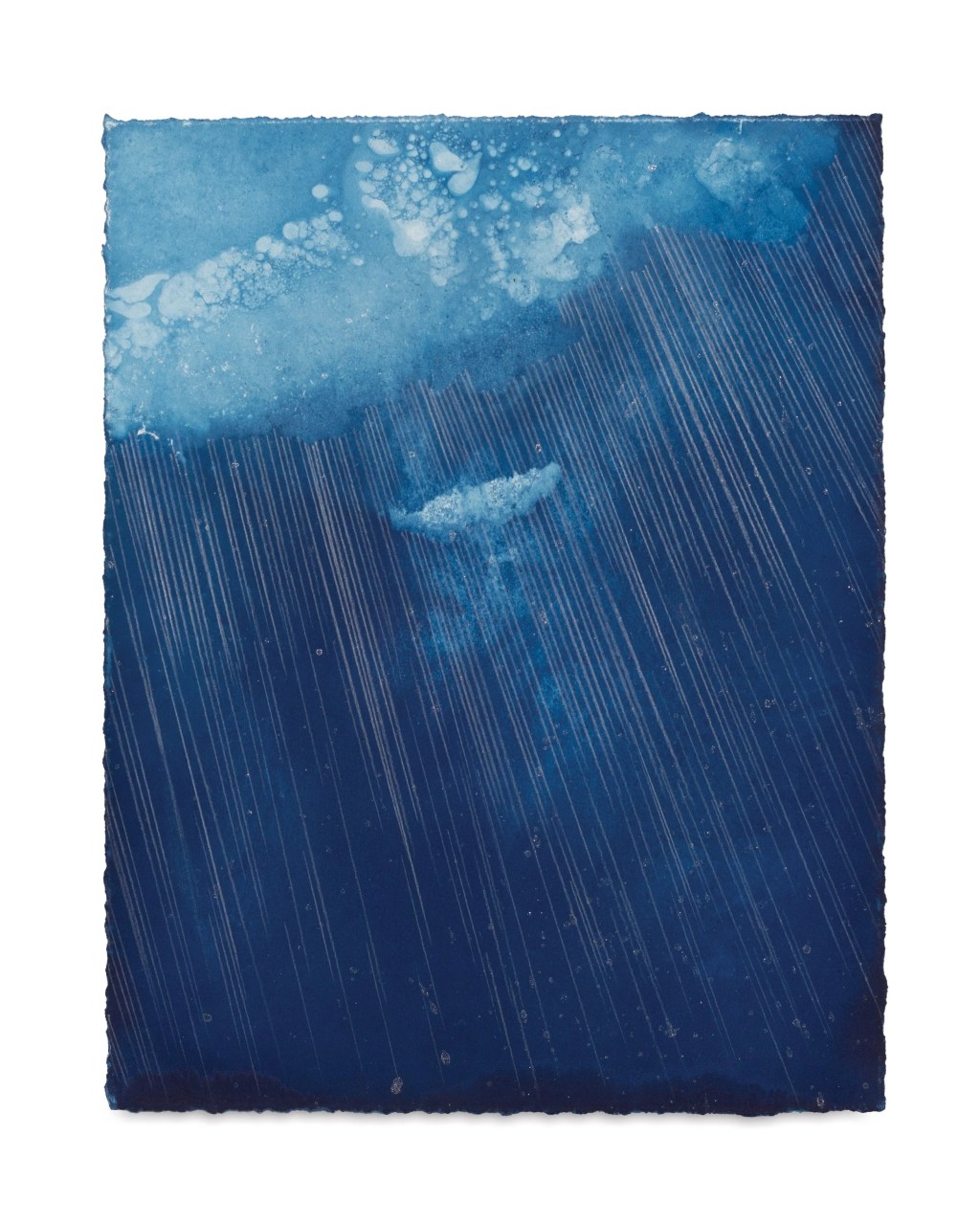
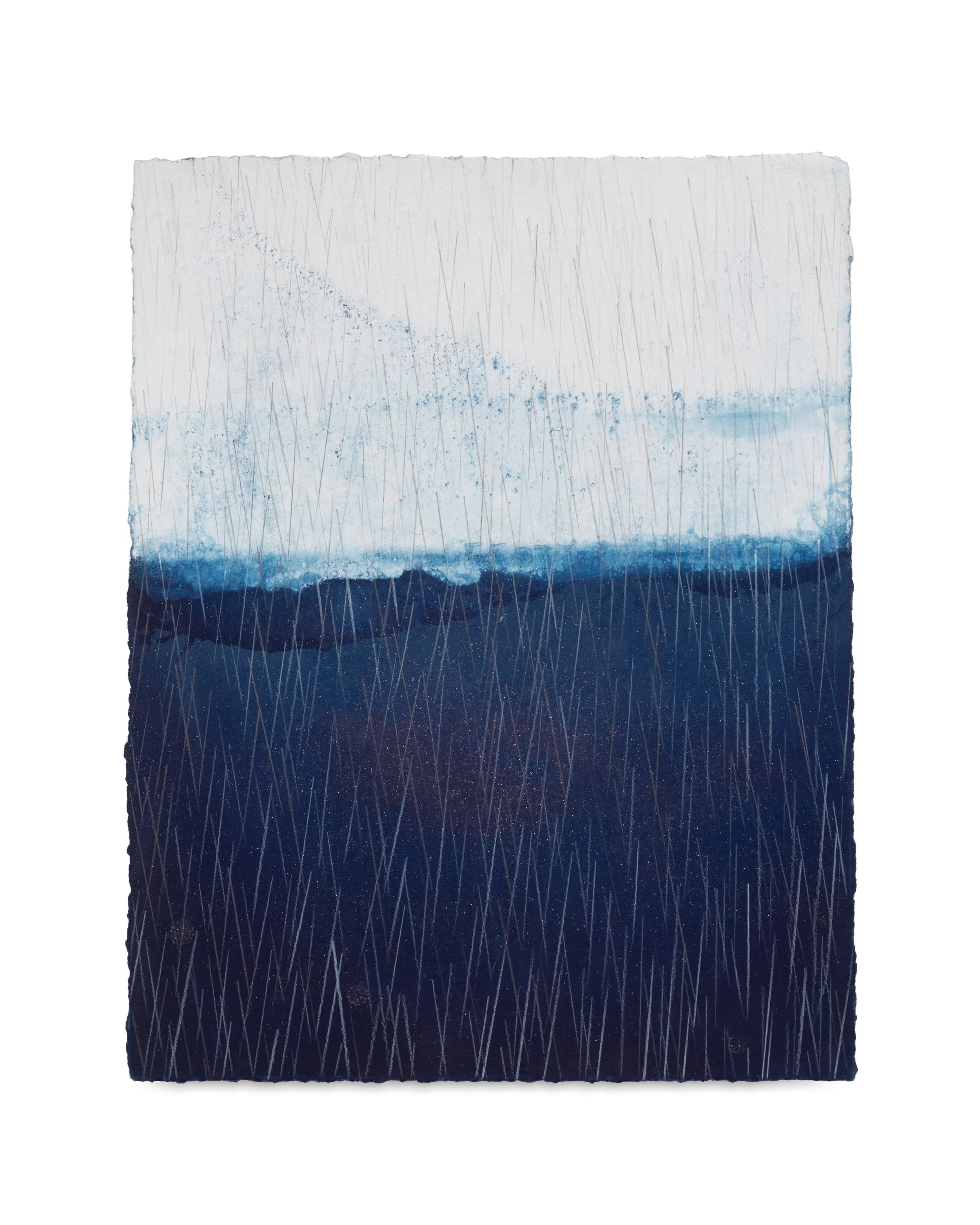
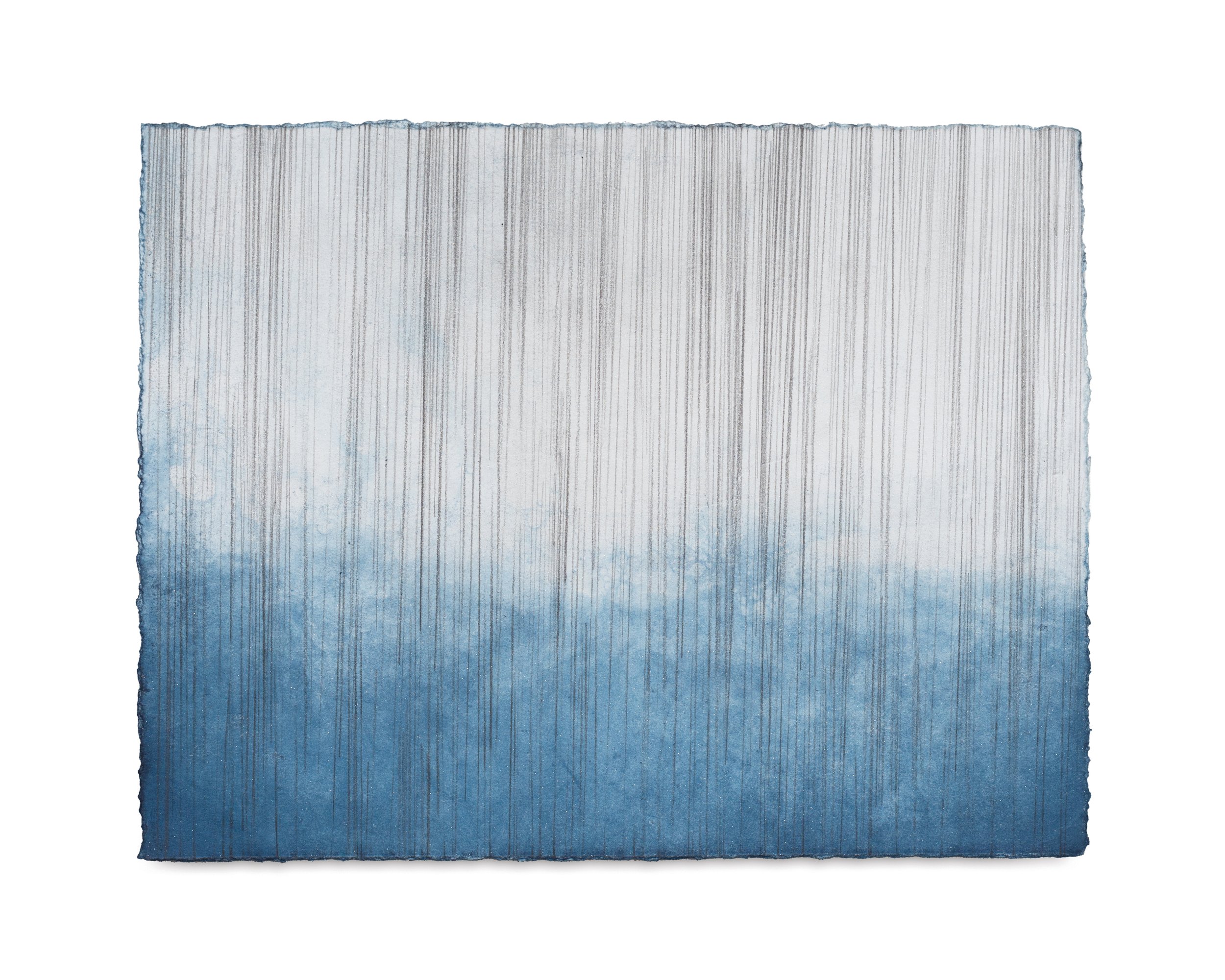
Ando has tried to draw what the words describe. Indigo, graphite, and silver powder allow Ando to suggest the density, direction, and shifting light of rain. Her materials are restrained; changes in tone and texture do much of the work.
“Drawings are like words; they contain and can transmit an entire concept,” Ando said. “I tried to imagine and visualize what each word meant and hoped to evoke that in my drawings.” She wanted the drawings to suggest the particular rain named by each expression, rather than supply a literal illustration.
A drawing titled Hakushūu refers to heavy rain that falls intermittently in autumn. The word specifies an autumn rhythm of rain and interruption. Another, Shinotsuku ame, describes an intense, fine rain, likened to a bamboo grove. The titles make unusually exact demands on the viewer’s imagination.
Ando began the project during the pandemic. The quiet gave her time to concentrate on the dictionary and its drawings. “The project was in direct response to the quietude of the pandemic,” she said. “That period gave me a chance to focus on the dictionary. I valued that space for sustained, total concentration.”
The resulting collection attends to the hour, season, and circumstances of rainfall. Several terms are so specific that a translation reads almost like a small story.
Many of the terms are old. Ando drew on the Nihon Shoki, the eighth-century chronicle of Japan, and the Man’yōshū, the early anthology of Japanese poetry. Among the entries is hisa-kata no ame, “rain from the heavens,” which she traces to the latter collection. Ando reads it as an example of the sacred place that weather could hold in older accounts of the natural world.
“I think this demonstrates a relationship to the natural world that recognizes the sacred,” she said. She suspects that the pace of modern life has made such distinctions harder to notice.
Some of the most memorable entries involve animals and spirits. Kitsune no yomeiri, a fox’s wedding, refers to rain that falls even while the sun is shining. A related expression, tirabui, means “fox bride rain.” In Japanese folklore, foxes have long been associated with magical behavior and with messengers of Shinto deities. The strange conjunction of sunlight and rain becomes a fox’s wedding procession.
“They are some of my favorite words,” Ando said. Such expressions “send me to a place of wonder.” In the folklore Ando describes, foxes are frequent suspects whenever nature behaves mysteriously.
The dragon words are less gentle. Kōryō un’u evokes rising to heaven, encountering a rain cloud, and becoming a dragon; bunryūu describes rain that splits a dragon’s body in half. When Ando lived in a redwood forest in the Santa Cruz mountains, she encountered storms she believes could have earned the second name. She remembers torrential rain in the redwood forest around her former home.
The collection accommodates poetry, folklore, agriculture, and everyday observation. A single storm can belong to more than one of these worlds.
Ando has also worked with Japan’s traditional calendar of seventy-two microseasons, brief periods defined through observed changes in nature. The microseasons depend on signs in the natural world, which makes them especially interesting to Ando as the climate changes.
The microseasons, she said, offer “an excellent and poetic lens through which to examine our changing climate,” because they are fundamentally about “noticing subtle distinctions in the natural world.” She sees their value in the act of observing, even as familiar seasonal patterns change.
The Chelsea exhibition gives visitors time to study these differences in the drawings themselves.
When rain next falls in the city, Ando’s collection offers an unusual question to ask of it: what sort of rain is this?
Miya Ando: Rain Drawings is on view through November 14, 2026, at Sundaram Tagore Gallery, 542 West 26th Street. Water of the Sky is published by MIT Press.

