
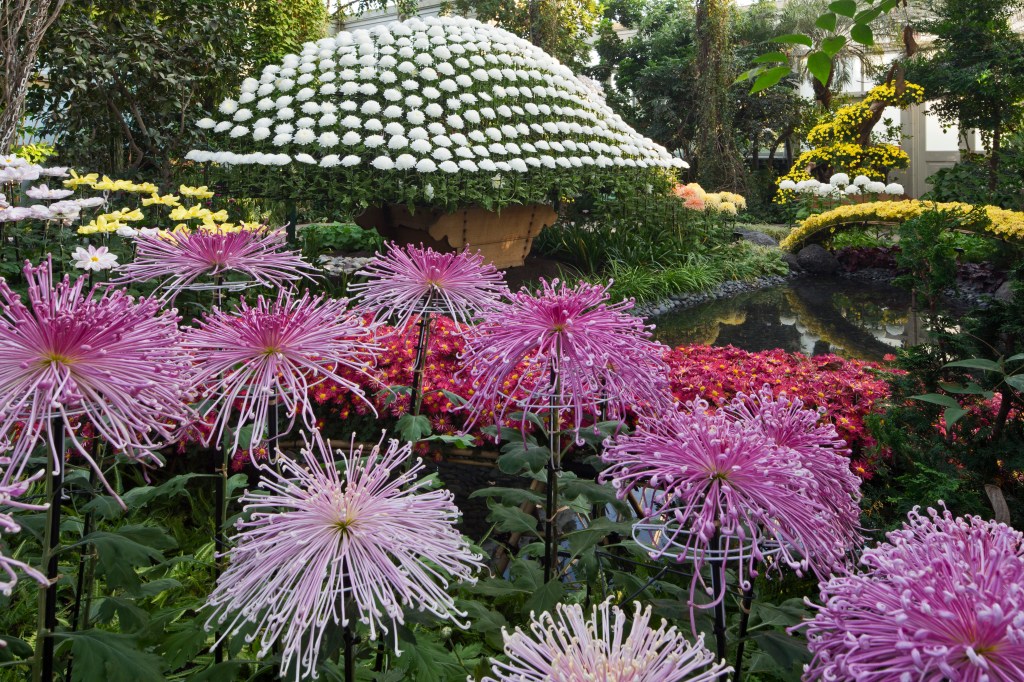
One plant, hundreds of flowers: it sounds like a botanical trick, and in a way it is. But the trained chrysanthemums appearing at the New York Botanical Garden this autumn are less a miracle of nature than an argument about patience. They have been coaxed toward their final shapes over many months, long before visitors arrive to admire the results.
Kiku: Spotlight on Tradition, running from October 31 through November 15, brings a Japanese horticultural practice to the Bronx. The garden says its growers spend approximately 11 months training chrysanthemums in traditional forms. What looks effortless at the end depends on an elaborate sequence of interventions, careful timing and attention to the growth of living material.
The grandest example is ozukuri, often called the thousand-bloom style, in which an extraordinary canopy of blossoms rises from a single stem. The effect can seem architectural. In a conventional garden, a flowerbed gains its impact through the accumulation of separate plants. Here, one plant is made to perform the work of many.
To appreciate the distinction, it helps to think of horticulture not merely as planting but as a craft. A grower works with a material that changes independently, responding to light, water and temperature. The plan may be precise, but a chrysanthemum is not a piece of wood that will reliably stay where it has been cut. The achievement is partly a negotiation between artistic intention and biological habit.
That tension makes the display interesting even for visitors who have little affection for decorative flowers. The trained forms suggest familiar artistic disciplines, from sculpture to choreography. Each depends on repetition and restraint. Yet the material remains alive, and the finished shape is temporary. A flower has its own timetable, no matter how carefully someone has planned its arrival.
Chrysanthemums also have a cultural life extending far beyond the American autumn association with garden-center pots and front-door decorations. In Japan, the flower has long appeared in visual art, ceremony and symbolism. A formal cultivation display therefore carries meanings that cannot be reduced to attractive fall color.
At the same time, there is a danger in treating such a show as a collection of exotic marvels. Its most interesting quality may be the work behind the spectacle. The extraordinary appearance of the plants rests on studied technique and sustained collaboration among gardeners, rather than on some mysterious national instinct for floral perfection.
New Yorkers are accustomed to gardens as places of relief from control: a bench, a path, leaves blowing where they will. Kiku offers nearly the opposite proposition. The pleasure lies in seeing how much can be achieved by disciplined intervention without entirely suppressing the nature of the plant.
The Bronx setting helps that contrast along. Outside the greenhouses, autumn foliage moves through its comparatively unruly seasonal transformation. Inside, horticultural timing has been directed toward a brief public appearance. Both displays depend on seasonality, but they produce entirely different experiences of it.
The Nolen Greenhouses are scheduled to host the chrysanthemums daily from 10 a.m. to 4 p.m. A highlighted weekend on November 7 and 8 adds crafts and performances by Taiko Masala Dojo, with drumming scheduled for 12:30 and 2:30 p.m. Those events may attract families, but the quieter experience of examining the cultivation itself seems equally worthwhile.
One of the minor sorrows of elaborate seasonal horticulture is how little time a year’s labor may occupy in the public imagination. Visitors see the bloom, take a photograph and continue walking. The cultivation is much longer than the exhibition. That imbalance may be part of what gives these plants their particular poignancy.
The result is a different kind of autumn outing, one less concerned with finding the brightest tree than with recognizing the astonishing amount of labor concealed in a perfectly arranged flower.
Kiku: Spotlight on Tradition runs October 31 to November 15 at the New York Botanical Garden. Check the garden for admission and current programming. This is an advance feature, not a firsthand review.