
Every October, New Yorkers are told to admire the leaves. That is reasonable advice, but not terribly imaginative. Autumn in the city can offer more than a race to locate the brightest maple tree before the wind strips it bare.
The New York Botanical Garden is making a compelling seasonal argument for the Bronx this year. Its late-October and November calendar moves from Japanese chrysanthemums trained into improbable formations to a city of miniature buildings fashioned from botanical materials. In between, there are the changing trees and paths of the garden itself.
These attractions are related, but they are not interchangeable. If you are planning a visit, it is worth deciding whether you want the fleeting spectacle of leaves, the controlled craftsmanship of a greenhouse display or the holiday theatricality of model trains. Trying to see all three without attention to the calendar would defeat the point.
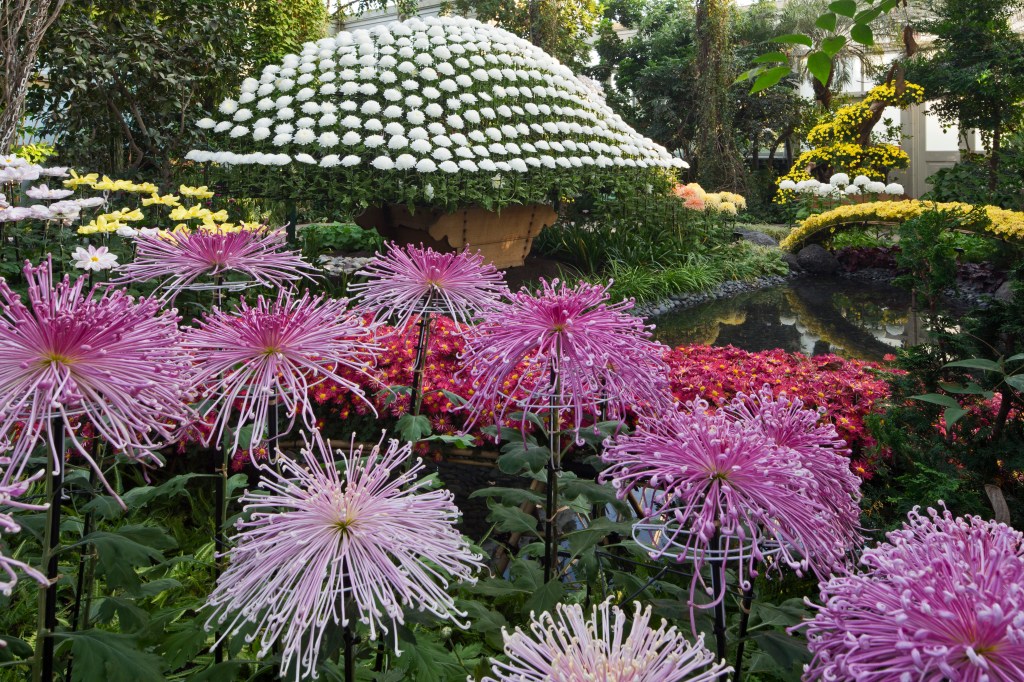
The first major event is Kiku: Spotlight on Tradition, running October 31 through November 15. Gardeners spend much of the year training chrysanthemums into traditional Japanese arrangements, sometimes inducing a remarkable number of flowers to emerge from one stem. It is a study in deliberateness at a moment when the rest of the landscape is changing almost by the hour.
That makes the Kiku display particularly interesting as an autumn attraction. We tend to regard fall color as something to find, not something to create. The chrysanthemums reverse the premise. Their appearance is the product of painstaking work with a living plant, undertaken months before visitors begin thinking about sweaters and weekend excursions.
Scheduled programming on November 7 and 8 adds crafts and taiko drumming. Anyone primarily interested in viewing the flowers may prefer a quieter weekday, although the garden’s actual crowd levels will vary.
On November 14 the Holiday Train Show arrives. Nearly 200 replicas of New York landmarks, made from plant materials, will form the setting for circulating model trains in the conservatory. The attraction continues through January 10, 2027.
The train show is a more explicitly theatrical experience. The pleasure comes partly from recognizing familiar architecture in a different material and scale. New York’s grand buildings turn into intricate objects that can be surveyed without craning your neck.
The two exhibitions overlap on November 14 and 15. That sounds like an ideal double bill, but visitors should check ticket requirements before making plans. A garden admission or one event ticket should not be assumed to cover every exhibition or special program.
For foliage itself, timing is less dependable. A fixed event can publish opening and closing dates; leaves respond to weather. A cold snap, strong wind or heavy rain can change the appearance of a path dramatically. Anyone hoping to photograph peak color ought to check recent garden photographs and conditions shortly before leaving home.
That uncertainty is part of the appeal. Unlike a display designed to be ready for a particular opening morning, a tree doesn’t perform on command. In a city organized around reservations and schedules, the unpredictable changes of a season have a different kind of authority.
There is also a practical distinction between spending an hour photographing an autumn display and making a day of the garden. The New York Botanical Garden is a large site, and seasonal exhibitions occupy only part of it. Visitors who rush directly to an event and back out may miss the broader landscape that gives the seasonal program its setting.
Instead of treating the Bronx as an inconvenient alternative to a Manhattan park, think of the trip as an opportunity to get away from a familiar circuit. The garden offers a combination of planned spectacle and ordinary outdoor walking that many compact city green spaces cannot provide in one visit.
Nor must autumn be treated as a countdown to winter. The Kiku exhibition emphasizes patient cultivation; the train show turns architecture into a kind of indoor fantasy; the trees follow their own irregular course. Each asks for a different pace and form of attention.
If there is one organizing idea for a visit, it is to leave enough time for whatever is not listed on the event calendar. A striking branch, a stretch of quiet path or a sudden change in light may be the most satisfying discovery of the day.
The New York Botanical Garden is in the Bronx. Verify hours, seasonal programming and separate ticket requirements before your visit. This guide describes announced events rather than firsthand conditions.