By Sascha Brodsky
Okwui Okpokwasili and Peter Born had an unusual request in mind for their audience: scream. Or cry. Or wail, if the spirit moved them. Everyone in the theater would join in. The logistics proved impossible, but the idea was too good to abandon entirely.
So, when adaku, part 2: she shivers with it comes to the Brooklyn Academy of Music on November 11, the room will do the wailing instead. Recorded voices will rise from different directions, like cries from the seats around you. “We wanted to retain a feeling that people are singing all around you,” Born said in an interview with New York Hours. You need not make a sound yourself. There will be plenty to listen to.
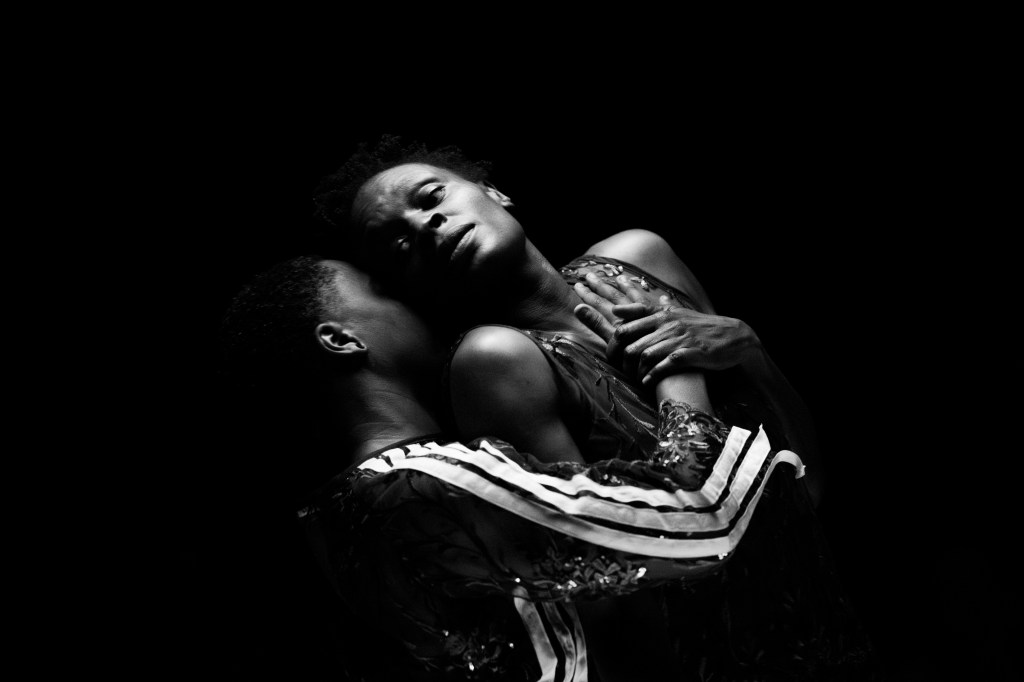
Such an ambition sounds perilously close to a demand that the audience feel something on command. But Okpokwasili and Born, partners in life and art whose collaborative practice is called sweat variant, are interested in making a space in which grief can exist without being tidied up or explained. Their new work combines movement, song, text and an elaborately designed environment. It is the second part of a speculative trilogy about a family whose history is broken open by the transatlantic slave trade.
The first installment, adaku, part 1: the road opens, was set in an imagined precolonial West Africa and appeared at BAM in 2023. Part two skips generations, arriving in a near-future United States. Here a young woman has been taught that her history is not worth remembering. Suddenly, pieces of that history begin to reach her. She cannot know everything that happened. She has to decide what to do with what she learns.
Okpokwasili said she made the leap through time because she wanted to consider how the original violence might reverberate nearer to the present. In her telling, the shock of loss can pass through generations of women, an inheritance felt in the body as well as understood by the mind. One part of adaku ends with a wail; the next begins with one.
That transition took work. There was no single rehearsal epiphany when a performer discovered the right sound. Okpokwasili has collaborated with many members of the company for years, exploring the ways bodies press against, hold and respond to one another. For this production, she said, the performers tried to build a cry powerful enough to “unsettle” what had been buried in memory. The wail is both an individual act and something the group makes together.
The heroine’s discovery offers no convenient solution. “The young woman at the center of this work ends up holding and learning, not her entire history, but a delicate and essential part of it,” Okpokwasili said. What she acquires is less a set of facts than a new way to move through the world and relate to other people. That difference is crucial to the work. A missing family history cannot simply be fetched, like a lost file, and restored.
The production also considers the theft of objects intended to preserve connections with ancestors. It would be easy to give such an object a precise dramatic function: something taken, something sought, something recovered. Okpokwasili warned against so literal an interpretation. The sense of what, or who, has disappeared keeps changing. “Nothing is where it should be,” she said. “This piece is a record of disorder.”
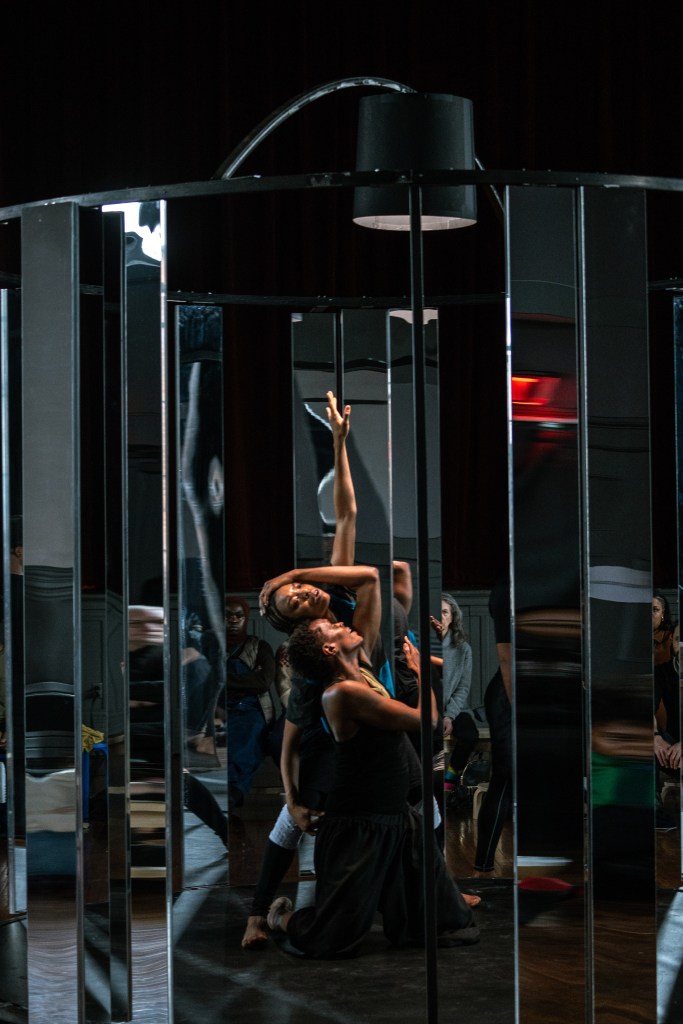
Born’s stage design seems determined to resist a single interpretation, too. One prominent element is a long red form, which can resemble a length of hair, a road or a landscape. Born thought of an umbilical cord and afterbirth as well. He wanted something with a “nesting” quality, at once sheltered and exposed, to accommodate an opening sequence in which a sustained wail moves back and forth across the boundary between crying and song.
He was careful about how to light this space. Direct illumination, he felt, would strip away some of its intimacy, so the light comes indirectly, reflected off the floor and water overhead. “I’m hoping it can suggest several things at the same time,” he said. The red shape is not a puzzle with a correct answer. Depending on where the mind goes, it might be a route forward, a connection backward, or a place to rest.
Born has a theory about why ambiguity is useful. Even when a scene is brightly lit and straightforward, he argues, spectators are assembling a story from whatever they can perceive. A partial image asks them to do that work more consciously. “We never see a complete image, only fragments,” he said. The hope is that each person constructs a version of the experience from the gestures and sounds that stay with them.
Yet he is not opposed to clarity. The work contains considerable text, including a nonlinear story moving through the lives of a mother and daughter. Born wants its changing emotions to register, even when its images are elusive. To that end, he has tried an unusually modest piece of visual interference: red-and-blue television static projected over a stage already illuminated with red, blue and white light. The static is hardly visible. He wonders whether it might introduce a low-level agitation that viewers feel without knowing its source.
Then again, he worries it might just annoy them. This is the kind of problem that can occupy a designer whose larger project involves centuries of historical loss. On a stage, even the grandest idea eventually comes down to particulars: how long a sound lingers, where a light falls, how much visual irritation is too much.
The work premiered at the Wexner Center for the Arts in Columbus, Ohio, October 20–22. The company continued revising it through the final performance, Born said. The BAM engagement now brings the piece into a more familiar orbit. Born hopes that, surrounded by friends and members of their community, the performers will find new possibilities in the wail. He describes live performance as an exchange that changes with the people in the room.
There is no guarantee that a theater full of strangers will arrive at a shared feeling, and perhaps that is just as well. Grief is not especially cooperative. It does not become more manageable because somebody has devised a beautiful stage picture around it. Okpokwasili and Born seem to be offering something less comforting and more curious: a place where private sounds can meet without becoming the same sound.
The audience will not, after all, be required to wail. The voices will come from around them, and they can decide how to listen.
adaku, part 2: she shivers with it runs November 11–15 at BAM Fisher’s Fishman Space. Tickets and information.

