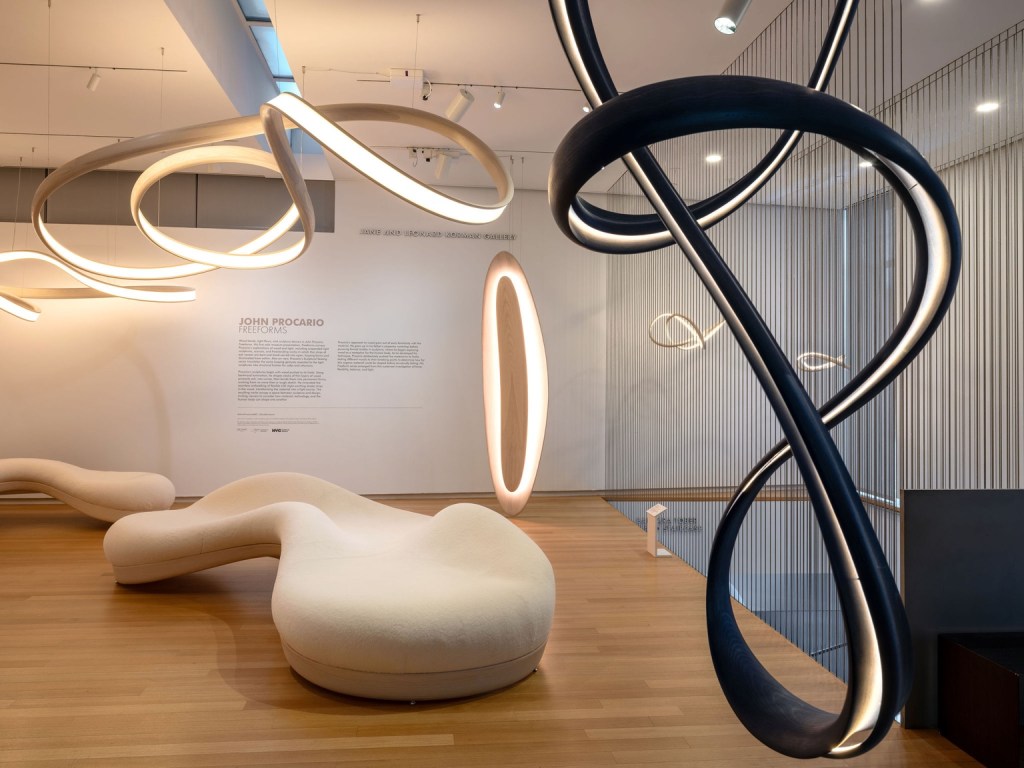
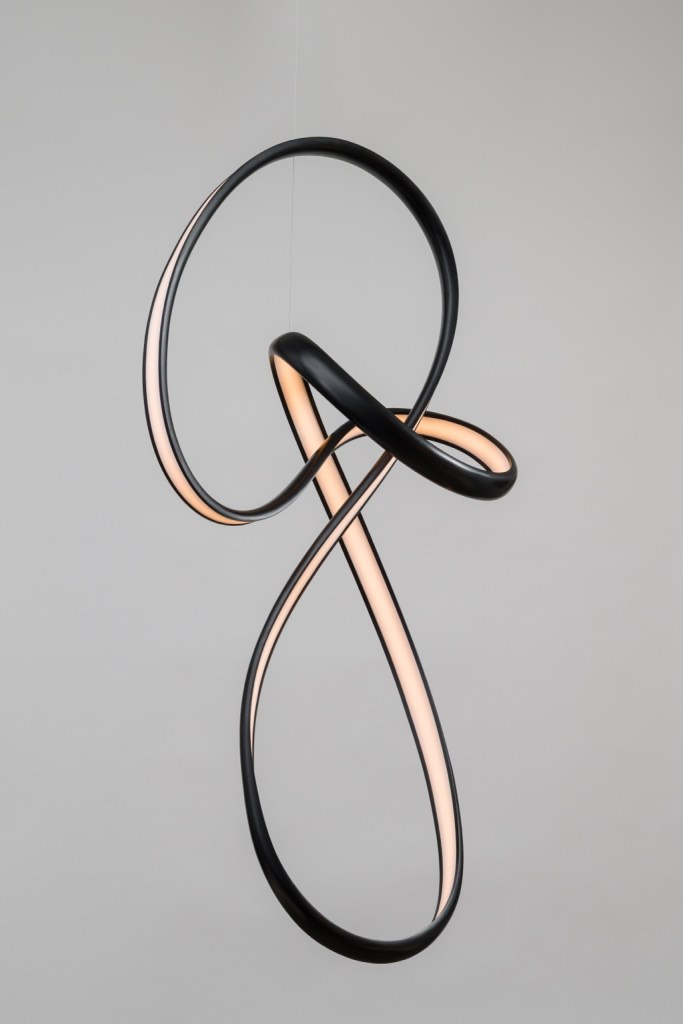
The wood in John Procario’s sculptures seems to have escaped the carpenter’s shop and forgotten how to stand straight. A dark strip climbs into the air, doubles back, crosses itself and runs off in another direction. A thin band of light follows it around the bend. One sculpture looks like a knot pulled almost tight; another has the wandering outline of a line someone began drawing and couldn’t bear to finish.
Nothing about the making is so casual. Procario bends strips of ash almost to their breaking point, glues them together and spends hours sanding away the traces of his labor. The results hang and coil through John Procario: Freeforms, at the Museum of Arts and Design, where more than fifteen pieces bring a designer’s workshop into a museum gallery. The exhibition, his first solo museum presentation, opened October 27 and continues through April 4.
There are lamps here, and seating, and works that can fairly be called sculpture. None looks particularly worried about which category it belongs to. The question of what these objects do, beyond looking extraordinary, is more interesting than the question of what to call them.
“I envisioned John Procario’s exhibition as an installation about light,” Elissa Auther, the museum’s deputy director of curatorial affairs and chief curator, said in an interview with New York Hours. She was thinking not simply of illumination but of “how light shapes the psychology of the rooms we inhabit.” Put a lamp in a corner and you can change the mood of the place. Procario makes that familiar trick strange again by giving the light a body of its own.
An LED strip runs along the inner edge of a wooden curve, then slips behind it. Seen from the side, a loop looks narrow and precarious; a few steps to the left reveal another crossing. The glow picks out the wood’s shape without fully explaining it. In a photograph, these things are beautiful designs. Their more mischievous quality lies in how they keep changing as a person circles them.
“In Procario’s work, the viewer never captures a ‘correct’ view or center in relation to the body,” Auther said. “The infinite looping quality of the works provides what seems like infinite ways to perceive the work.” The eye searches for a beginning and an end and finds another curve instead.
Procario grew up in Cold Spring, New York, around his father’s carpentry workshop. Wood was not an exotic material, and making things with it was an ordinary activity. He later studied sculpture; in a 2024 interview with the design firm Workshop/APD, he recalled the importance of a college woodworking course in helping him understand that the material he knew so well might still surprise him.
What captivated him was not the reassuring solidity of timber but its capacity to give way. On his studio website, Procario compares wood with the human body. A bone, a muscle, a piece of ash: each will bend only so far. He tested the limits by pushing pieces until they broke. The broken ones were not wasted experiments. They told him where the boundary lay.
His method, freeform bentwood lamination, sounds cooler and cleaner than it is. Thin strips of ash are bent, glued in layers and held in place until they keep their shape. Instead of forcing the wood around a fixed mold, he lets its response influence the curve. A report in the Hudson Valley newspaper The Current described the scene at his Beacon studio in 2024: wood bent around posts, clamps everywhere, sanding and finishing that could consume hours. About a thousand clamps were on hand. It is difficult to imagine a less ethereal collection of equipment.
That is the pleasing contradiction of the work. A finished sculpture looks as though someone flicked a wrist and left a trail in the air. Back in the studio, keeping that trail aloft requires glue, pressure, judgment, dust and an enormous number of clamps. The material has to be coaxed into the arrangement, and sometimes it refuses.
Auther is alive to the difference. “The way John Procario holds rigidity and liquidity in wood in perfect tension interests me,” she said. “Nothing in his work appears forced or dominates the conversation. There’s an unexpected grace to the work given the physicality of the process.” A film in the exhibition shows the bending technique, restoring some of the physical effort that the polished surfaces conceal.
It is also possible to admire one of these objects and immediately wonder where to put it. Procario’s work has appeared in private interiors and commercial settings; he is represented by Todd Merrill Studio, a supporter of the exhibition. The market for sculptural lighting sits comfortably beside the market for sculpture, though museums have not always felt so comfortable with the company of useful things. A handsome light fixture might seem to have wandered into the wrong institution.
This is precisely the division MAD has spent its life questioning. Auther calls the territory between art, design, craft and utility “the blur zone.” The categories sound firm until an object such as Procario’s arrives. Its lines might be studied as sculpture, its light used to furnish a room, its bends admired as a feat of woodworking. Each description is accurate; none quite finishes the job.
The seating pieces make the problem wonderfully literal. Procario carries his rolling lines into sofas and other furniture, where they must do more than enchant the eye. A chair has to support a human being. For the Sculptural Seating series, the body is no longer merely an analogy for wood under stress; it is an actual weight to be accommodated. The flowing shape has to meet a practical demand, and still look like itself.
Auther sees the series as a demonstration that Procario’s compositions can move into other utilitarian objects “with a sculptural vision.” In Anthropose IV, a 2026 collaboration with designer Alex Roskin, ash curls upward from a polished stainless-steel base. The hard sheen below sets off the warmth of the wood above. The effect is less like a finished argument about nature and industry than a meeting between two materials with very different manners.
Even the light has a complicated relationship with craft. Procario began working with LEDs in 2012. Their slenderness makes the improbable curves possible as lamps: the electrical component can follow the wood rather than dictate a bulky socket or shade. The newest technology is unobtrusive. The thing a visitor notices is the old material, contorted with unmistakable human difficulty.
“For an artist like Procario, whose work invites its recognition as handmade, innovation is felt out through direct encounter with a material—namely, wood,” Auther said. That seems a more useful response to the age of digital design than a sentimental defense of the handmade. Procario is not shunning technology. He is using it to show what technology has not replaced: a knowledge of how something feels when it is about to snap.
Auther offers galaxies, drawings in space and feedback loops as possible associations for the sculptures. They are easy enough to see. So are bodies turning or arms reaching, and occasionally the shape of something caught mid-fall. But the best comparison may be to a gesture that has somehow lasted longer than it should. A curve thrown into space remains there, held by the stubborn wood that first resisted it.
To ask whether it is a lamp or a sculpture misses some of the pleasure. The light comes on; the shape changes as you walk; the wood has survived an ordeal that no longer shows. For a material so often valued because it holds things steady, Procario has found a remarkably unsettled life.
John Procario: Freeforms is on view at the Museum of Arts and Design, 2 Columbus Circle, through April 4, 2027.

