Film review · New York Hours
Aaron Sorkin has never met an argument he could not improve by making everyone in it speak faster. In The Social Reckoning, his companion film to The Social Network, he has found the sort of subject that might defeat even his fondness for repartee: the transformation of a social network into an enormous machine for manufacturing outrage. Sorkin’s answer is to make a film that is itself exhausting company.
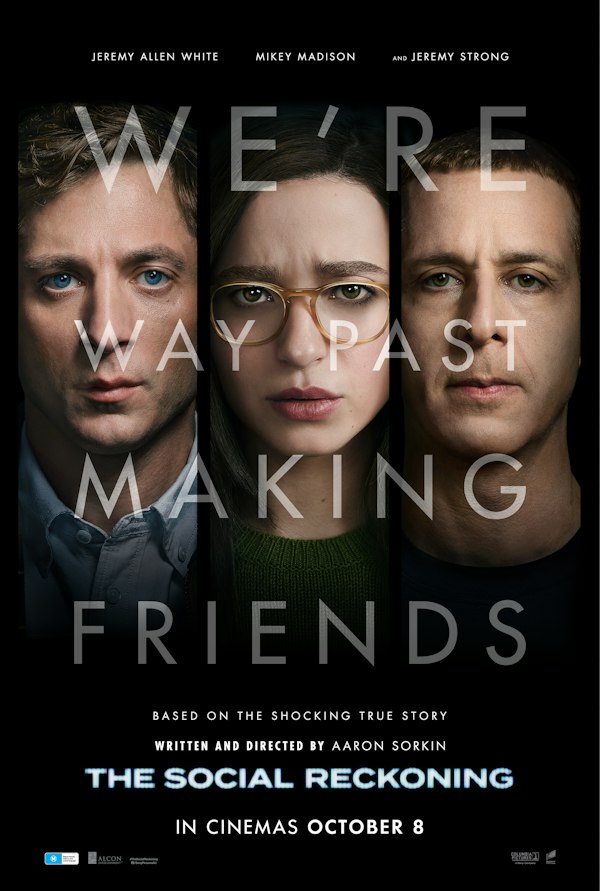
The film centers on Frances Haugen, the Facebook whistleblower played by Mikey Madison, and Jeff Horwitz, the Wall Street Journal reporter played by Jeremy Allen White, whose reporting helped expose the company’s internal knowledge of the harm its products could cause. Mark Zuckerberg, played by Jeremy Strong, occupies a parallel story of executive defensiveness and corporate maneuvering. The underlying reporting is serious. The revelations mattered. Nothing in that history requires the people dramatizing it to be pleasant.
Yet unpleasantness is not automatically complexity. A film can fill a room with difficult people and still offer a convincing sense of why they need one another, how their loyalties change, or what they will sacrifice. Here, the prickliness often feels supplied by the screenplay rather than discovered in character. People speak in the polished rhythm of a showdown they somehow knew was coming. Even ordinary conversations seem to have been scheduled for maximum rhetorical impact.
Sorkin wrote the 2010 film, but David Fincher directed it. The distinction matters. Fincher’s glassy surfaces and precise visual arrangements made the characters seem trapped in systems they barely understood, even when they were creating them. The early Facebook world had the chill of a laboratory where nobody had read the safety instructions. In the sequel, with Sorkin directing as well as writing, the systems become speeches. The problem is announced, explained and argued over, sometimes within the same breath.
Strong’s Zuckerberg is a formidable presence but hardly an illuminating one. The portrayal seems designed to make power look repellent, which it does, though repulsion is a low dramatic bar. A villain need not be sympathetic, but he ought to remain interesting after the audience has registered that he is awful. There is little mystery in a man who arrives already embalmed in his own arrogance.
The film also asks us to accept too many interactions as plausible simply because they serve a satisfying line. Real institutional wrongdoing has a deadening texture: cautious emails, meetings where nothing is said plainly, chains of responsibility designed to dissolve at precisely the moment someone asks who made a decision. Sorkin favors the opposite. His scenes have the convenience of public debates, with points scored and positions clarified. The more perfectly someone expresses the moral case, the less like life it sounds.
Haugen and Horwitz should offer a way out of this airless verbal gymnasium. Whistleblowing and investigative reporting depend on patience, doubt, judgment and innumerable uncinematic decisions. A source has to decide whom to trust; a reporter has to determine what can actually be proved. The relationship contains natural suspense. But the screenplay keeps reaching for a cleverness that is far less compelling than the work itself.
Perhaps the deepest difficulty is the word reckoning. Facebook’s failures did not arise because nobody found an eloquent enough sentence to describe them. Many of the consequences were visible well before this film was made. A reckoning, properly understood, entails some change in how the world works, not merely a satisfying occasion to explain how it went wrong. That makes the film’s appetite for moral closure particularly hard to credit.
There are actors here capable of far more than the material allows, and there is a worthwhile movie buried beneath the noise: one about a reporter, a source and the almost absurd scale of the institution they challenged. It would need to trust silence, uncertainty and human contradiction. The Social Reckoning rarely does. The result is an indignant film populated by people who are difficult to like and, still more damagingly, difficult to believe. Its anger may be justified. Its drama is not.
Sources and film information: Film information · Additional background · Further reading.

