Film criticism · New York Hours
Film essay · Based on verified film materials, festival notes and published reporting; not a firsthand screening review.
Concrete has a serious image problem. It is the substance we complain about when a sidewalk buckles, when a building looks forbidding, or when a formerly eccentric corner of New York becomes the site of an expensive rectangle. It is also what holds up enormous portions of the city. A filmmaker who announced that he wanted to make the definitive documentary about concrete could reasonably expect a polite silence, followed by a change of subject.
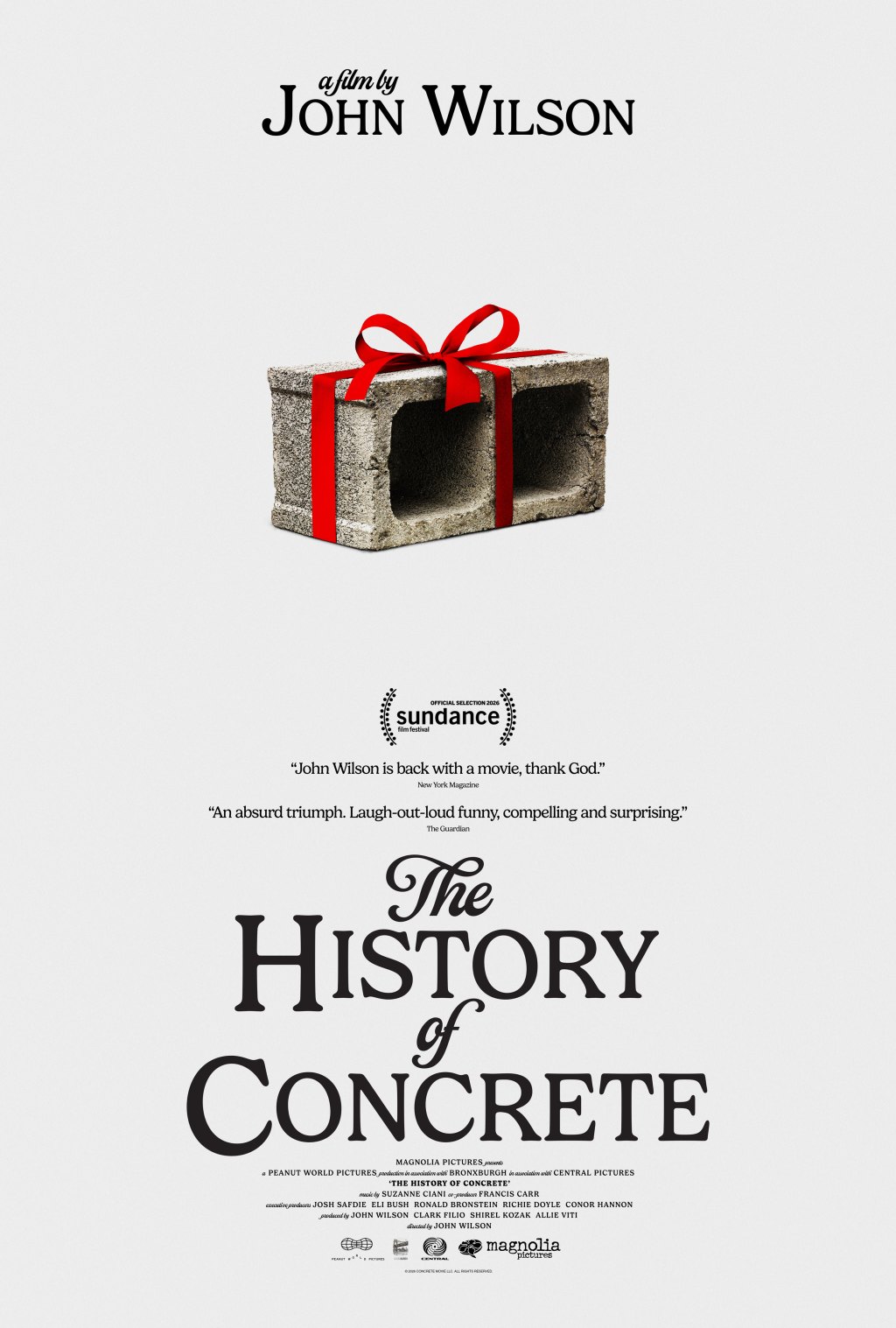
That filmmaker is John Wilson, whose HBO series How To with John Wilson established his gift for noticing what everybody else has agreed not to see. His first feature, The History of Concrete, takes the material’s dreadful reputation as an invitation. There is something wonderfully perverse about insisting that the ordinary pavement beneath a city deserves a movie of its own.
But Wilson is not, at heart, a lecturer about building materials. His film has a second plot: an encounter with a workshop devoted to the formula for a saleable Hallmark movie. The suggestion is that almost any subject can be made commercially inviting if one obeys the proper dramatic instructions. This seems an especially fine joke when the subject is concrete, which has little obvious capacity for a charming small-town romance.
The juxtaposition suggests a more serious question. What happens when an artist who works by curiosity and digression submits to an industry that wants the shape of a story determined in advance? One method follows an unlikely interest until a stranger or a place reveals something astonishing. The other begins with the emotional result the audience is supposed to have and builds backward. Both call the product a movie.
Wilson’s practice depends on accidents: unexpected sights, awkward encounters, a piece of visual evidence discovered while looking for something else. This is a difficult kind of art to explain to anyone demanding a pitch. It can sound like not having an idea. Its value becomes clear only after the wandering has produced a pattern that nobody could reasonably have predicted.
Concrete offers a useful metaphor without needing to become a strained one. It is made from ordinary materials, transformed into something seemingly solid, then exposed to time, weather, pressure and neglect. Movies undergo their own process of mixture and hardening. A screenplay becomes a budget, a budget becomes a production, and a production becomes a piece of work that may no longer resemble the originating curiosity.
New York is the proper setting for this comic argument. Its streets are crowded with evidence of grand plans rubbing against small human improvisations. A city built from systems and permits remains full of things nobody planned: improvised repairs, peculiar signage, accidental compositions, private rituals performed in public. Wilson’s eye makes such phenomena impossible to dismiss as mere background.
The danger for the filmmaker is self-satisfaction. Once a digression becomes a signature, the apparently accidental discovery may begin to seem as carefully packaged as a Hallmark screenplay. That is the tension that makes this project more interesting than the joke of its title. Can a method built on surprise survive its own success?
To approach The History of Concrete expecting an educational survey of cement chemistry would be to miss the challenge Wilson has set himself. This is an inquiry into what stories are permitted to be about. The subject is undeniably hard. The rules governing the movies, it turns out, may be harder.
Sources and film information: Film information.

