Film criticism · New York Hours
Film essay · Based on verified film materials, festival notes and published reporting; not a firsthand screening review.
A country that has disgraced itself may be surprisingly eager to welcome back its most distinguished citizens. The ceremony offers reassurance to both parties: the nation can point to a figure of moral and cultural authority, and the exile can be told that his absence has finally been forgiven. In Fatherland, Paweł Pawlikowski makes the novelist Thomas Mann’s return to Germany in 1949 the occasion for a darker question. Who is forgiving whom?
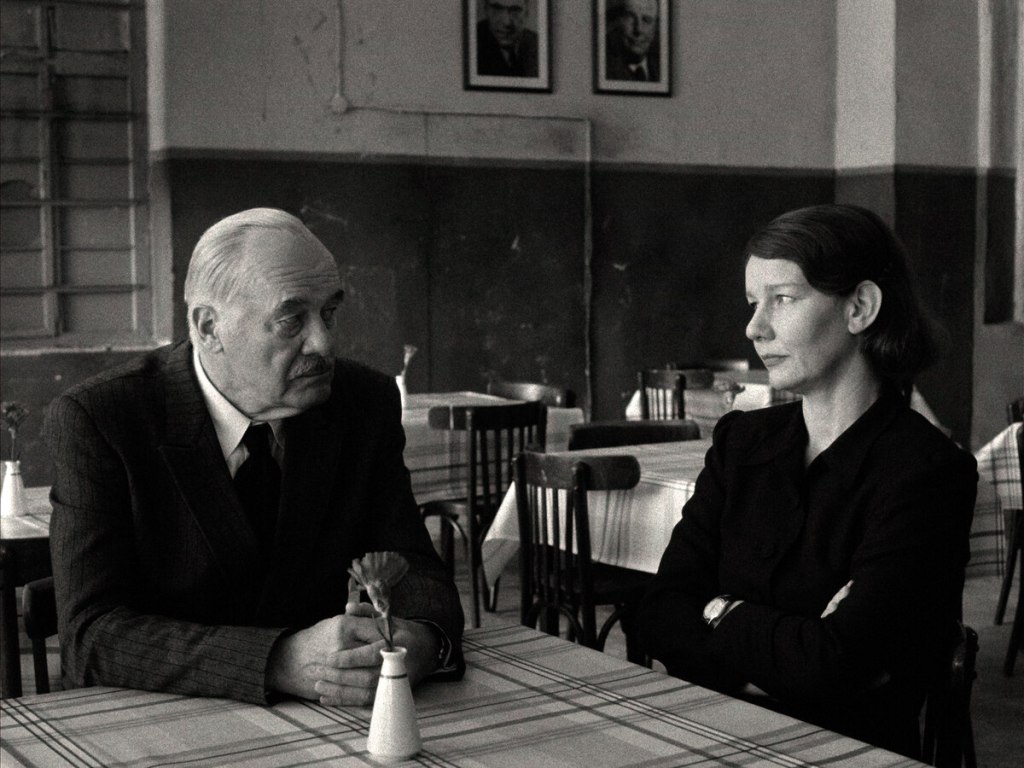
Mann, played by Hanns Zischler, arrives to receive honors associated with Goethe. After years in exile, he finds the country divided between rival political systems, each eager to claim a share of German civilization. Traveling with him is his daughter Erika, played by Sandra Hüller, whose presence prevents the journey from becoming a simple series of public speeches by an elderly famous man.
Erika was herself a writer, performer and committed opponent of Nazism. Where her father can appear protected by the prestige of his name, she carries a more intimate record of what exile and European catastrophe have cost the family. In the film, she also manages his words and watches the people who want to use them.
Pawlikowski, the director of Ida and Cold War, is drawn to historical situations where private feeling cannot be separated from political pressure. With cinematographer Łukasz Żal, he again works in black and white, choosing compositions that make the human figure seem provisional against large, damaged institutions. The restraint is part of the argument: catastrophe does not require visual hysteria to remain present.
Two Germanys await Mann, and each has a language for explaining itself. In the West, recovery promises a return to respectable civic life. In the East, public ritual advertises a new political legitimacy. Both need a figure who can make their claims sound continuous with the nation’s finer past. Mann, whose writing made him an emblem of that past, is useful to everyone.
The film’s central trick is that this historical journey is also a family drama. Mann’s public standing cannot resolve the hurts carried by Erika and her brother Klaus. An honored parent may still be a difficult parent; a nation celebrated for its literature may have recently tolerated barbarism. The title insists that these two levels of injury occupy the same word.
There is also a pointed question about the liberties of historical fiction. The real journey has been reshaped for drama, including the substitution of Erika for the wife who accompanied Mann in 1949. That alteration allows the director to concentrate more sharply on the intergenerational argument, but it also changes the emotional nature of the journey. A daughter can demand explanations that a spouse might approach differently. The film should be read as an interpretation of history, not a transparent record of it.
An eighty-two-minute film is not obliged to encompass every contradiction in the Mann family or the German postwar settlement. But compression can make moral problems look too easily arranged. The great writer stands for compromised authority; the daughter for restless conscience; the ruined country for a past everybody wants to stop discussing. Reality, one suspects, was more stubbornly confused.
That may be the enduring discomfort of Fatherland. A writer can return to receive a prize, deliver a speech and depart. The people applauding him must continue to live with themselves after the ceremony ends. National rehabilitation is easy to stage. The work that would justify it cannot be completed in an afternoon.
Sources and film information: Film information · Additional background.

