Film review · New York Hours
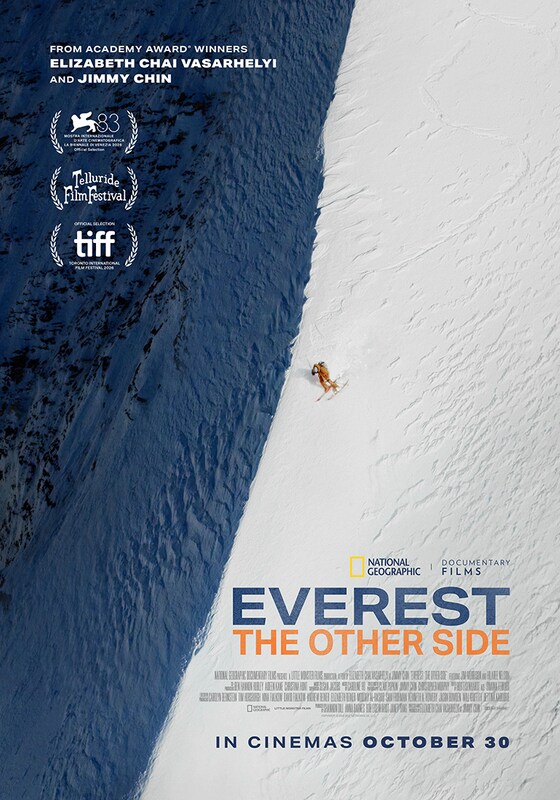
On a mountain, distance can be difficult to judge. The camera can show us a human figure suspended on an immense slope, orange against an almost indecent expanse of white, but it cannot tell us what that figure believes the descent will settle. That gap is the troubling space inside Everest: The Other Side, the new documentary from Elizabeth Chai Vasarhelyi and Jimmy Chin. The film makes the physical achievement legible and the emotional motives, in the end, strangely obscure.
The skier at its center is Jim Morrison, whose great ambition was to descend Everest’s north face by a route so steep and unforgiving that the phrase “ski run” seems grotesquely inadequate. Morrison had shared that dream with Hilaree Nelson, his partner and a formidable mountaineer. Nelson died in an avalanche during a previous expedition, a loss that left Morrison devastated and her two sons without their mother. The documentary follows his attempt to return to the mountain and finish what they had begun.
Even a viewer unmoved by the ceremonial language of achievement must submit to the images. Chin and Vasarhelyi, whose earlier Free Solo examined a climber pursuing another nearly unthinkable feat, are exceptionally good at rendering danger. Drone views establish the outrageous geometry of the face. Footage from the climbers’ own cameras makes the mountain abruptly intimate: a blade of snow, a pick, a boot seeking purchase. A slip ceases to be an abstract possibility and becomes a matter of inches.
There is also a considerable human cost to the expedition’s logistics. What appears in publicity as the triumph of one determined man depends on the labor, competence and exposure of a whole team. Their contributions deserve attention precisely because the solitary-hero story is so appealing. A mountain does not care whose name is on the poster.
Morrison’s grief is palpable, and the filmmakers have access to the kind of private history that can turn an adventure documentary into something more unsettling. He had suffered catastrophic loss even before Nelson’s death: his first wife and their two children died in an airplane crash. To encounter so much bereavement in one life is almost beyond comprehension. The temptation, for filmmaker and audience alike, is to regard the return to Everest as an act whose meaning has already been settled by sorrow.
But what if grief explains the obsession without justifying it? Nelson’s death is neither a plot twist nor an inconvenience to be overcome in a triumphant last act. It is the event that makes the triumphant last act so difficult to receive. She left children behind. Morrison risks leaving more people to mourn. It is possible to feel for him deeply and still wonder why one more descent must be attempted, and why the summit of personal necessity should outrank every competing obligation.
The film seems to assume that finishing the dream is a form of fidelity to the person who died. Perhaps it is. Yet fidelity can also mean accepting what a loss has made impossible. An expedition may be a memorial, a compulsion or a refusal to live in a world where the last ascent ended as it did. Those are not the same thing, and a documentary with such extraordinary access might have pressed harder to distinguish them.
Nor is admiration a satisfactory substitute for scrutiny. We are inclined to forgive the recklessness of an athlete when the footage is sublime. What the filmmakers ask us to celebrate looks, from a different angle, like a remarkably elaborate arrangement for courting catastrophe. That it culminates in a feat of staggering skill does not remove the original question. It makes the question more urgent.
Everest: The Other Side is moving, often magnificent, and finally evasive. Its finest achievement is to convey how a mountain can pull human beings toward it with a force that exceeds reason. Its weakness is a reluctance to examine whether surrendering to that force is noble, selfish or some unstable mixture of the two. The mountain supplies all the scale anyone could want. What remains missing is a convincing account of why anyone had to be there.
Sources and film information: Film information · Additional background · Further reading.

