Massimiliano Gioni, the Italian curator who once helped run a gallery barely larger than a closet, now oversees one of New York’s most prominent contemporary-art museums. In an exclusive interview, he discusses the institution’s future, the changing Bowery and the advantages of not owning any art.
By Sascha Brodsky
Massimiliano Gioni once helped run an art gallery so small that visitors could barely get inside. The Wrong Gallery, which he founded in Chelsea with the artist Maurizio Cattelan and curator Ali Subotnick, occupied a space scarcely larger than a closet. It had a glass door, an exhibition program and almost none of the usual amenities of an art gallery. The joke was partly about the absurdity of the art world, but the exhibitions were serious.
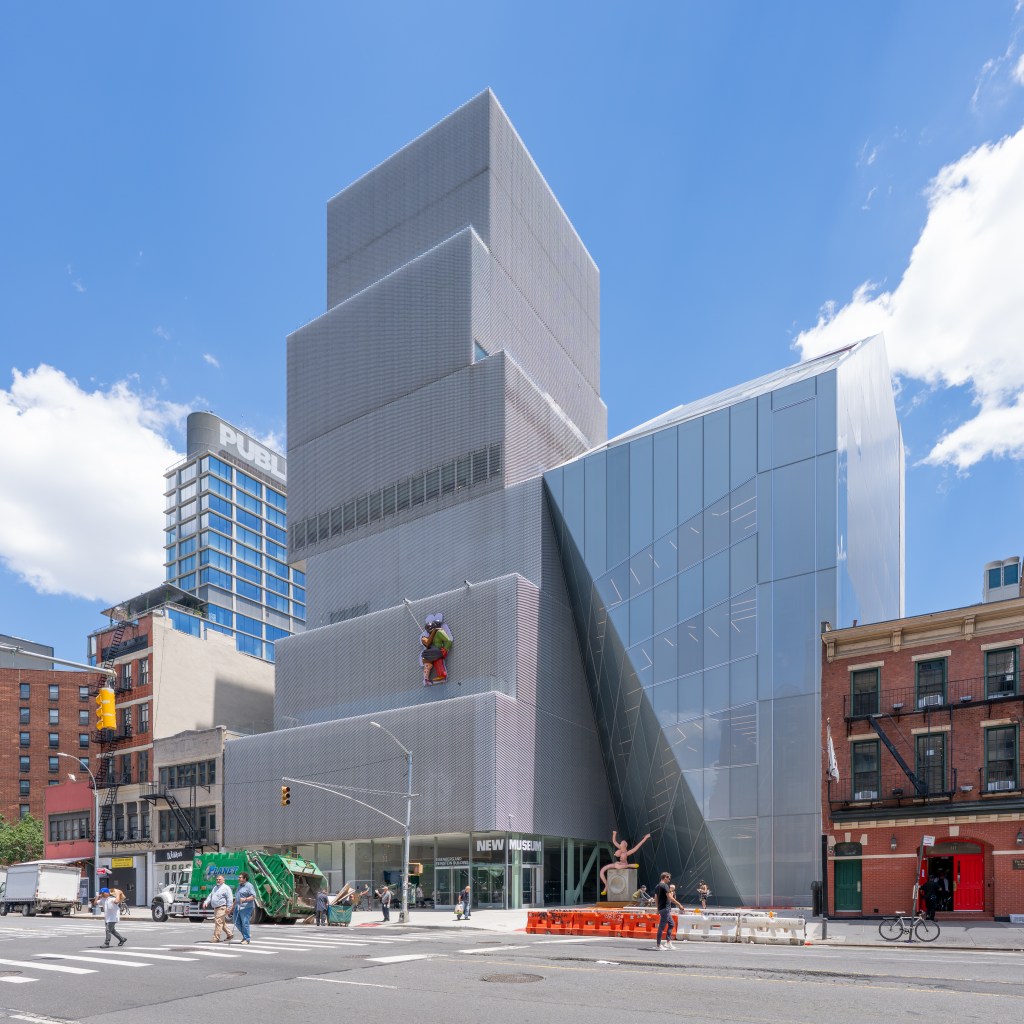
Two decades later, Gioni has a rather different amount of real estate to contend with. In August, he became director of the New Museum, which recently completed a major expansion on the Bowery. Its exhibition space has doubled, and the institution now occupies two adjoining buildings designed by internationally celebrated architects. Gioni, who has spent twenty years working there, would nevertheless like to preserve something of the spirit of that improbable little Chelsea gallery.
“We have double our spaces, but I like to say we are still a smart car not a stretch limo,” he said in an interview with New York Hours.
It is an amusing way to describe a museum whose new addition, designed by OMA, stands alongside the original SANAA building, a stack of silvery boxes that has been a Bowery landmark since 2007. The expansion gives the museum considerably more room to exhibit art, but also raises an awkward question. Can an institution founded to challenge the art establishment avoid becoming part of it?
Gioni believes that the answer lies partly in something the New Museum has never been particularly interested in acquiring: a permanent collection.
“The fact that we don’t have a collection allows more flexibility and perhaps our role is precisely that of scouts for other bigger institutions,” he said.
The museum has made its reputation by showing artists before they acquire the sort of recognition that guarantees a place at MoMA or the Whitney. The larger museums can preserve the masterpieces. His institution can concern itself with finding the next ones, or at least making a persuasive case for work others have overlooked.
“You always see it first at the New Museum,” he said.
In 1977, Marcia Tucker, a curator who had been fired from the Whitney Museum, established the New Museum with little money and a conviction that living artists deserved more attention. She wanted an institution devoted to new work, particularly the kind that did not fit comfortably within established categories. The absence of a permanent collection was deliberate: it would prevent yesterday’s discoveries from crowding out tomorrow’s.
The museum first operated in temporary downtown quarters before establishing an exhibition space at the New School. In 1983, it moved to Broadway in SoHo, then a center of New York’s contemporary-art scene. Tucker ran the institution for more than two decades, making a virtue of exhibitions that could unsettle critics and visitors alike. One early show, Bad Painting, celebrated artists who seemed cheerfully indifferent to accepted standards of skill and taste.
Lisa Phillips succeeded Tucker in 1999 and led the museum through a period of dramatic growth. In 2007, it moved into its Bowery headquarters, designed by SANAA’s Kazuyo Sejima and Ryue Nishizawa. Its off-center stacked floors looked as if someone had assembled a precarious tower from silver boxes. The building was an immediate landmark, though its arrival was not universally celebrated.
Gioni joined the New Museum in 2006, during preparations for the Bowery opening. Born in Italy in 1973, he moved to New York in 1999 and worked at the contemporary-art magazine Flash Art. His early career reflected an art world in which making exhibitions, writing criticism and playing pranks were not always entirely separate activities.
The Wrong Gallery, conceived with Cattelan and Subotnick, mocked the idea that a gallery required luxurious rooms or elaborate institutional machinery. Gioni went on to organize international exhibitions on a far grander scale, including the 2013 Venice Biennale’s The Encyclopedic Palace. Inspired by an Italian-American mechanic’s dream of housing all human knowledge in one enormous building, it brought together celebrated artists, outsiders and obsessive collectors.
Gioni became the New Museum’s artistic director in 2014. Now only its third director, he has inherited both the institution’s spirit of experimentation and the practical responsibilities of an expanding cultural landmark.
He invokes Harald Szeemann, the influential Swiss curator whose motto was “From vision to nail.” An exhibition, in this view, demands attention to everything from its intellectual premise to the precise placement of an object. Gioni applies the same principle to running a museum.
“Institution building needs to function at different levels, all integrated, from the macro to the micro,” he said.
That includes the museum’s relationship with a neighborhood that has changed enormously since he arrived. The Bowery, once associated with cheap hotels, bars, restaurant suppliers and people living on the margins, was becoming a desirable address even before the SANAA building opened.
“In 2007 there was a lot of anxiety about the museum participating in the transformation of the Bowery, gentrifying the neighborhood,” Gioni recalled.
He remembers a warmer welcome when the expanded museum reopened. Nearby businesses told him that they had missed its visitors during the construction closure. He believes neighbors now recognize the museum’s contribution. There is another possible explanation: much of the Bowery’s transformation has already happened. A museum once perceived as a herald of change is now part of the established neighborhood.
Gioni points to activities less visible than its exhibitions. Teaching artists work with children in Lower East Side housing projects. A teen program introduces young people to artists and museum professions, provides stipends and gives participants a place to spend time making art. The museum also collaborates with the Bowery Mission next door.
Its exhibition The Bowery: Devil’s Mile examines the street’s history over five centuries. It is an apt subject for an institution that has become part of the neighborhood’s own story. The museum is both a chronicler of change and a participant in it.
An immigrant himself, Gioni sees no contradiction between the museum’s international ambitions and its downtown identity.
“I like to say we are a museum with an accent: truly global and cosmopolitan—like a real New Yorker,” he said.
Contemporary art, he suggests, can resemble an encounter with a foreign language. The visitor may understand very little at first, yet that initial bewilderment can be the beginning of something rewarding.
“Contemporary art puts us in front of things we don’t understand, things that speak a language different from ours,” he said.
It is a more demanding proposition than the familiar museum promise that art should be instantly accessible. Gioni is willing to defend not knowing. An artwork may be worth the visitor’s time precisely because it refuses to behave as expected.
The museum’s reopening exhibition, New Humans: Memories of the Future, included artists from more than fifty-five countries, according to Gioni. Its next Triennial, scheduled for February, will feature artists from nearly forty countries. The bigger building creates room for more ambitious presentations, but Gioni is less interested in size for its own sake than in what happens when somebody stands before a work of art.
For an example, he points to I Am Tony, an exhibition of work by Arthur Jafa. The American artist and filmmaker frequently draws on footage circulating through the internet and popular culture, particularly images of Black American life. Familiar clips become unsettling or exhilarating through their arrangement and scale.
Gioni believes this makes a case for visiting museums in an age when almost anything can be viewed on a phone. Jafa’s work, he said, examines how digital culture can turn violence into spectacle. In a gallery, a viewer is invited to look deliberately rather than simply absorb one image before flicking to the next.
The distinction matters for an institution that has just invested heavily in physical space. Museums cannot compete with the convenience or volume of the internet. They can ask people to look longer.
For all his international commitments, the thing that has most recently surprised Gioni about New York is comparatively modest. Speaking with teenagers in the museum’s education program, he discovered that some did not know how many commercial galleries in the city allow people to see art without paying admission.
After decades of gallery-going, he had come to regard this abundance as an ordinary fact of city life. The teenagers reminded him that it was not.
“The biggest contemporary art museum in the world is made up of New York galleries,” he said.
A person can wander between exhibitions in Chelsea, Tribeca or the Lower East Side without buying a ticket. Some of the art will be forgettable, some incomprehensible, and occasionally something will remain in the imagination long after the show closes. Gioni regards that freedom as one of the city’s great pleasures.
“It’s a free university, right there in front of us.”
There is something reassuring about a museum director who has just acquired twice as much exhibition space reminding people that they can find art elsewhere for nothing. It suggests that Gioni has not forgotten the mischievous young curator who once helped operate a gallery barely large enough to admit its visitors. The New Museum has become bigger and more established. Its director’s task is to make sure there is still room for the unexpected.

