By Sascha Brodsky
Massimiliano Gioni once helped run a gallery in Chelsea so small that most visitors had to look at the art from the sidewalk. The Wrong Gallery, which he founded with the artist Maurizio Cattelan and curator Ali Subotnick, occupied a former doorway. It had a glass front, a changing exhibition program and no room for the ceremonious mingling that usually accompanies a gallery opening. The work was meant to be taken seriously. The gallery itself was something of a joke.
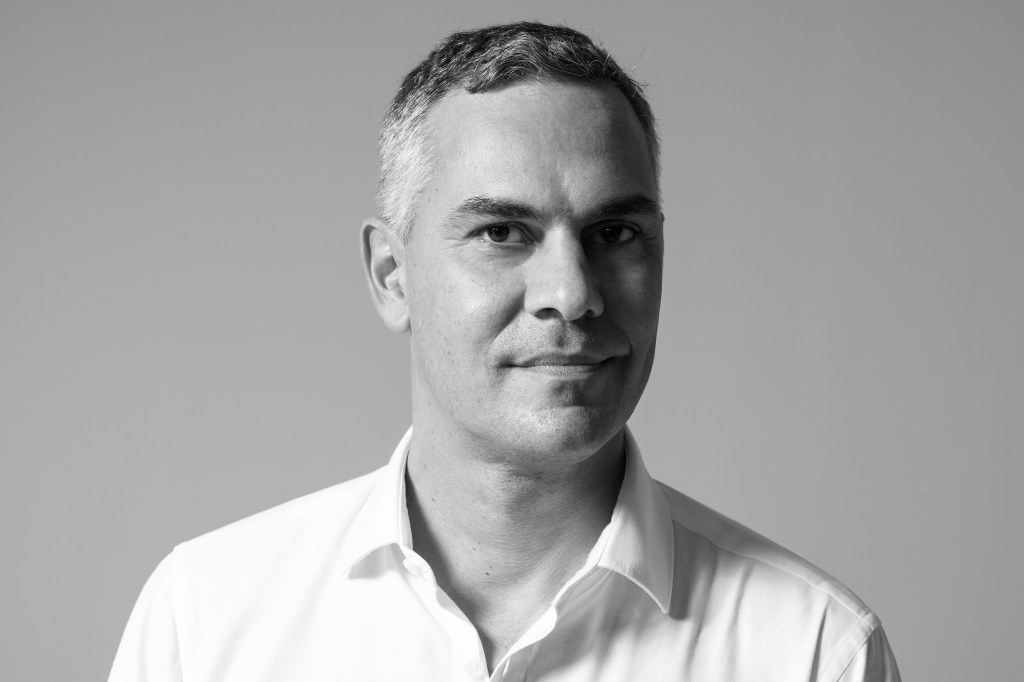
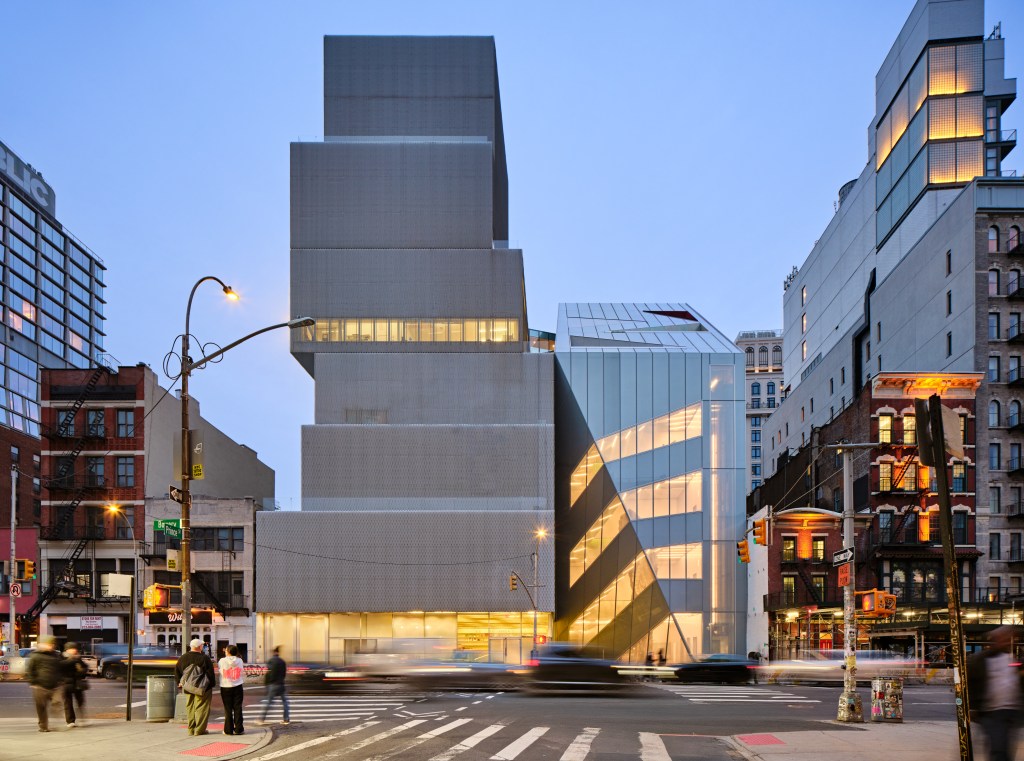
Two decades later, Gioni is in charge of considerably more real estate. In August, he became director of the New Museum, which has just completed a major expansion on the Bowery. The new building, designed by OMA, joins the original SANAA structure, doubling the museum’s exhibition space. Gioni, who has worked at the institution for twenty years, is determined that its increased size will not make it more respectable.
“We have double our spaces, but I like to say we are still a smart car not a stretch limo,” he said in an interview with New York Hours.
The comparison seems particularly improbable on the Bowery, where the original museum rises in a series of off-center aluminum boxes and the new addition introduces an altogether more imposing architectural presence. The institution has grown substantially since its founding nearly fifty years ago, acquiring the buildings, international reputation and institutional obligations that its founders might once have regarded with suspicion.
Gioni’s new job is to oversee all of this without allowing the New Museum to become too much like the museums it was established to challenge.
His answer begins with something the institution doesn’t have.
“The fact that we don’t have a collection allows more flexibility and perhaps our role is precisely that of scouts for other bigger institutions,” he said.
Unlike MoMA or the Met, the New Museum has no permanent holdings that must be conserved, studied and occasionally brought out for public admiration. Its galleries can be cleared and filled again without reference to a storehouse of masterpieces. This makes the institution unusually free to take chances on artists who have not yet acquired the reputations that make them safe investments for larger museums.
Gioni sees the arrangement as a competitive advantage. The New Museum can operate with a speed that institutions responsible for vast collections often cannot match. It can make discoveries and leave other museums to pursue them later.
“You always see it first at the New Museum,” he said.
This is not quite true of everything the museum exhibits, but it is an accurate expression of its ambition. The pleasure of discovering something before everyone else has always been an important part of the New Museum’s identity.
That ambition began with Marcia Tucker, a curator whose dismissal from the Whitney Museum helped precipitate the founding of the New Museum in 1977. Tucker believed that established institutions had become too cautious, too concerned with preserving what they already owned and too slow to recognize the art being made around them.
She imagined an institution devoted to living artists, particularly those who had yet to receive the blessing of the art establishment. The New Museum would have no permanent collection. Instead, it would provide a succession of exhibitions, arguments and provocations, each capable of replacing the one before it.
One of Tucker’s early exhibitions, Bad Painting, opened in 1978 and presented work that seemed cheerfully indifferent to conventional notions of artistic competence. Its title suggested that the criteria by which museums distinguished good art from bad might themselves be worth examining.
The New Museum spent its early years in comparatively modest quarters, eventually establishing itself on Broadway in SoHo. It acquired a reputation for presenting difficult, overlooked and occasionally outrageous work. The institution’s willingness to make people uncomfortable was not an unfortunate byproduct of its mission. It was part of the point.
Lisa Phillips, who became director in 1999, presided over the next transformation. Under her leadership, the museum moved to the Bowery in 2007, occupying a new building designed by Kazuyo Sejima and Ryue Nishizawa of SANAA. The structure, a stack of shimmering metal boxes, looked at once precarious and entirely self-assured.
It was an unlikely monument for a museum that had once prided itself on having little to lose. The building made the institution a conspicuous presence in a neighborhood that was itself changing rapidly.
Gioni arrived during this period. Born in Busto Arsizio, Italy, in 1973, he moved to New York in 1999 and worked at Flash Art, the international contemporary-art magazine. He belonged to a generation of curators for whom art making, exhibition organizing, writing and performance were not always readily distinguishable activities.
His partnership with Cattelan was particularly instructive. The Italian artist had built a career on elaborate provocations that sometimes seemed designed to expose the art world’s capacity to take almost anything seriously. Gioni occasionally appeared in public impersonating Cattelan, making authorship itself part of the performance.
The Wrong Gallery emerged from the same atmosphere of mischief. Its cramped quarters mocked the conventions of the commercial gallery while allowing Gioni and his collaborators to mount exhibitions that attracted considerable attention.
The joke had a practical consequence. It demonstrated how little a gallery needed in order to function, provided that the people responsible for it had sufficiently interesting ideas.
Gioni’s career soon took him into rather larger spaces. He helped organize the 2006 Berlin Biennale, directed the 2010 Gwangju Biennale in South Korea and curated the international exhibition at the 2013 Venice Biennale.
That Venice exhibition, The Encyclopedic Palace, took its title from the ambitions of Marino Auriti, an Italian-American mechanic who imagined constructing a building capable of containing all human knowledge. Gioni assembled work by celebrated artists, outsiders, visionaries and obsessive collectors, often placing the professionally trained beside people whose creations had seldom been considered art.
The exhibition made an argument about the human impulse to organize experience, even when the resulting systems were elaborate, eccentric or impossible. Its range reflected Gioni’s fascination with people whose imaginations operate beyond the accepted boundaries of artistic practice.
At the New Museum, where he became artistic director in 2014, Gioni helped shape exhibitions by artists including Lynda Benglis, Pipilotti Rist and Sarah Lucas. When Phillips retired, the museum chose a successor who had already spent much of his professional life developing its artistic identity. He is only its third director.
The promotion has required him to think about subjects that curators can sometimes leave to other people. A director must concern himself with budgets, buildings, staff and the machinery of an institution whose daily operations are far less mysterious than the art on its walls.
Gioni invokes Harald Szeemann, the influential Swiss curator, whose motto was “From vision to nail.” For Szeemann, the grandest conception of an exhibition was inseparable from the practical work of installing it.
“Institution building needs to function at different levels, all integrated, from the macro to the micro,” Gioni said.
His responsibilities now include the New Museum’s relationship with a neighborhood that has changed almost beyond recognition during his tenure.
When the museum opened its SANAA building in 2007, the Bowery was already losing much of the character that had defined it for generations. The flophouses, bars and restaurant-supply businesses remained, but expensive apartments, hotels and fashionable restaurants were arriving. The new museum seemed to some residents less a cultural gift than an announcement of what the neighborhood was becoming.
“In 2007 there was a lot of anxiety about the museum participating in the transformation of the Bowery, gentrifying the neighborhood,” Gioni recalled.
The reception to this year’s reopening, he said, was markedly different. During the museum’s closure for construction, neighboring businesses told him that they missed its visitors. Its return was greeted with a warmth he had not experienced the first time around.
There is a complication in that account. The people who worried about gentrification nineteen years ago were not necessarily the same people who welcomed the reopening. Much of the Bowery’s transformation has already taken place. The museum is now an established landmark in a neighborhood where the commercial advantages of a cultural destination are readily understood.
Gioni argues that its contribution is not limited to the customers it brings to nearby businesses.
The New Museum runs programs with teaching artists for children in Lower East Side public housing. Teenagers can spend time making art, meet working artists and learn about careers in museums while receiving stipends for their participation. The institution also collaborates with the Bowery Mission, the longtime organization that serves people experiencing homelessness.
The museum’s exhibition The Bowery: Devil’s Mile examines five centuries of the street’s history. It is a subject with an unavoidable irony for an institution that has become one of the most visible symbols of the area’s transformation.
Gioni, who came to New York from Italy, sees the Lower East Side’s history of successive immigrant communities as part of the museum’s own identity.
“I like to say we are a museum with an accent: truly global and cosmopolitan—like a real New Yorker,” he said.
For him, the experience of encountering contemporary art has something in common with arriving in a country whose language one does not yet speak. There is the initial confusion, the uncertainty about what matters and the gradual recognition that unfamiliar things may be worth understanding on their own terms.
“Contemporary art puts us in front of things we don’t understand, things that speak a language different from ours,” he said.
Gioni does not regard this bewilderment as a problem to be solved by better wall labels. He believes it is part of what makes art valuable. An exhibition need not immediately explain itself to its audience, and a visitor need not understand everything in order to have a worthwhile experience.
The New Museum’s expanded space has given him more opportunities to pursue this kind of encounter. Its reopening exhibition, New Humans: Memories of the Future, included artists and other figures from more than fifty-five countries, according to Gioni. The next Triennial, scheduled for February, will bring together artists from nearly forty countries.
The international reach of these exhibitions reflects an ambition that has long exceeded the institution’s physical dimensions. But Gioni also believes the experience of seeing art in person has become more important as images circulate ever more freely through digital media.
He points to the museum’s Arthur Jafa exhibition, I Am Tony, as an example. Jafa, the American artist and filmmaker, frequently works with images drawn from television, popular culture and the internet, rearranging them in ways that challenge the habits of ordinary viewing.
His videos can be exhilarating and deeply disturbing. Footage of Black American life, musical performances, expressions of joy and acts of violence appears in combinations that refuse the easy progression from one image to the next.
Much of the material may already be familiar to viewers accustomed to scrolling through an endless stream of photographs and videos. What changes in Jafa’s work is the attention it demands.
Gioni believes the exhibition offers a powerful argument for the continued existence of museums. Jafa’s art examines the relationship between digital culture and the presentation of violence as spectacle, turning material that might otherwise be consumed casually into something requiring sustained consideration.
A phone can deliver an image almost instantaneously. A museum can place that image in a room, alter its scale and insist that a visitor spend time with it.
For all the attention Gioni has devoted to the New Museum’s new buildings, however, one of his recent discoveries about New York involved something that requires no museum admission at all.
While speaking with teenagers in one of the institution’s education programs, he learned that some did not know how many commercial galleries in the city allow people to see exhibitions for free.
The realization surprised him. For much of his adult life, Gioni has moved among galleries as naturally as other New Yorkers move among coffee shops. He knows that a person can spend an afternoon looking at art without buying a ticket or having any particular destination in mind.
To the teenagers, this was not necessarily obvious.
“The biggest contemporary art museum in the world is made up of New York galleries,” he said.
There is something particularly appealing about this declaration from the director of a museum that has just doubled its exhibition space. The city offers an extraordinary abundance of art in rooms that are open to almost anyone willing to walk through the door.
A visitor can move among galleries in Chelsea, Tribeca and the Lower East Side, seeing work by unfamiliar artists alongside that of people whose reputations have been established for decades. Some exhibitions are negligible, others puzzling, a few genuinely transporting. No single institution has chosen the works or arranged them into a coherent history. The visitor must make a path through them.
Gioni considers this one of New York’s great, insufficiently appreciated pleasures.
“It’s a free university, right there in front of us.”
As a young curator, he helped make a gallery out of a doorway. Now he presides over two substantial buildings on the Bowery. Somewhere between those extremes lies the idea he has spent his career pursuing: that the most interesting art is often the work nobody yet knows quite what to do with.

