On November 7 and 8, visitors to the New York Botanical Garden will be able to hear Japanese drums among the chrysanthemums. Hiro Kurashima and his Brooklyn ensemble, Taiko Masala Dojo, are performing during Kiku, the garden’s annual celebration of Japanese chrysanthemum cultivation. The pairing makes sense to Kurashima: both the music and the flowers are products of years of practice and careful attention.
“Autumn is a season of harvest—a time to celebrate the fruits of the year, following the sowing of seeds in the spring and the nurturing of growth throughout the summer,” Kurashima said in an interview with New York Hours. Playing at the garden, he added, gives the ensemble a chance to express gratitude “for the bounties of nature across the spring, summer, and autumn seasons.”
Kiku: Spotlight on Tradition, which runs from October 31 through November 15, showcases chrysanthemums cultivated using Japanese techniques. Among the attractions is ozukuri, a painstaking method of training a single plant to produce a broad canopy of blossoms. Other arrangements send flowers cascading downward. The plants are impressive partly because the work behind them is so difficult to see.
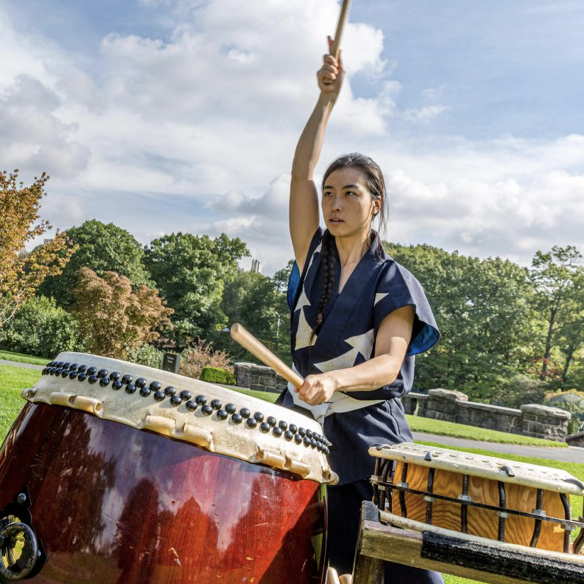
Kurashima’s interest in taiko dates back about thirty years, to an international festival at UCLA. There he watched a group visiting from Japan perform in a way he found “both traditional and innovative.” He was hooked. “Ever since then, I have been hooked on the allure of taiko—and I remain just as captivated today.”
Taiko is often described in terms of its volume, but Kurashima is more interested in how the drums work together. He points to Daihachi Oguchi, a musician associated with Suwa Daiko, who helped develop the modern ensemble style known as kumi-daiko. Instead of relegating drums to accompaniment, Oguchi brought instruments of different sizes and sounds together as the main event.
“Historically, taiko served merely as accompaniment for songs, dances, or other instruments, with performers relegated to the edge of the stage,” Kurashima said. Oguchi’s approach, he explained, allowed drummers “to create more complex musical compositions.” He likens the different drums to instruments in an orchestra. Each has its own role, and the impact depends on the players listening closely to one another.
Founded by Kurashima in 2001, Taiko Masala performs around New York at festivals, schools and cultural events. Its members use drums of different sizes, including a large o-daiko. The music is physical: players move their whole bodies as they strike, and the audience can watch a rhythm travel across the group. But successful ensemble playing also requires restraint. Not every drum should be heard at once.
Kurashima describes the structure of a performance through jo-ha-kyū, a Japanese artistic principle involving an opening, a period of development and a climax. The pattern may repeat as the music moves forward. The progression helps explain why a taiko performance can feel like more than a sequence of increasingly loud beats. There is a story in the timing, even without words.
Just as important to Kurashima is the audience. He uses the Japanese expression ichi-go ichi-e, often understood as a once-in-a-lifetime meeting, to describe the connection between performers and listeners. The players may know the piece thoroughly, but they cannot know exactly who will be there or how the audience will respond. That uncertainty is part of the occasion.
It is especially appealing in a public garden, where some visitors will arrive expressly for the drumming and others may encounter it by accident. Kurashima imagines someone who came merely because the weather was pleasant, then stopped at the unexpected sound. “If, upon seeing our performance, you happen to feel something, that would be wonderful,” he said.
He is careful not to suggest that a few pieces of music can explain an entire culture. His group’s repertoire represents “only a small facet of Japanese culture,” he said. In New York, a city with no shortage of cultural encounters, that modest claim is rather inviting. The music can be appreciated without requiring visitors to become instant experts in its history.
Nor does he want people simply to stand back and admire the musicians’ technique. “Music is even more enjoyable when you participate rather than just watch,” Kurashima said. Taiko Masala often encourages an exchange with its audience, making a concert feel less formal than the precision of the playing might suggest.
Asked what he most looks forward to sharing, Kurashima spoke not about the loudest drum or the most difficult passage, but about joy and “the peace of everyday life that allows for such musical moments.” It is a gentle thought from someone whose instrument can shake the air. The chrysanthemums, meanwhile, offer their own quiet reminder of how much preparation goes into a brief public appearance.
Visit: Kiku: Spotlight on Tradition, New York Botanical Garden, October 31–November 15. Taiko Masala Dojo performs November 7 and 8 at 12:30 and 2:30 p.m. Performances are included with the All-Garden Pass.

