Exclusive interview
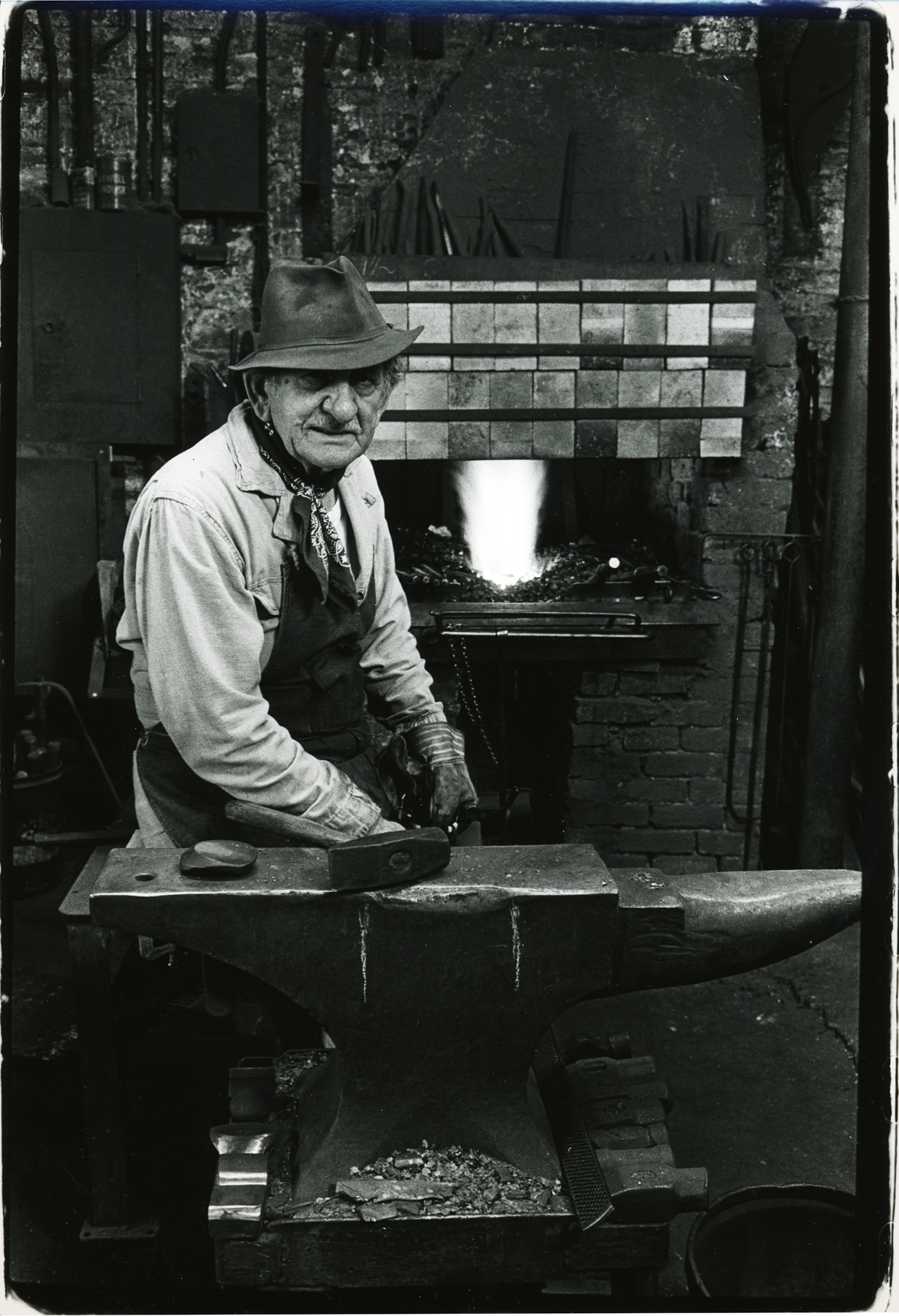
In Wang’s World at the Bronx Documentary Center, an Astoria blacksmith stands behind his anvil with a hammer laid across it and a fire burning at his back.
He wears a hat and a knotted neckerchief. His face, turned toward the camera, occupies less of the photograph than the tools and masonry around him. The picture dates from 1988, but almost nothing in the frame announces the decade. The hammer rests within reach of his gloved hands; behind his shoulder, the fire registers as a white flare against the dark brickwork.
The portrait is among the images supplied for an exhibition of Harvey Wang’s photographs and films, opening November 13 at the center’s annex. Co-curated by Sean Corcoran, the show ranges across decades of work, including Wang’s photographs of the East Village in the seventies and eighties. Looking back, he finds information in the pictures that he did not necessarily recognize when he made them.
“Something that seemed mundane when new, becomes an essential record years later,” he told New York Hours in an interview.
The original attraction was simpler. Growing up in suburban Queens, a two-fare journey from Manhattan, he wanted to explore. An older cousin taught him to make darkroom prints. Otherwise, he recalled, he was largely untrained. He looked for instruction in photographs, especially the work of the Depression-era Farm Security Administration photographers, whose pictures preceded his own life.
“I was curious about people, and how they lived and worked,” he said.
He was drawn to scenes that seemed to belong to an earlier time. In the blacksmith’s portrait, he made room for the details of the trade. The anvil fills the foreground, its pointed end extending almost to the edge of the frame. The tools behind the man remain visible. A caption can give the occupation and the year; the photograph supplies the setting in which the work happened.
Over the years, the projects accumulated into books. There were retired baseball players and rock wives; there were the New Yorkers of Harvey Wang’s New York, published in 1990. In Flophouse: Life on the Bowery, from 2000, the lives of Bowery residents became the subject. His biography lists six photography books, including collaborations with the radio producer David Isay.
Film had already taken him beyond the single image. While working on Holding On in the early nineties, he began making films; assignments for National Geographic television and WNET led to shorts and features. The exhibition will include three screening events, he said. His books now also include From Darkroom to Daylight, published in 2015.
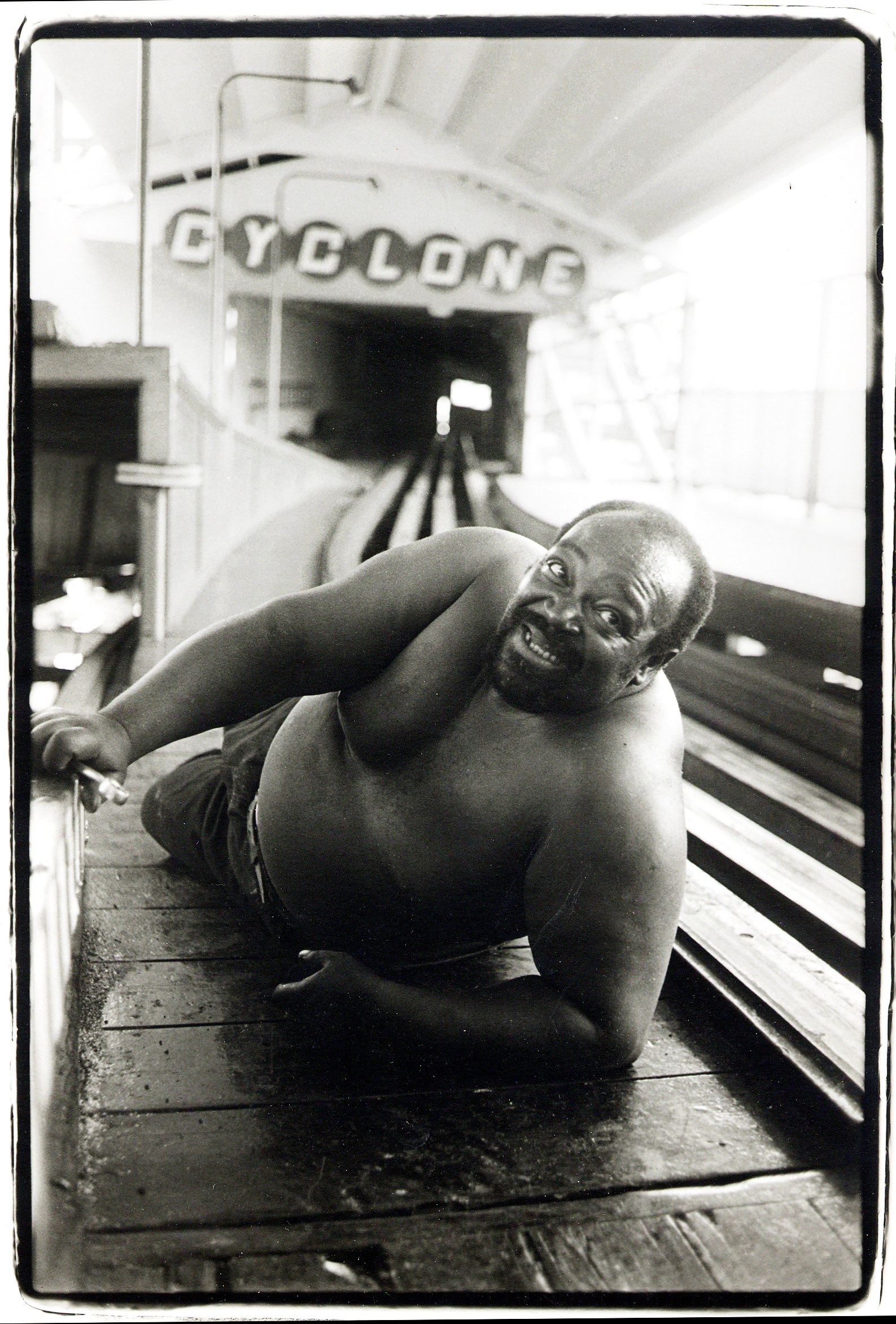
In a portrait from 1986, Eddie Day, a brakeman on the Cyclone, leans toward the camera, shirtless and smiling. The roller coaster’s name hangs above the tracks behind him. His elbow rests on the wooden platform, his body cutting diagonally across the upright frame. The photograph keeps the amusement-park machinery in view while allowing its worker to take up most of the space.
Deciding which pictures belonged in the exhibition involved returning to the work before it had acquired the authority of an archive. Some photographs mattered because of a connection with the person in them. Others recorded an event or represented an advance in his technique. He also wanted to include early pictures that had persuaded him he could make something good.
Revisiting the contact sheets brought a less comfortable discovery. The younger photographer had sometimes stopped too soon. He could see occasions when he might have gone further, made another exposure or tried something that felt less safe.
“Maybe it was my shyness, fear, or the cost of film,” he said, “but I realize now that I often did not go far enough in making photographs outside my comfort zone.”
The pictures he did make also contained a record of his education. Looking at them now, he recognizes the influence of photographers whose work taught him new ways to see. In choosing the exhibition, he was sorting through those discoveries as well as the subjects themselves.
Asked what a photograph might preserve that a written history could miss, he recalled a passage in the documentary about Robert Crumb. The artist described photographing utility poles, wires and street infrastructure as reference material. Such things could establish a place and a time, though few people thought to remember them. In Wang’s own pictures, signs, cars, clothes and graffiti have taken on that work.
His account of what New York has lost begins with the cost of staying. He remembers places where people could afford to live, create and pursue unconventional lives. He suspects that some version of that city still exists, but sees fewer places where it is possible.
Another change confronts him on buses, subways and street corners, where people retreat into their screens. “Everyone is connected, but no one is connecting,” he said.
The transition from film to digital disrupted his own work. The darkroom had been central to his process. Making the print was part of making the picture; when that familiar sequence disappeared, he struggled.
“When photography transitioned from analog to digital, I felt a rupture in my work,” he said.
Eventually, the computer gave him a way back to something he had enjoyed early on. He used to make composites and collages in the darkroom. Photoshop allowed him to return to those experiments, with different tools and different results. He describes some of the newer work as more graphic, even decorative, than his earlier documentary photographs.
“I am still excited to make pictures, and see how things look when photographed,” he said. “And I still feel compelled to create works that reflect the world, and my travels through it.”
Wang’s World: Photographs and Films of Harvey Wang is on view November 13, 2026, through January 10, 2027, at the BDC Annex, 364 E. 151st St., Bronx. Opening reception: November 13, 6–9 p.m.

