
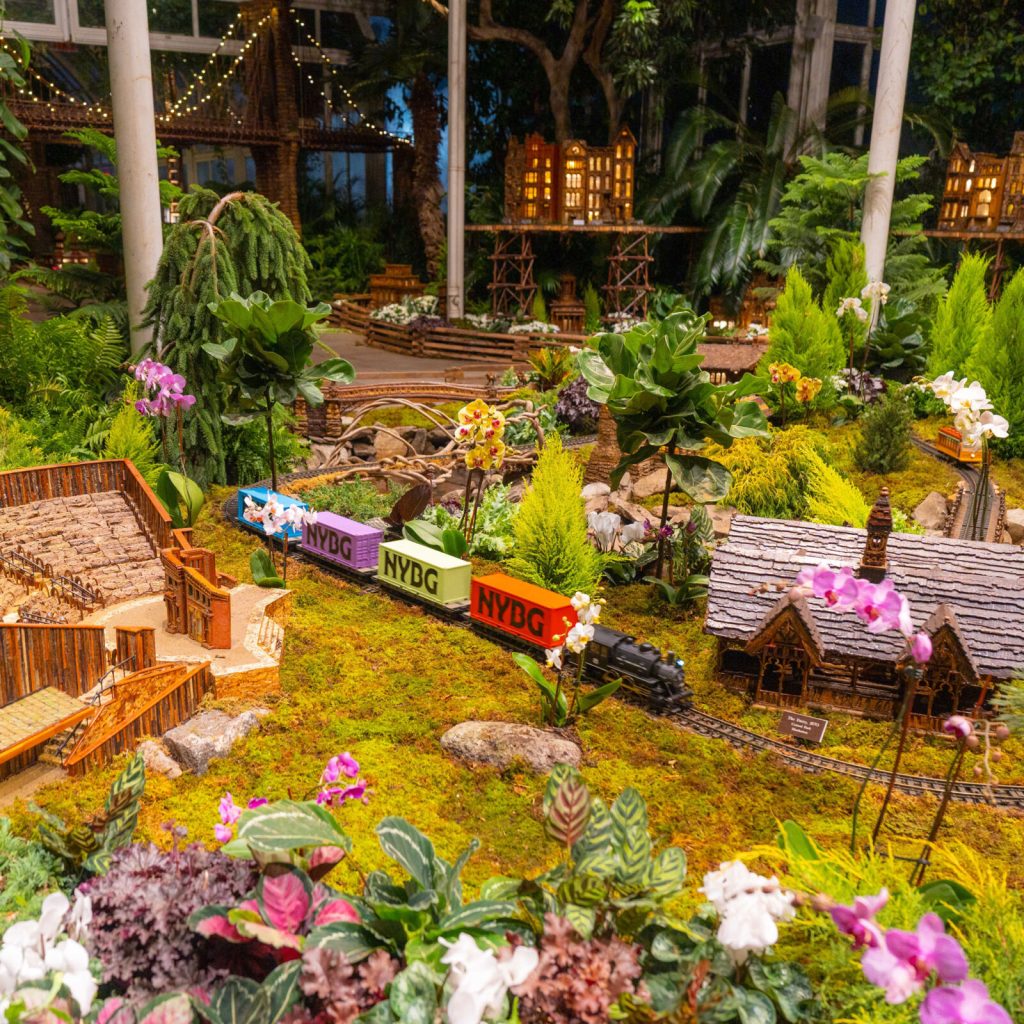
New York does not generally reward a sense of proportion. Its buildings are too tall, its traffic too insistent and its distances frequently seem longer than the map promised. Once a year, though, the entire city becomes small enough for a model train to pass through.
The New York Botanical Garden’s Holiday Train Show returns November 14, bringing miniature landmarks and moving trains into the Enid A. Haupt Conservatory. The garden says this edition will include nearly 200 replicas of New York buildings and structures. It remains one of the city’s stranger seasonal traditions: a celebration of urban architecture constructed from the materials of the natural world.
The buildings are not conventional plastic miniatures. Pinecones, leaves, bark, palm fronds and other botanical ingredients stand in for the substance of a very unbotanical metropolis. Such substitutions produce a delightful visual contradiction. The city is recognizable because of its shapes, yet its familiar surfaces have been reinvented as plant matter.
That is more than a clever Christmas decoration. Miniatures can alter the way people think about places they know. A building experienced in daily life as a looming landmark becomes something one can examine in its entirety. Bridges turn into delicate spans. The city suddenly seems manageable, almost affectionate.
Trains are essential to the illusion. Without them, the installation would be an architectural model. As they circulate among the landmarks, the city acquires scale and narrative. Movement suggests connections among otherwise isolated buildings and gives visitors a reason to follow the scene instead of taking it in with a single glance.
The conservatory itself is a significant part of the attraction. A greenhouse in the Bronx is an unexpectedly persuasive setting for a fantasy New York, particularly when the weather outside turns cold. Plants become both the substance of the model city and the living surroundings against which it appears.
That pairing is a reminder of something usually absent from urban postcards. New York’s grand structures have always depended on materials drawn from elsewhere. Here the relationship is made playful and obvious. The constructed metropolis returns, symbolically at least, to bark, seed and leaf.
The tradition is easy to dismiss as primarily an outing for children, particularly because model trains have an obvious appeal to younger visitors. But the craftsmanship rewards adult attention. Look closely at how an architectural feature has been reproduced, or how an unlikely plant part has been pressed into service as an ornament, and the display becomes a collection of small acts of ingenuity.
Scale is also the source of the show’s emotional pull. People who spend their days navigating New York’s inconvenient grandeur can enjoy a moment of mastery over it. Streets and buildings that ordinarily dictate our movements are reduced to an environment that can be circled in minutes.
An outdoor mountainscape with additional trains and illuminated scenery is also planned this season. It may broaden the experience beyond the conservatory, though visitors should check what is operating on the day of their visit rather than assume that every feature is available at every hour.
The show runs through January 10, 2027, with a members’ preview scheduled for November 13. Its calendar therefore stretches from early holiday anticipation into the quieter weeks after New Year’s Day, when some of the city’s seasonal decorations have already disappeared.
There is a useful contrast with the Botanical Garden’s Japanese chrysanthemum exhibition, which overlaps with the train show on November 14 and 15. One display trains living plants into extraordinary artificial forms. The other builds artificial architecture out of plant material. Seen together, they offer two quite different versions of horticultural imagination.
The attraction succeeds as an idea because it lets people recognize the city without having to contend with it. It offers New York in an unusually forgiving size, intricate enough to fascinate but small enough to leave behind.
The Holiday Train Show opens November 14 at the New York Botanical Garden and continues through January 10. Consult the official ticket calendar for timed admission and special events. This is an advance feature based on published program details.