At the Guggenheim, an FBI agent has acquired the sort of retrospective usually reserved for painters.
His name is withheld. His career supplies the thread for Father Country I Do Love You, Taryn Simon’s exhibition of photographs, texts, videos and sculptures filling the museum’s rotunda through March 14, 2027. Nearly a decade in the making, its 42 chapters follow the consequences of a working life spent gathering evidence, carrying out orders and entering other people’s worst days.
A federal agent makes an appealing guide to the national psyche. He goes where he is sent, sees what he is permitted to see and files a report. The rest belongs to somebody else. Simon, a New York artist whose subjects have included wrongful convictions and places the public cannot enter, takes up the unfinished business.
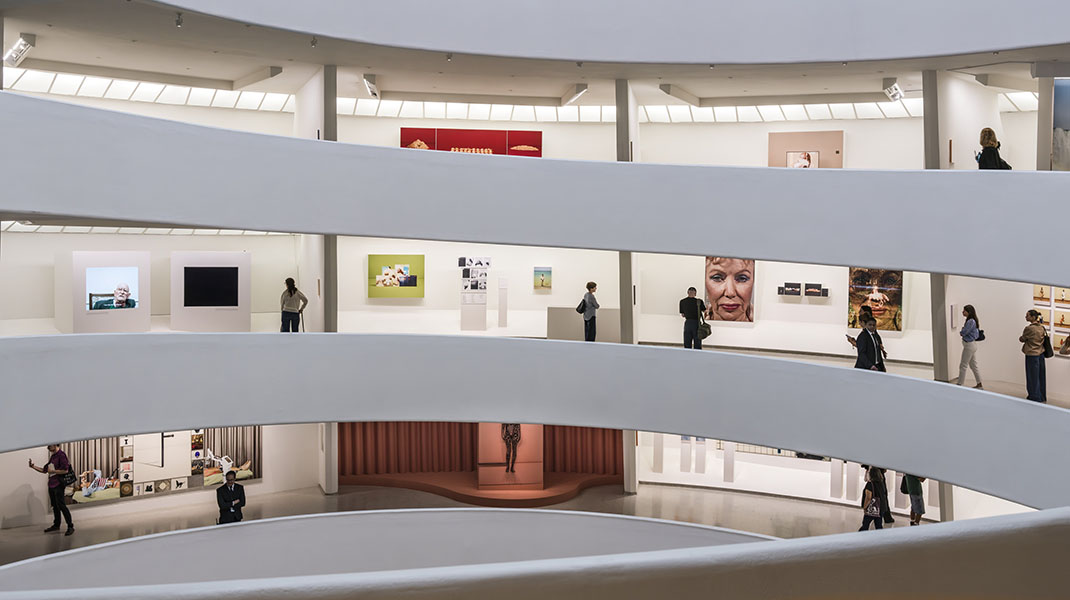
The premise has the pull of a thriller. Its scale is extravagantly New York. According to the exhibition announcement, this is the Guggenheim’s largest debut of new work and its first solo rotunda exhibition devoted to a photography-based artist. Nat Trotman organized it; former chief curator Nancy Spector initiated the project. A show about people who operate in the background has been given the whole spiral.
The museum’s installation photographs offer an intriguing view of the arrangement. Brightly colored works and faces occupy the galleries behind the white bands of Frank Lloyd Wright’s ramps. From across the rotunda, the building interrupts the pictures. One can see a great deal without being able to read very much. The architecture supplies its own demonstration of partial knowledge.
Among the agent’s assignments, as the museum’s published account describes them, was babysitting a model’s children at a Hilton while she helped lure Washington mayor Marion Barry into the 1990 crack cocaine sting. He also searched the wreckage of the American embassy bombing in Nairobi and eavesdropped on Soviet embassy employees. On assignment in Saudi Arabia, he took time to photograph a Flat Stanley for a friend’s child.
That last detail has the saving awkwardness of ordinary life. A person can be an instrument of foreign policy and still owe somebody a favor involving a paper doll. The exhibition’s premise allows these obligations to occupy the same biography. The small errand does not explain the large operation. It makes the man doing both harder to reduce to his badge.
In a September interview with W, Simon explained how she found him: his name appeared on an evidence receipt during her research. Their first meeting, at a Mexican restaurant in Maryland in November 2017, led to years of conversations. “He represents a middleman, someone who enacts a lot and touches so much without access to the entire picture,” she told the magazine.
Simon followed his cases into other lives. W describes her contact with Paul Ames, whose father, Aldrich Ames, was arrested for espionage in 1994. Paul was five when agents raided the family home. The exhibition pairs his portraits with examples of valuables confiscated by the government in other cases. Childhood and procedure meet in the same account, with very different ideas of what counts as a possession.
There is a considerable distance between understanding that an arrest was justified and understanding what it felt like to be the child in the house. Art can make room for the second question without pretending to overturn the first. Simon’s method gives the people around a case lives beyond their usefulness to its resolution.
She has been worrying at the authority of evidence for years. In The Innocents, made between 2000 and 2003, she photographed people who had served time for violent crimes they did not commit. Her account of that project traces how photographs, composites and identification procedures can alter an eyewitness’s memory. A picture introduced to establish the truth could help secure a false conviction.
The portraits returned the subjects to places that had acquired significance in their cases: an arrest location, an alibi site, the scene of a crime. Some had never been to that last place before. Photography could put them there at last, after a mistaken identification had already sent them to prison. The apparent simplicity of a person standing before a camera became exceedingly difficult to trust.
With An American Index of the Hidden and Unfamiliar, in 2007, Simon examined the privilege of access across government, science, medicine, entertainment and other domains. The subject was partly the boundary itself: who gets to look, who must ask and who can say no. The new exhibition brings a person who has worked on the authorized side of such boundaries into view.
Another man runs through it. Simon’s father worked for the United States government, living in Thailand and traveling widely before turning to manufacturing and selling arcade games. As the Guggenheim’s account of the accompanying book explains, she never learned his complete story. The exhibition announcement says his diagnosis of Alzheimer’s disease ended her hope of hearing it.
That knowledge gives the accumulation of records a private urgency. A daughter’s questions do not necessarily arrive when a father is ready to answer them. Later, the opportunity may have gone. Against the vast resources devoted to assembling an official account of events, the missing family story looks painfully modest. It can be just as irretrievable.
The show is dedicated to him. It also makes room for play: W describes a teak track along which visitors can send a billiard-like ball down the rotunda, a reference to his later trade. The descent turns cause and consequence into something one can set moving. The person who starts it does not determine every turn.
All of this has, inevitably, become a New York occasion. In an account published Thursday, Vogue reported on a Bottega Veneta celebration at the museum attended by Julianne Moore, Salman Rushdie and Marina Abramović. The subject of hidden power has found a conspicuous audience.
For the rest of us, the reason to follow the story is less social. The agent offers a way into events usually encountered as headlines and verdicts. Simon then follows the details that those accounts have little room to keep. A child, an errand, a father’s changing occupation: the things that make a life specific also make it resistant to an official summary.
America was a subject on which her father had supplied at least one answer. In the exhibition announcement, Simon recalls him calling it “the best story on earth, if you could find someone to tell it.”