
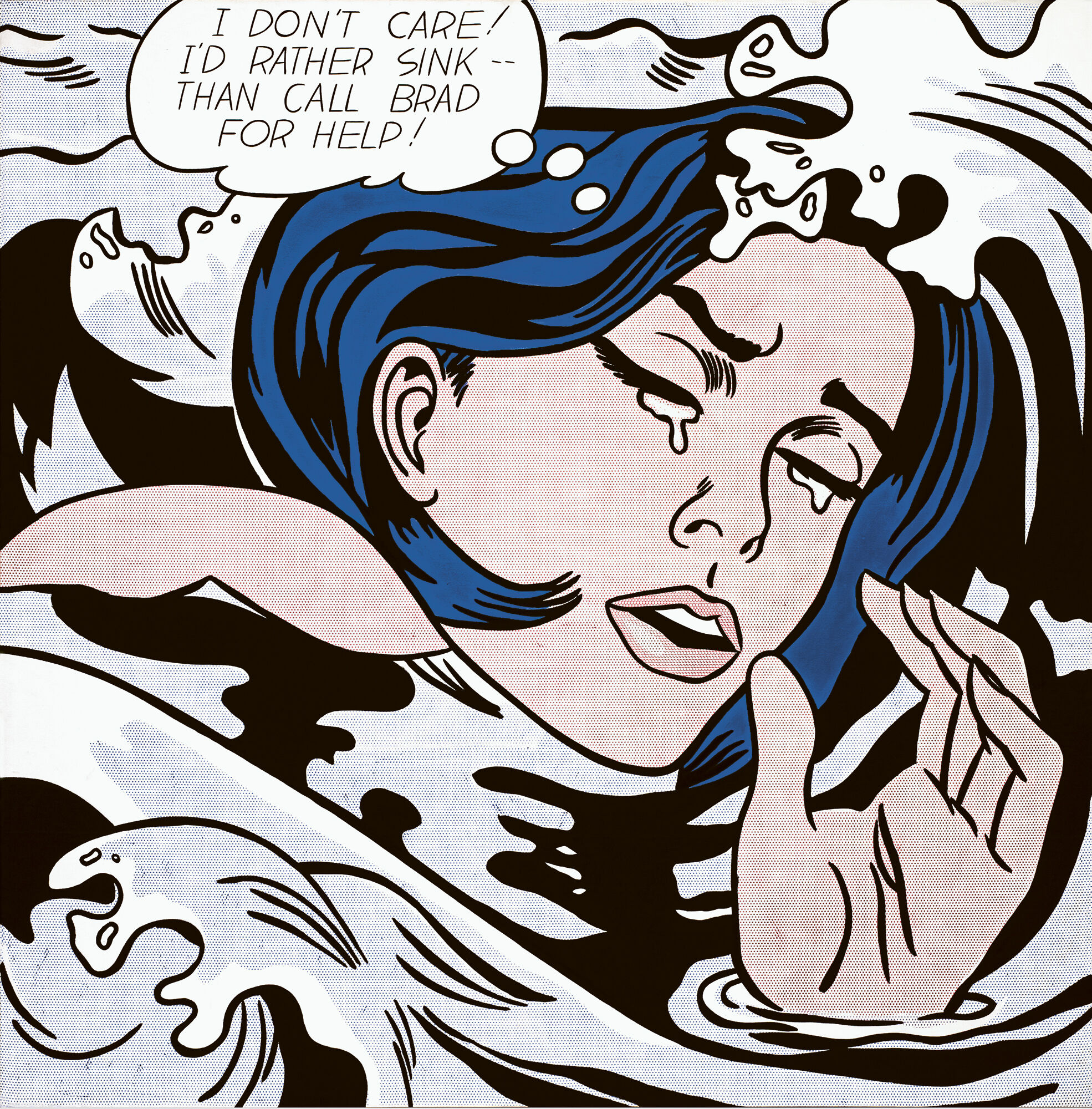
The woman in Roy Lichtenstein’s Drowning Girl would sooner perish than ask Brad for help, a position that makes Brad interesting without requiring him to appear.
Her blue hair moves with the water. A tear slips from a closed eye. The wave curls around her face with a flourish almost too agreeable for the emergency. One wants to know what Brad did. The painting has no intention of saying.
The picture is among the works in Roy Lichtenstein: Like New, which opened October 11 at the Whitney Museum of American Art. Organized by curator Meg Onli and artist Alex Da Corte, the exhibition is the first New York retrospective of Lichtenstein’s work since 1993. Its roughly 130 works offer plenty of occasions to reconsider the charge that has followed him into the museum: he copied other people’s pictures.
He did. The question is what happened in the copying.
MoMA identifies the source of Drowning Girl, painted in 1963, as an illustration by Tony Abruzzo in the 1962 DC romance comic Secret Hearts, number 83. Abruzzo’s page includes a boyfriend clinging to an overturned boat. Lichtenstein cut him out, cropped the scene around the woman and changed his name from Mal to Brad. He also shortened her complaint, removing a reference to a cramp.
A cramp gives her a physical predicament. Without it, the refusal becomes absolute. There is only the woman, the wave and her resolve to sink. Brad may be a cad; he may merely be available. Either possibility seems intolerable to her. Romantic humiliation has supplied its own emergency.
The absurdity does not quite extinguish the feeling. People do prefer suffering to making a particular telephone call. Lichtenstein grants this familiar stupidity a beautiful surface. The hair flows, the wave gathers, the face remains composed enough to belong in an advertisement. She is having a dreadful time in a picture that has everything under control.
Abruzzo deserves to keep his place in its history. His drawing supplied the woman, the water and the emotional situation. Calling the source “commercial imagery” can make a working artist disappear behind an abstraction. Somebody drew that cheek and devised that wave. A defense of Lichtenstein that requires us to overlook the original draftsman is a weak defense.
It is also unnecessary. The changes are visible. Lichtenstein stripped away the context in which the drawing performed its job, carrying a reader through a story. His woman cannot be rescued by the next panel. The canvas holds her in an interminable fit of pride.
That alteration depends partly on the art world’s arrangements. A comic offers its pleasures among other pages. A painting occupies a wall and asks to be considered separately. The museum supplies silence, space and the suspicion that anything receiving so much of either must deserve it. Looking at Lichtenstein, one becomes unusually conscious of the address.
The Whitney’s account of his technique stresses the labor behind the mechanical appearance: the outlines, flat colors and regular dots were meticulously made by hand. This is a peculiar sort of virtuosity. He worked to remove the evidence of expressive exertion. Even the distress has excellent manners.
The restraint gives the paintings their glamour and their chill. A tear is legible as a tear before it belongs to anybody. The woman’s hair has the handsome sweep of a design for hair. We recognize the feeling through a set of visual conventions, then find ourselves attending to the conventions. The emotion continues, a little embarrassed by the scrutiny.
The retrospective includes Look Mickey, Girl with Ball, Happy Tears, Little Big Painting and Artist’s Studio “The Dance.” Its reach across six decades, from early work to the 1990s, gives the comic paintings some company. The borrowing extended into art’s own repertoire. Lichtenstein’s subject could be a brushstroke as readily as a blonde.
The return of Greene Street Mural introduces a further complication. The Whitney has re-created the roughly 96-foot work by hand. Lichtenstein and his assistants painted the original in 1983 at Leo Castelli’s Greene Street gallery. According to the Roy Lichtenstein Foundation’s catalogue raisonné, it was covered over with the artist’s consent in January 1984 and fully destroyed in October 1988.
The surviving composition can be painted again; the original wall cannot be recovered. For an artist whose reputation rests so heavily on duplication, this seems a fitting afterlife. It also makes the reverence for the original object harder to sustain without qualification. Which part of the work have we come to see?
New York gets its own joke in Masterpiece. A woman assures a painter named Brad that the city will soon be clamoring for his work. The Whitney’s audio guide credits the source figures to comic artist Ted Galindo. Lichtenstein turns them into an advertisement for an artist’s future greatness, delivered by an obliging blonde. The painting on the easel is largely withheld from us. Her confidence will have to do.
The scene catches an appetite that New York has never had much trouble feeding. Artists want recognition; collectors want to have recognized them first. Masterpiece accommodates both desires while making them look faintly ridiculous. Lichtenstein, painting his way toward fame, had put himself within reach of the joke.
The question of who gets credit remains. Abruzzo’s contribution does not diminish because Lichtenstein’s painting is good. Nor does naming Abruzzo dispose of the painting. A museum ought to make the relationship available for inspection. The pleasure of these pictures survives knowing where they came from.
In Drowning Girl, it depends on that knowledge. We can see what was removed and feel the loss of the reassuring story around her. The wave has nowhere to go. Brad has been banished. The woman is left with a decision that, however foolish, is entirely hers.
In the Whitney’s published audio guide, Lichtenstein’s biographer Avis Berman describes the operation in five words: “He destroys the anecdote.”