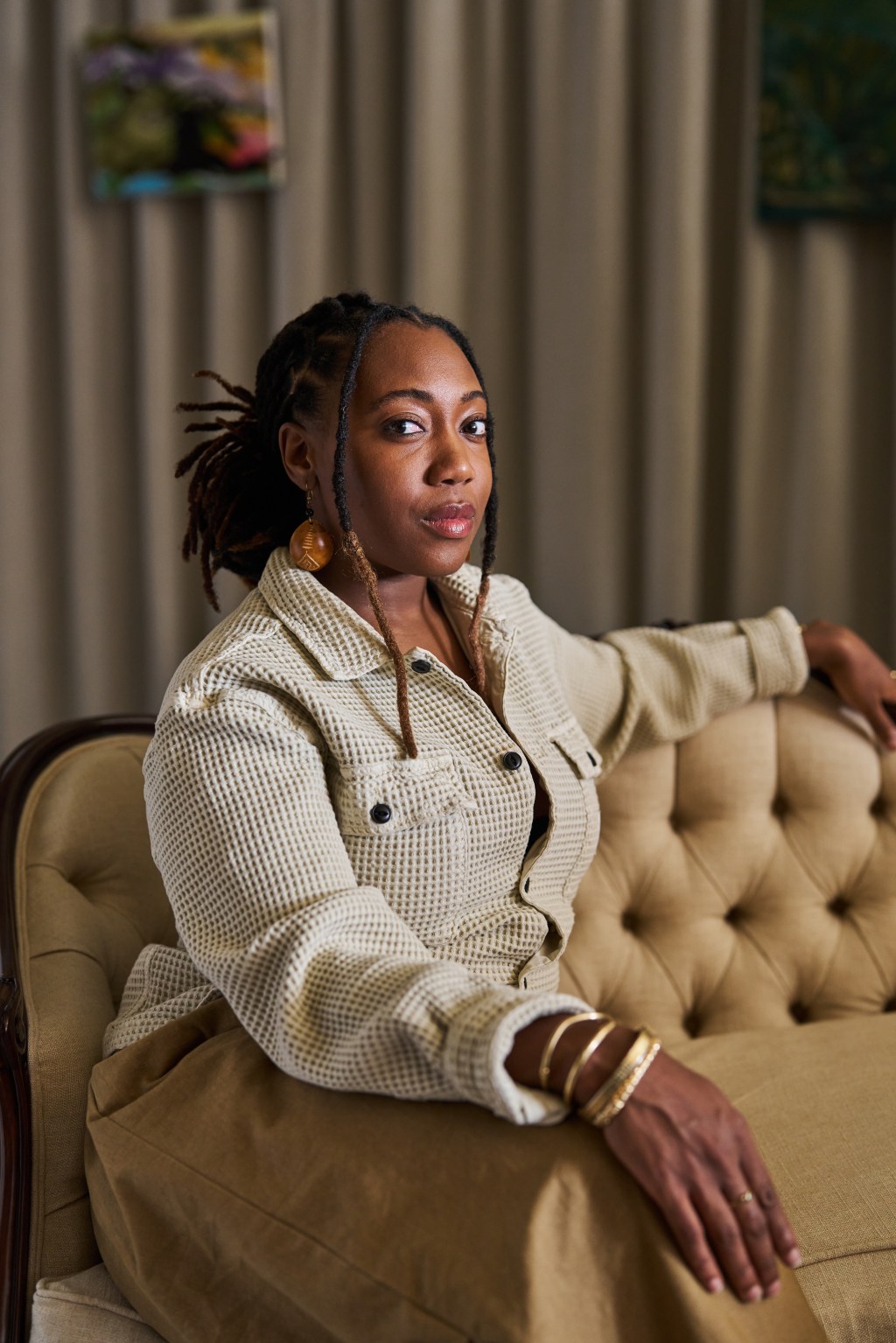
At 183 Christopher Street, a former farm event space has become the setting for a chef’s declaration of independence. Calabash, a new thirty-seat restaurant from Camari Mick, is at once a bakery, an Afro-Caribbean brasserie, and an attempt to make visible the traditions that have shaped her cooking. Its name comes from a vessel that has traveled through the African diaspora for centuries. Its menu takes a similarly expansive route.
Mick has spent much of her career making desserts for other people’s restaurants, including the Musket Room and Raf’s. She was named one of Food & Wine’s Best New Chefs in 2024, and has been a James Beard Award semifinalist four times. Those distinctions brought recognition, but Calabash, which began daytime service earlier this month and introduced dinner on October 9, offers something different: a chance to decide not just what goes on the plate but what sort of room surrounds it.
There are familiar ingredients put to unfamiliar purposes. Hoppin’ John, the rice-and-pea dish associated with the American South, becomes a dolma wrapped in collard greens. Jollof rice meets the crisp-bottomed Persian technique of tahdig beneath pork belly, green mango chow chow, and bitter greens. A daytime plate of suya steak with maduros revisits the conventions of steak frites; cornbread pancakes arrive with salted maple sabayon. This is not cooking that divides the world into neat culinary territories.
The ambition extends beyond dinner. Mick is working with chef de cuisine Tajeh Porter, formerly of Brooklyn’s Nura. The room, designed by Drummond Projects, features art selected with gallerist Cierra Britton, whose gallery has concentrated on women artists of color. The restaurant also plans a monthly pay-what-you-can dinner, with reservations made available to email subscribers. It is a small space carrying a rather large set of ideas about who a restaurant can serve.
One particularly revealing feature is the absence of alcohol. The house-fermented drinks and nonalcoholic pairings might look like a carefully engineered expression of the restaurant’s philosophy. In fact, Mick says, the program arose because the schedule for a liquor license did not match the opening timeline. What could have been a limitation became an occasion to experiment with fermentation, wellness, and African herbalism.
In an email interview with New York Hours, Mick discussed the freedoms of ownership, the persistence of savory flavors in her pastry work, and why a restaurant must appeal to more than the appetite. The exchange follows in full.
Three questions for Camari Mick
Calabash is your first solo restaurant. What did you want to build that you could not quite build inside somebody else’s restaurant?
Ownership and community were top things for me when I was planning to open Calabash. I wanted to see myself and my culture reflected in the restaurant. Being able to have control of the food from first bites to last sips means that I get to appeal to different audiences that might not have engaged with the other restaurants I’ve worked with.
You are best known for pastry. How has taking responsibility for an entire restaurant changed the way you think about dessert?
It actually hasn’t changed the way that I think about dessert, now that I think about it. I’ve always put savory applications into my desserts and experimented with savory flavors in pasty. My mom didn’t like sweet desserts so I’ve always kept that thought in the back of my head when I’m creating desserts. So really it’s been business as usual on the pastry front but the added benefit of flexing my creative muscles with multiple savory courses.
The room includes work by Black and brown women artists, and the beverage program is nonalcoholic. How important was it that Calabash express a point of view beyond the food?
Its extremely important that Calabash expresses this POV beyond the food, since as people we are not one dimensional. While I’m an artist on the plate, I think it’s important for all of your senses to be used during a fine dining experience, and that includes visually with different perspectives in the room including the the art and interior design. When it comes to the non alcoholic program, it was something unexpected that we had to pivot into. It’s essentially a permitting and timing thing. Calabash is a proof of concept — we took over the Heermance Farm event space on Christopher street (which they still own), so the process of getting a license didn’t align with the timeline needed to open the restaurant. It was a curveball that we took in stride and turned into an opportunity to get creative, especially with the house fermentation. I’m most excited about leaning into wellness and African herbalism with the mocktail program.
Calabash is at 183 Christopher Street in the West Village. Daytime service runs Thursday through Sunday; the five-course dinner is served Friday and Saturday evenings. Photographs by Gentl and Hyers, provided by Calabash.