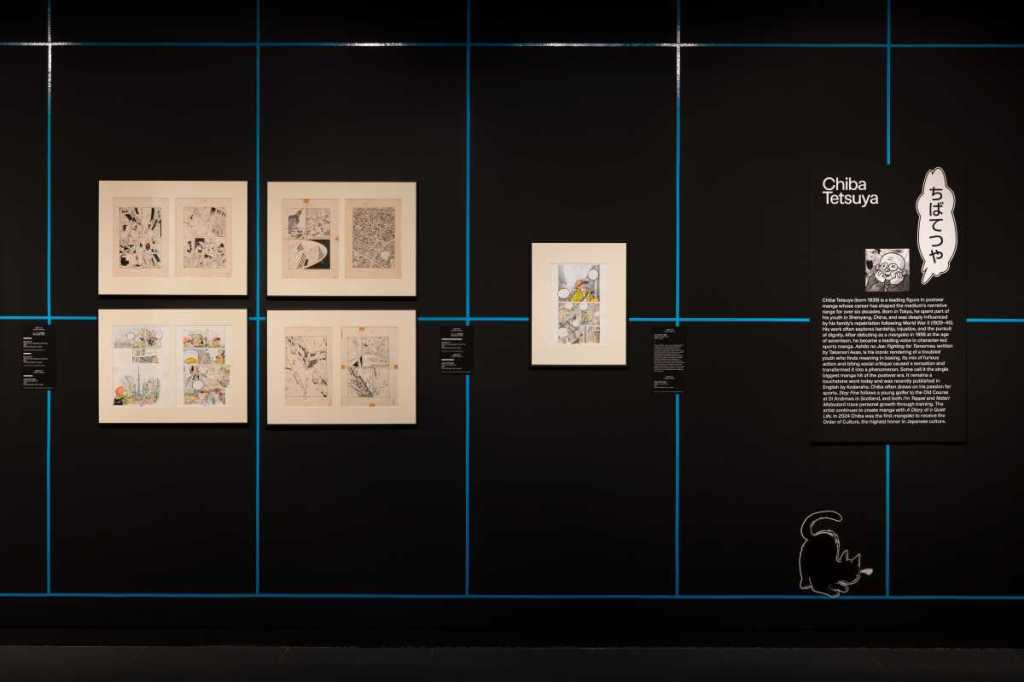
For most of its life, manga was meant to be held close: a book bent in the hand, pages turned quickly, pictures consumed in sequence. At the Brooklyn Museum, it has been pulled apart and enlarged into something closer to architecture.
Installation view of “Art of Manga” at the Brooklyn Museum. Photo: Paula Abreu Pita / amNewYork.
Art of Manga, which opened Saturday and runs through Jan. 31, brings more than 600 original drawings to Eastern Parkway for what the museum calls the first major exhibition in the Americas devoted to manga as an art form. The show arrives in New York after a run at the de Young in San Francisco, but the Brooklyn version has the useful advantage of landing in a city already accustomed to arguments about where popular culture ends and museum culture begins.
The exhibition’s central wager is simple: take away the reproduction, the cheaply printed book and the enormous industrial machinery that carries manga to millions of readers, and look instead at the marks themselves. On the original sheets are blue-pencil guides, corrections, pasted-over mistakes and shifts in ink that vanish in publication. The drawings stop behaving like images from a finished product and start looking like evidence of labor.
That transformation is helped by the installation. The galleries are dark, with bright lines dividing the walls into something resembling a gigantic comic grid. Framed pages appear inside those fields like panels that have somehow escaped their books. The exhibition is arranged to be read from right to left, following the direction of Japanese manga rather than asking the work to conform to the museum’s usual traffic patterns.
The artists represented span several generations and wildly different sensibilities: Chiba Tetsuya, Akatsuka Fujio, Rumiko Takahashi, Hirohiko Araki, Gengoroh Tagame, Fumi Yoshinaga and Eiichiro Oda among them. Their work includes the long-running worlds of One Piece, Inuyasha and JoJo’s Bizarre Adventure, along with quieter and more adult forms of storytelling. What joins them is less a house style than a grammar: speed, compression, repetition and an almost musical control over how the eye moves across a page.
Nicole Coolidge Rousmaniere, the show’s curator, has framed the exhibition as an argument for looking past manga’s familiarity. “Why wouldn’t we put manga on display?” she told amNewYork. The question sounds rhetorical, but museums have spent decades answering versions of it badly. Objects that arrive through commerce, fandom or mass circulation often have to be made strange before institutions are comfortable calling them art.
Manga presents an especially awkward case for that old hierarchy because its success is so enormous. It is at once an intimate drawing practice and a global entertainment system. A single page may begin with one artist’s pen and end as part of a franchise that includes television, film, games, clothing and toys. The more successful the image becomes, the easier it is to forget that somebody once sat at a desk and drew it.
Art of Manga reverses that process. A published page becomes an object again. A familiar character becomes a set of decisions: the pressure of a line, the placement of a speech balloon, the sudden white space around a face. For viewers who know the stories, there is the shock of encountering something they thought they knew in a physically different form. For those who do not, the show offers a way into manga that does not require several hundred volumes of prior knowledge.
The museum has placed a smaller exhibition beside it, Manga Before Manga: Japanese Art from the Collection, that pushes the story back more than 900 years. Twenty-one works trace earlier Japanese traditions of sequential imagery, exaggerated gesture and visualized speech. A 15th-century handscroll includes graphic devices that anticipate the speech bubble; Hokusai appears later in the story, before the word “manga” acquired anything like its present meaning.
The pairing is clever because it refuses the two easiest stories museums tell about popular art. Manga is neither presented as a sudden eruption of modern youth culture nor embalmed as the latest branch of an ancient tradition. It becomes something more unruly: an art form that absorbed centuries of visual habits, industrial printing, postwar popular culture and the particular inventions of individual artists.
The Brooklyn Museum has become unusually comfortable with these border disputes. Its exhibitions on David Bowie, Spike Lee and fashion have treated celebrity, design and popular culture not as guilty pleasures but as material worth taking seriously. Manga belongs naturally in that lineage. The museum is not discovering that millions of people care about it. It is asking what changes when a form designed for speed is made to stand still.
That may be the most interesting tension in the room. Manga depends on motion even when nothing physically moves. A figure lunges because of the lines around it; a pause lasts because a panel widens; a sound becomes visible through typography. Put those pages behind glass and the reader becomes a museumgoer, encouraged to linger over what was designed to propel the eye forward.
The result is not quite the elevation of manga into “fine art,” which would be the dullest possible outcome. It is something more useful: a chance to see the machinery of a familiar visual language before it disappears again into reproduction.
“Art of Manga” is on view through Jan. 31, 2027, at the Brooklyn Museum, 200 Eastern Parkway. Timed admission starts at $30 for adults. The museum is open Wednesday through Sunday.

