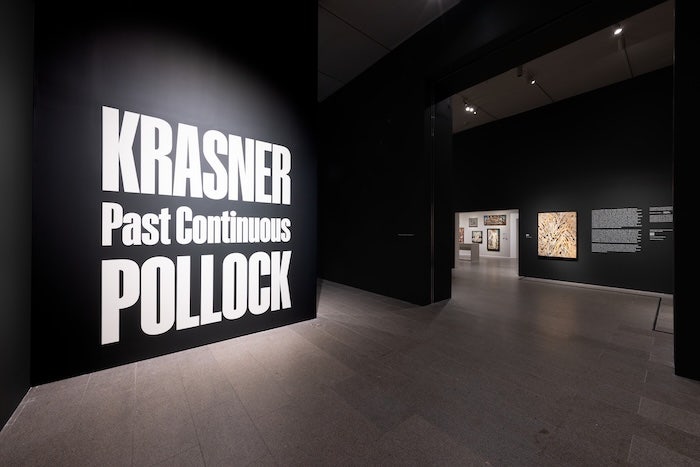
At the Metropolitan Museum of Art, Lee Krasner no longer enters the story through Jackson Pollock.
Krasner and Pollock: Past Continuous, which opened Sunday at the Met Fifth Avenue, places more than 120 paintings, works on paper and archival objects across the full sweep of both artists’ careers. The museum calls it the first major New York presentation devoted to either artist in more than 20 years and the first exhibition to examine their entire careers together, rather than treating Krasner chiefly as the wife, widow and guardian of Pollock’s reputation. The show runs through Jan. 31, 2027.
The premise sounds simple: two artists, two careers. In this case, that is almost a provocation. Pollock became one of the defining figures of postwar American painting, his dripped skeins of enamel turned into shorthand for Abstract Expressionism itself. Krasner spent decades fighting a more complicated battle, first for room to make her work and later for recognition that it belonged in the same history.
The Met’s curators, David Breslin and Brinda Kumar, have built the exhibition around that imbalance without turning it into a trial. In the museum’s announcement, Breslin described Krasner and Pollock as artistic equals whose different directions grew from shared terrain. The galleries move through 12 chapters, sometimes placing their work together and sometimes separating them, a structure that insists on influence without collapsing one artist into the other.
Krasner had a New York art life before Pollock entered it. A Brooklyn-born daughter of Jewish immigrants from what is now Ukraine, she studied at Cooper Union, the National Academy of Design and later with Hans Hofmann. A MoMA chronology records her exhibiting with American Abstract Artists in 1940, two years before she and Pollock appeared in the same John Graham-organized group show. She was already embedded in the city’s modernist circles, and MoMA notes that she later introduced Pollock to artists, dealers and critics who would become important to his career.
They married in 1945 and moved to Springs, on Long Island’s East End, where the mythology of Pollock’s great breakthrough took physical form. He eventually worked in the barn, a space large enough for the unstretched canvases he laid on the floor and attacked from all sides. The Met dates the most concentrated period of his drip technique from 1946 to 1951. Krasner worked in a small upstairs bedroom, where she made her densely worked Little Images, paintings whose scale was partly dictated by the room.
That domestic arrangement has become one of the clearest examples of the practical inequalities buried inside the legend of the heroic New York painter. Yet Krasner’s work did not simply wait for permission to grow. Her practice kept changing. She moved through tight, all-over abstractions, collage and assemblage, often cutting up earlier canvases, including discarded pieces by Pollock, and recombining them into something newly tense and deliberate. MoMA describes reinvention as the through line of a career that moved restlessly across more than five decades.
The Met makes that restlessness visible by setting it against Pollock’s more compressed arc. His best-known work arrived with extraordinary force and in a relatively short period. Krasner’s career kept opening after his closed. When Pollock died in a car crash in 1956, she was in Europe. The following year, according to MoMA’s account of her career, she moved into the barn studio he had used. Her scale expanded with the space.
The change was not merely architectural. Works such as The Seasons from 1957 and the later Umber paintings pushed into a larger, more bodily register. The Met’s own account of Night Creatures notes that Krasner painted at night during a period of insomnia, working largely in black, white and earth tones because she did not want to handle color without daylight. The story is not one of a suppressed painter suddenly discovering ambition. It is one of an artist whose circumstances, grief and available space altered the scale on which ambition could operate.
Krasner also became one of the principal stewards of Pollock’s legacy. MoMA credits her with helping to build its major Pollock holdings, and the Met notes that she gave the museum drawings and works on paper during her lifetime. That caretaking role was real, but it helped produce a historical irony: the more effectively she protected Pollock’s place in the canon, the easier it became for museums and critics to describe her in relation to him.
Past Continuous is designed to reverse that habit without pretending the relationship did not matter. Its title comes from a 1976 Krasner painting. The phrase is apt because the show keeps returning to the way the past remains active in later work. Pollock revisited earlier motifs near the end of his life. Krasner spent the 1960s and 1970s returning to, cutting apart and transforming forms she had already made, while continuing her dialogue with artists including Matisse, Mondrian and Picasso.
The museum has its own history inside this story. Pollock showed a painting at the Met in 1943, then became part of the group later known as the Irascibles, artists who protested the museum’s attitude toward contemporary American art. The Met acquired his monumental Autumn Rhythm: Number 30, 1950 not long after his death. Krasner gave works to the collection, and her memorial service was held at the museum in 1984. Despite those connections, the Met says this is its first major exhibition devoted to either artist.
That delay gives the show its charge. The familiar version of postwar art history has often been arranged around breakthrough men and supporting women, a structure so durable that simply putting two careers on equal footing can still feel radical. Here, Pollock does not need to be made smaller for Krasner to become larger. His drip paintings remain astonishingly consequential. What changes is the grammar around them.
The result is a different kind of double portrait. One career burns hot and brief, the other keeps changing for nearly three more decades. One artist became famous enough to eclipse the room around him; the other kept working until the room finally widened. At the Met, they meet again, not as myth and footnote, but as two painters whose histories are easier to understand once neither is forced to stand behind the other.
Krasner and Pollock: Past Continuous is on view through Jan. 31, 2027, at the Metropolitan Museum of Art, 1000 Fifth Avenue. Featured image: Installation view of Krasner and Pollock: Past Continuous at The Metropolitan Museum of Art. © The Metropolitan Museum of Art.

