Billy Crystal has spent much of his career turning memory into comedy. In 860, which began Broadway previews Thursday night at the Imperial Theatre, the number itself is the memory: the street address of the Pacific Palisades house where he and his family lived for 46 years before it was destroyed in the 2025 fire.
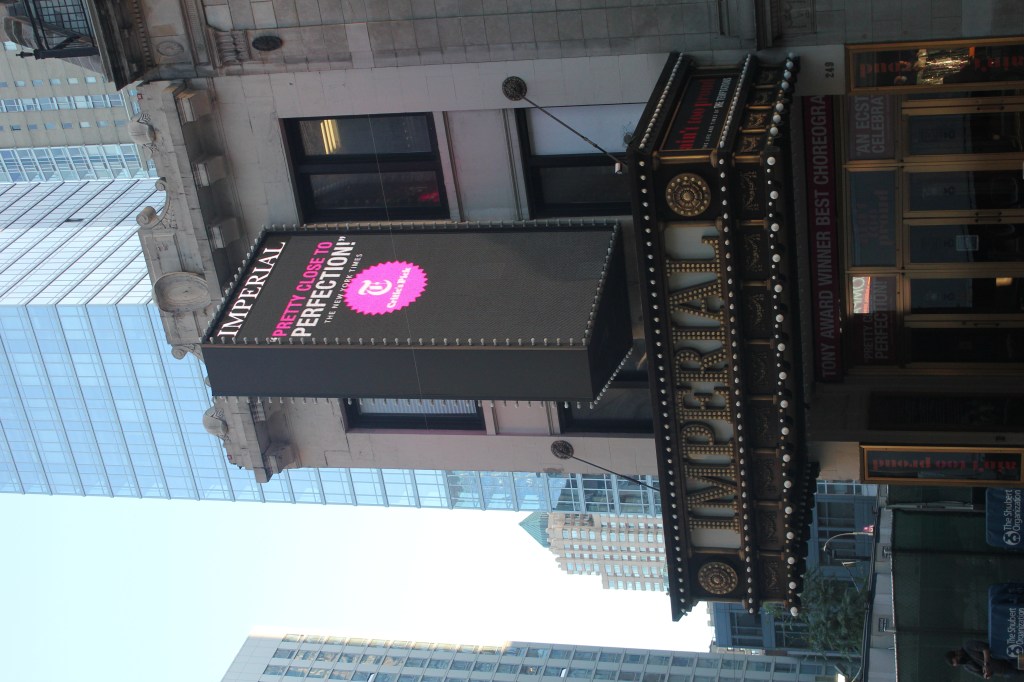
The Imperial Theatre on West 45th Street, photographed in October 2021. Photo: Epicgenius / Wikimedia Commons, CC BY-SA 4.0.
The new solo show arrives on Broadway less as a conventional comeback than as a return to a form Crystal has made distinctly his own. He wrote and performs 860, with Scott Ellis directing, in a limited engagement that opens officially on Oct. 21 and is scheduled to run through Jan. 3. The Broadway League lists the running time at 100 minutes, without an intermission.
Crystal has described the project as a companion piece to 700 Sundays, his 2004 autobiographical Broadway debut. That earlier show looked backward toward his childhood on Long Island and the death of his father when Crystal was 15. It won the 2005 Tony Award for best special theatrical event, returned to Broadway in 2013 and established a useful theatrical grammar for Crystal: one man, a roomful of remembered people and the knowledge that a family story can grow larger without becoming less particular.
860 begins from a different kind of absence. While the Palisades fire was unfolding around his home, Crystal told Broadway Direct, he began shooting video on his phone and making notes as a diary. Later, he saw that material as the beginning of another stage work. If 700 Sundays was about the house in which a comedian was formed, 860 is about the house where the life that followed actually happened.
That distinction gives the new show a striking premise. Crystal and his wife, Janice, bought what he has described as a modest, run-down three-bedroom stucco house and altered it over the decades as their family and his career expanded. The details he has chosen to discuss publicly are not grand ones. A tree that had to be removed became a staircase railing. His mother’s tomato-shaped pincushion survived in memory. So did a box of tiny matches from his parents’ wedding, one of which he would use each year to light a memorial candle on their anniversary.
Objects like those are usually too ordinary to qualify as heirlooms until they are gone. That is one of the more intriguing ideas hovering around 860 before its official opening: a house as an accidental archive, holding decades of private evidence that no one thinks to catalogue while it is still there.
The production literalizes that archive. Scenic designer Scott Pask has centered the staging on Crystal’s home office, where much of his writing was done and where friends and colleagues visited. Crystal told Broadway Direct that he unexpectedly found a 360-degree photograph of the room, showing every wall. Video designers Hana S. Kim and Kylee Loera are also using footage Crystal shot around the time of the fire. Marc Shaiman provides original music and adaptations; Jen Schriever designed the lighting and Dan Moses Schreier the sound, according to Broadway.com.
The result, at least as Crystal has described it before opening night, is not an attempt to rebuild the lost house board by board. It is closer to a reconstruction of what memory does with a room after the room disappears. Walls become prompts. Objects acquire biographies. An address stops being a location and becomes a container.
Broadway is an apt place for the experiment because Crystal has already used the stage to collapse public and private versions of himself. His film career includes When Harry Met Sally…, City Slickers and Analyze This; he was a Saturday Night Live cast member and has hosted the Academy Awards nine times. Yet his most durable Broadway success came from standing largely alone and talking about family. 700 Sundays played 163 performances in its original run and broke box-office records for a nonmusical at the Broadhurst Theatre before winning its Tony.
There is another bit of Broadway circularity in the choice of the Imperial. Crystal performed the 2013 return engagement of 700 Sundays there. He has also recalled visiting the theater as a teenager after the death of his father, when he and his mother saw Zero Mostel in Fiddler on the Roof. Decades later, during the return of 700 Sundays, Crystal discovered that his dressing room had been Mostel’s. The Imperial, in other words, already belongs to the personal geography from which Crystal builds his stories.
He was last on Broadway in 2022 in Mr. Saturday Night, the musical adaptation of his 1992 film, which brought him Tony nominations as both performer and co-writer. 860 strips the machinery back again. The Broadway League identifies Crystal as the sole star and writer. Whatever theatrical technology surrounds him, the essential proposition remains unusually simple: an audience, a storyteller and a set of memories that have become more valuable because their physical setting is gone.
Crystal has been careful to frame the show as something other than an evening of catastrophe. In announcing 860, he called it “a joyous and heartfelt visit,” and in a recent interview said he wanted audiences to feel as though he were inviting them into the house. That choice matters. Grief is present in the premise, but the show’s advertised subjects also include friendship, luck, love and laughter.
It would be premature to say how successfully 860 balances them; the production does not officially open for nearly three weeks. But its timing gives Broadway a rare kind of new work from a famous performer: not a revival, not an adaptation of a familiar screen title, and not a victory lap. It is a newly made piece about what remains when the scenery of an ordinary life disappears.
For Crystal, that scenery now stands, in altered form, on West 45th Street. A Los Angeles address has become a Broadway title. The house is gone. For 100 minutes at the Imperial, the invitation is to go inside anyway.

