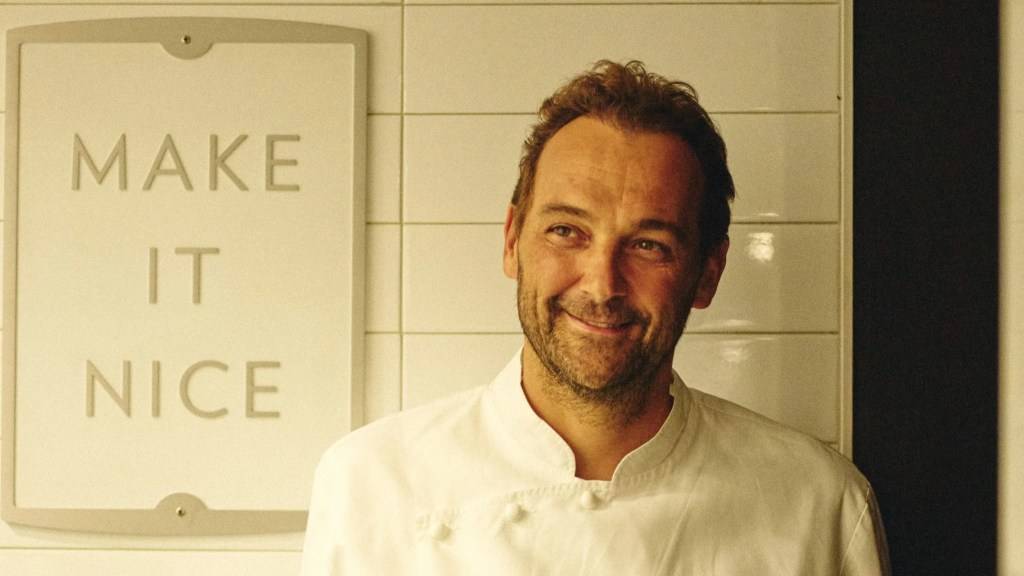
For twenty years, Daniel Humm has been associated with one of the grandest dining rooms in New York; now he is preparing to see what happens when he comes down to street level.
This fall, Humm is opening HUMM at 435 Hudson St. in the West Village, in the former En Japanese Brasserie space, his first restaurant to carry his own name outside Eleven Madison Park. The new place is being built around an open kitchen and a wood-fired hearth, with an à la carte menu, shareable plates, cocktails and wine, a striking change of scale for a chef whose reputation was made on long tasting menus, choreographed service and the peculiar pressure of running a restaurant expected to behave like an institution.
Going downtown
The distance from Eleven Madison Park to 435 Hudson Street is barely two miles, but in restaurant terms it can feel like a change of country. At Madison Square, the approach to dinner begins before the first plate arrives. The room is high-ceilinged and formal, the service closely calibrated, the occasion built into the address. A meal there asks diners to surrender several hours and a considerable amount of money to the restaurant’s idea of how an evening should unfold.
On Hudson Street, the ambition is different. HUMM is expected to operate à la carte rather than around a set tasting menu. Daniel Humm Hospitality has described the cooking in job postings as centered on a wood-fired hearth and an open kitchen, with “a mix of shareable plates and individual dishes” and a substantial cocktail and wine program. The group has named Dmitri Magi, a longtime Humm lieutenant, as managing partner and executive chef of the new restaurant.
That sounds straightforward until you consider who is trying it. Humm is not a chef looking for his first room. He is a chef who has spent much of his adult life turning one room into a symbol of American fine dining, then repeatedly taking it apart.
He arrived at Eleven Madison Park in 2006, when the restaurant was still part of Danny Meyer’s Union Square Hospitality Group. Born in Switzerland, he had already earned a Michelin star at 24 and spent several years cooking in California. In New York, he and former business partner Will Guidara pushed Eleven Madison Park through a long transformation from an ambitious restaurant into a destination of nearly theatrical polish. They bought the restaurant from Meyer in 2011. The Michelin Guide awarded it three stars the following year. In 2017, the World’s 50 Best Restaurants list named it No. 1.
For a certain period in New York dining, Humm became inseparable from the idea of the tasting menu as performance. The dishes changed, but the larger trick was often one of control. Dinner could include tableside gestures, carefully timed surprises and food that seemed engineered to arrive with a story attached to it. The restaurant’s famous carrot tartare, passed through a hand-cranked meat grinder at the table, was as much a piece of misdirection as a vegetable dish.
Success did not make the restaurant more stable. It made reinvention part of the job.
Changing scale
The pandemic produced the most radical change. With the dining room closed, Eleven Madison Park became a commissary kitchen working with Rethink Food, the nonprofit Humm co-founded. The restaurant says its team prepared more than a million meals for frontline workers and New Yorkers facing food insecurity. When the dining room reopened in 2021, Humm made another break with the past and announced that the menu would be entirely plant based.
The decision was greeted with the kind of attention usually reserved for an election result or a celebrity divorce. There were arguments about luxury, vegetables, climate, protein and whether fine dining had become too interested in declaring its virtue. Some diners embraced the change. Others regarded it as an expensive exercise in denial. The Michelin Guide kept the restaurant at three stars, making Eleven Madison Park the first plant-based restaurant to hold that distinction.
Then Humm changed course again. In 2025, Eleven Madison Park announced that selected animal proteins would return as options for certain courses, while plant-forward cooking would remain central to the restaurant. “If we stopped changing, we would stop being the restaurant that we are,” Humm told 50 Best earlier this year.
The line is useful because it explains both the durability and the restlessness. Plenty of chefs spend decades defending the thing that made them famous. Humm has spent much of the last decade testing how much of that thing he can discard without losing the restaurant underneath it.
HUMM represents a different test. Instead of changing the rules inside Eleven Madison Park, he is leaving its architecture behind.
The West Village is an almost comically suitable place for such an experiment. The neighborhood has become a refuge for restaurants that want to look casual while operating with serious machinery behind them. Tiny rooms command impossible reservations. Bars behave like dining rooms. Dining rooms behave like bars. Chefs with national reputations open places whose chief luxury is that they appear not to be trying very hard.
At 435 Hudson, Humm is taking over the former home of En Japanese Brasserie, a restaurant that lasted nearly two decades in a part of Manhattan where longevity has become a minor miracle. The address sits between Leroy and Morton streets, in the quieter southern stretch of the neighborhood, away from the crush around Bleecker but close enough to absorb the West Village’s endless stream of people looking for somewhere that feels both discovered and already famous.
The hearth
The wood fire may prove to be the restaurant’s most important piece of equipment, not because New York lacks restaurants built around burning logs but because it suggests a shift in Humm’s vocabulary. Eleven Madison Park has long been associated with refinement, reduction and an almost obsessive removal of visual noise. Fire is less obedient. It blackens, smokes and changes with the weather, the wood and the cook tending it.
That does not mean HUMM will be rustic. Nothing in Humm’s recent work suggests an interest in pretending precision has disappeared. The design is being developed with French architect and designer Pierre Yovanovitch, who also worked on Clemente Bar, Humm’s art-filled cocktail lounge above Eleven Madison Park. Francesco Clemente, the Italian-born artist whose paintings gave that bar its name and visual identity, is also involved in the new project. Recent reports have described a broader art program that includes major contemporary work.
Art has become increasingly important to the way Humm frames restaurants. At Clemente Bar, painting is not decoration added after the fact. It is part of the premise. At Eleven Madison Park, the dining room has long treated objects, plates, flowers, light and spacing as part of the meal’s argument. HUMM appears to be extending that instinct into a room that is supposed to feel looser.
The harder question is what “casual” means when Daniel Humm uses the word. Eleven Madison Park’s current full tasting menu begins in the hundreds of dollars per person. Its brigade, wine program and service culture are designed around the expectations that come with three Michelin stars. A restaurant can be casual by comparison and still be a very serious place to eat dinner.
That tension may be the point. The most interesting version of HUMM would not be Eleven Madison Park with shorter menus and louder music. It would be a restaurant that forces Humm to decide which habits are essential once ceremony is no longer doing so much of the work.
After Eleven
There is a biographical element here that is difficult to ignore. Humm turned 50 this month. He has spent roughly two decades at Eleven Madison Park, an unusually long tenure in a profession where chefs often build careers by opening one place after another. For all the changes inside the restaurant, his public identity has remained attached to the same address on Madison Avenue.
He has expanded, certainly. The NoMad became a major restaurant and hotel project before the partnership behind it dissolved. Clemente Bar opened upstairs from Eleven Madison Park in 2024. Humm has written cookbooks, developed a home brand, backed a farm and, more recently, co-founded Riff, a line of boxed pasta and noodle kits meant for weeknight cooking. But Eleven Madison Park has remained the center of gravity.
HUMM is different because the chef’s name is not hidden behind a concept. It is the concept.
Putting your own surname on a restaurant is an old-fashioned act, almost quaint in an era of hospitality groups and brand names designed to be replicated. It also raises the stakes. If Eleven Madison Park is allowed to be an institution with its own history, HUMM arrives as a more direct statement about what its founder wants now.
There are hints in the way he has talked about his career lately. In interviews, Humm has described becoming less interested in winning for its own sake. He has spoken about purpose, sustainability and the emptiness he felt after Eleven Madison Park accumulated the prizes he had once chased. In a 2025 interview with Bon Appétit, he recalled reaching the top of the World’s 50 Best list and realizing that the accomplishment had not answered the larger question of what the restaurant was for.
Restaurants are bad places to resolve existential questions. They are expensive, fragile businesses in which a broken dishwasher can destroy the mood more efficiently than a philosophical crisis. Perhaps that is why the new place is intriguing. HUMM does not sound like a manifesto. It sounds like a restaurant.
There will be plates to share, individual dishes for people who do not want to share, cocktails, bottles of wine and a fire burning in the kitchen. Diners will be able to choose what they order rather than submit to a predetermined sequence. The chef who became famous for orchestrating dinner will have to leave more of the evening in other people’s hands.
Neighborhood test
That may sound like a modest development, but modesty has become one of the more complicated aspirations in expensive New York restaurants. The West Village is full of dining rooms designed to suggest that nothing particularly elaborate is happening even as reservation systems fill weeks ahead and armies of cooks work behind the scenes. Ease, in this part of Manhattan, is often the most labor-intensive effect of all.
Humm will arrive with advantages few neighborhood restaurateurs possess. His name generates attention before a menu is released. His hospitality group already has a deep bench. The new restaurant’s executive chef, Magi, has worked within Humm’s orbit for years. The wine, service and design programs will not be starting from zero.
Those advantages create their own problem. A neighborhood restaurant has to become part of somebody’s ordinary life. It needs regulars, last-minute drinks, a dish people order without discussing its conceptual framework. It has to survive the Tuesday-night test.
Eleven Madison Park has spent years trying to make special occasions feel singular. HUMM will have to figure out whether repetition can be its own form of luxury.
The timing is also interesting. New York is in the middle of another cycle of high-profile restaurant openings, including new projects from Daniel Boulud, Andy Baraghani, Camari Mick and Thomas Straker. The city’s dining culture has tilted away from some of the grand tasting-menu temples that defined an earlier era and toward smaller, more flexible rooms where the line between dinner and going out has blurred.
Humm helped define the era that came before. Now he is opening a restaurant shaped by the one that followed it.
There is an appealing reversal in that. For years, younger chefs studied Eleven Madison Park for lessons in refinement, hospitality and control. A generation later, one of the chefs who perfected that system is opening a restaurant that borrows some of its energy from the looser city that grew around it.
The question is not whether HUMM will be casual enough. Casualness is mostly theater anyway. The more interesting question is whether Humm can make a restaurant in which his enormous reputation stops being the main event once dinner begins.
At 435 Hudson Street, the fire will be visible. So will the cooks. For a chef who has spent twenty years mastering what happens behind the curtain, that seems like a useful place to start.
HUMM, 435 Hudson St., West Village. The restaurant is expected to open this fall.

