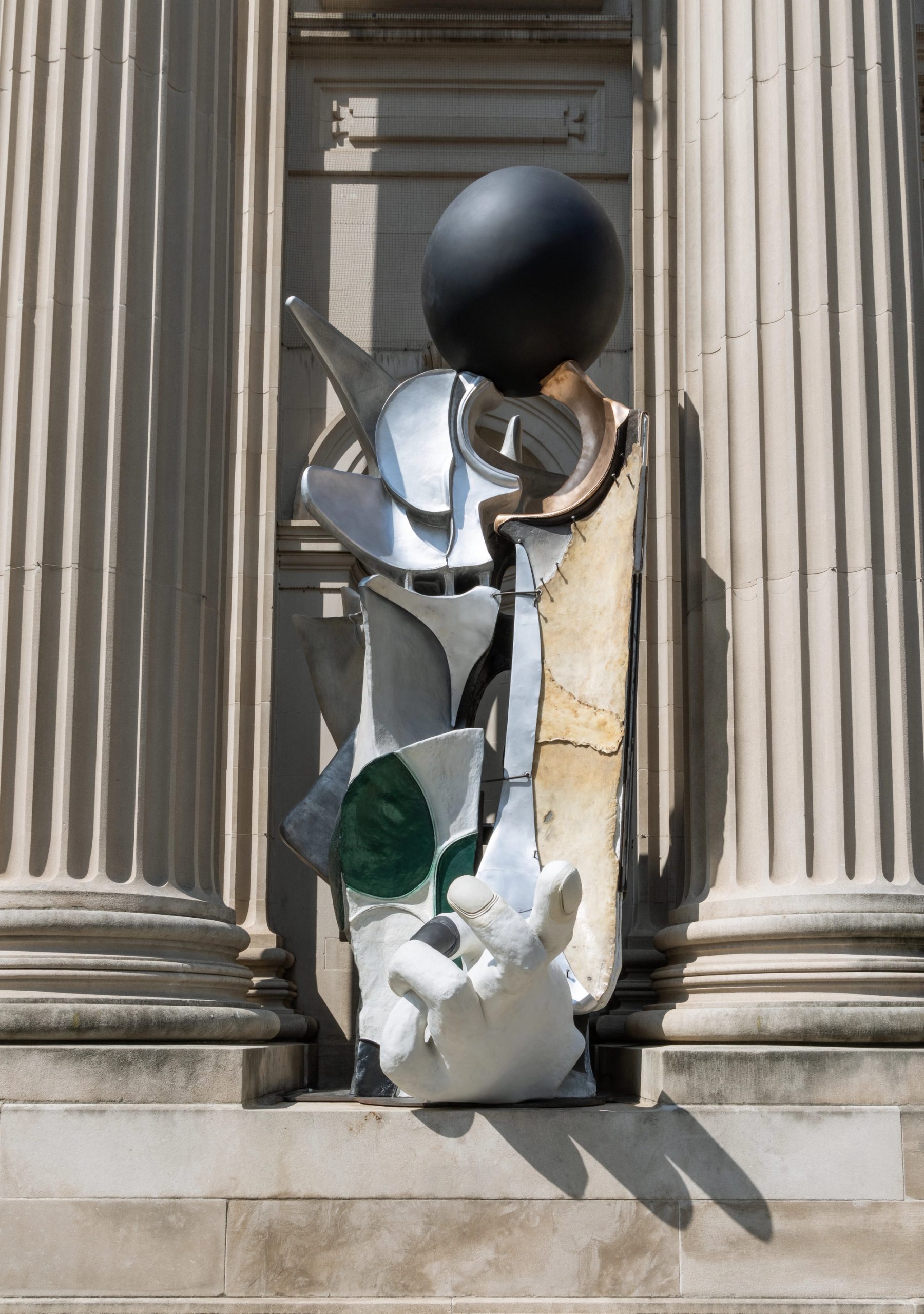
Four strange new figures now occupy the Metropolitan Museum of Art’s unfinished Fifth Avenue niches, looming over the front steps like artifacts from a civilization that has not yet arrived.
The works make up Speculation, a new façade commission by the Beijing-based artist Liu Wei. Unveiled on September 17, the installation is Liu’s first major presentation in the United States and The Met’s first commissioned project by an artist from China since 2006.
Bodies in pieces
At first glance, the sculptures appear metallic and almost mechanical. Look longer and they begin to suggest hands, limbs, ruined monuments and architectural fragments compressed together. The four works mix fiberglass composite, steel, aluminum alloy, bronze, chain, polyurethane paint and, in one case, bovine rawhide.
The human hand recurs throughout the group. It gives the sculptures an unnerving familiarity while keeping them just beyond recognition. Liu has long worked by taking forms from cities, bodies and historical architecture and reassembling them into objects that seem caught between construction and collapse.
That tension is particularly effective here. The Met’s façade is grand but visibly unfinished, with four empty niches built into Richard Morris Hunt’s Beaux-Arts design. Liu fills those spaces without pretending to complete the building. His sculptures instead make incompleteness the subject.
Constants and change
Each sculpture is named for a fundamental constant in physics: lambda, gravitational constant G, the speed of light c and Planck’s constant h. The scientific titles promise order. The works themselves look unstable, provisional and roughly sutured together.
The contradiction suits an artist whose career has unfolded alongside China’s rapid urban and economic transformation. Liu emerged in the late 1990s among artists seeking to define conceptual art on their own terms. Across painting, photography, video and monumental installation, he has repeatedly treated the modern city as both material and condition.
Speculation also arrives as The Met begins a transformation of its own. The museum recently broke ground on the Tang Wing for modern and contemporary art, designed by Frida Escobedo and scheduled to open in 2030. Until then, the façade commissions remain the institution’s most public statement about contemporary art.
“Our reality is a puzzle built by time. I want to answer it with a puzzle.”
Liu Wei, in The Met’s announcement
Plan your visit
- Where: The Met Fifth Avenue façade, 1000 Fifth Avenue
- Dates: September 17, 2026 through June 8, 2027
- Admission: The outdoor installation is visible from Fifth Avenue
- Related event: An Evening with Liu Wei, September 22 at 6:30 p.m.
Sources: The Metropolitan Museum of Art press release and exhibition page.
Why the façade matters
The Fifth Avenue façade is an unusually unforgiving exhibition space. Unlike a gallery, it offers no neutral white wall and no controlled route through the work. The sculptures have to compete with traffic, weather, the museum’s monumental stairs and one of the most recognizable cultural buildings in New York. They also meet people who may have no intention of entering the museum. That makes the commission public art in the most literal sense.
Liu’s forms benefit from that exposure. From a distance they read as silhouettes lodged in the architecture. Up close, their surfaces and mismatched materials complicate the first impression. The works can suggest body parts without settling into figures, and machinery without behaving like machines. Their scale is monumental, but their fragmented construction keeps them from feeling triumphant.
The placement also changes a familiar New York ritual. The Met steps usually turn visitors outward, toward Fifth Avenue and Central Park. The façade commission asks them to look back at the building. The empty niches, long treated as an architectural curiosity, become active frames. What once looked unfinished becomes available.
That is a useful way to approach Speculation: not as decoration added to the museum but as an argument with the building. Hunt’s façade projects permanence, symmetry and institutional authority. Liu answers with objects that look assembled, interrupted and subject to change. The scientific names add another layer. Constants are supposed to describe stable features of the universe, while the sculptures themselves appear anything but stable.
For a museum expanding its modern and contemporary program, the contrast is hard to miss. The façade gives The Met a place to put contemporary work directly into the daily life of the avenue, before a ticket, a security line or a curatorial explanation intervenes. You can encounter the sculptures on the way to work, from a bus window or while crossing the park.
The best time to see them may be twice. In daylight, the materials and architecture are easiest to read. Return later, when shadows flatten some details and exaggerate others, and the four forms become stranger. The museum closes. The façade does not.

