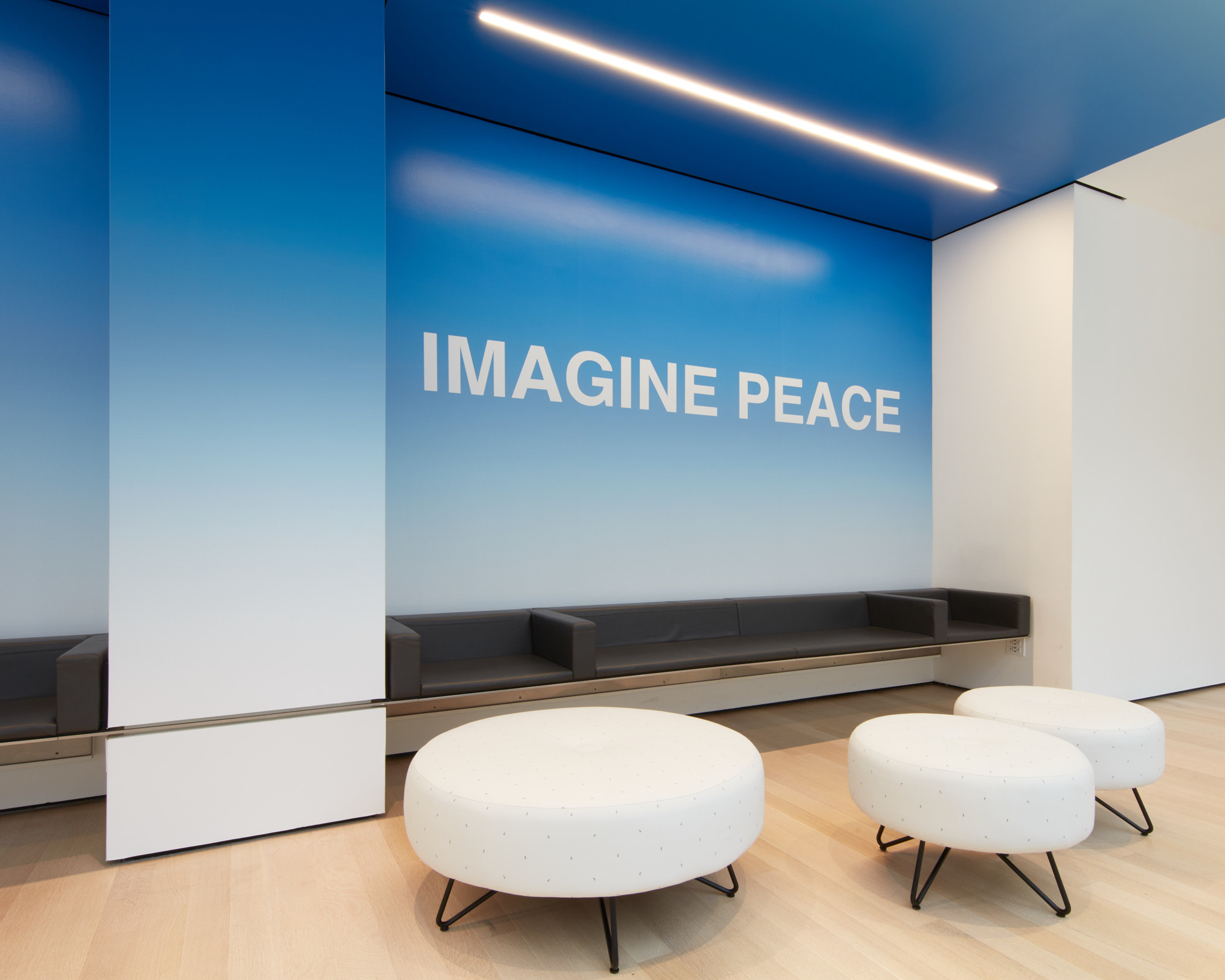
Two words occupy MoMA’s first floor this fall: IMAGINE PEACE. They read less like a title than an instruction, and that directness is precisely the point.
The installation, which opened September 3 and remains on view through spring 2027, extends Yoko Ono’s decades-long practice of turning concise language into public action. MoMA describes it as both an artwork and an invitation: a message designed to move beyond the museum walls and into ordinary life.
Words in public
Ono and John Lennon launched WAR IS OVER! (if you want it) in 1969, placing the phrase on billboards and in newspapers during the Vietnam War. Ono has returned to that method repeatedly, circulating messages through postcards, clothing, advertisements and digital platforms. The medium changes; the language remains deliberately plain.
At MoMA, the work occupies the museum’s most public interior threshold. Visitors do not need to hunt through galleries or decipher a wall label before encountering it. The phrase meets them upon arrival, temporarily converting the lobby from a place of circulation into a place of proposition.
The installation also continues a long relationship between the artist and the museum. MoMA presented Ono’s PEACE is POWER in 2019, and the current work coincides with a related installation planned for the new Terminal 6 at John F. Kennedy International Airport.
“Imagining is something that we can all do, even when we have different opinions about how to get there.”
Yoko Ono, quoted by MoMA
Plan your visit
- Where: MoMA, 11 West 53rd Street, Floor 1
- Dates: September 3, 2026 through spring 2027
- Hours: Check MoMA’s daily visitor information before going
Source: The Museum of Modern Art.
An instruction, not a slogan
The economy of Ono’s language is easy to underestimate. “Imagine peace” contains no explanation of what peace requires, who is responsible for it or what political program should follow. The work delegates that labor to the viewer. Its simplicity is not the absence of content so much as a refusal to complete the thought on someone else’s behalf.
That approach runs through Ono’s art. Instructions have long allowed her to make the audience a participant rather than a spectator. A sentence can describe an impossible action, invite a private mental image or ask a person to perform something ordinary with unusual attention. The artwork occurs partly in the gap between the words and whatever the reader does with them.
MoMA’s lobby sharpens that idea because it is a place built for movement. People arrive, orient themselves, check bags, meet friends and decide where to go. Most are not prepared to stop for an artwork before they have properly entered the museum. Putting the message there interrupts the choreography. The museum becomes, briefly, a delivery system for two words.
There is also a productive tension between the message and the institution around it. Museums preserve objects, establish histories and assign cultural value. Ono’s text needs almost none of that infrastructure to exist. It can be printed on a card, displayed on a wall or repeated by a stranger. The work is at home in MoMA, but it is not dependent on MoMA.
For visitors who know Ono chiefly through her connection to Lennon, the installation is also a reminder that her own artistic language developed around participation, conceptual gestures and compressed verbal prompts. The peace campaigns belong to that larger practice rather than sitting outside it as celebrity activism.
The installation is therefore worth seeing even though it can be understood in seconds. Its subject is what happens after those seconds. You read the words, continue into the museum and carry the instruction with you. A complicated institution has given over some of its most visible real estate to an idea almost anyone can repeat.
There is another reason the piece suits the lobby: it does not require silence. Ono’s message can survive the noise of arrivals, conversations and footsteps because it is designed for circulation. Visitors can photograph it, repeat it or ignore it, and each response becomes part of the work’s public life. In that sense, the installation behaves differently from an object protected in a gallery. Its power depends on being encountered casually as well as deliberately.
That openness also keeps the work from becoming merely commemorative. Ono’s long history is present, but the sentence remains in the present tense. It asks something of the person standing in front of it now.

