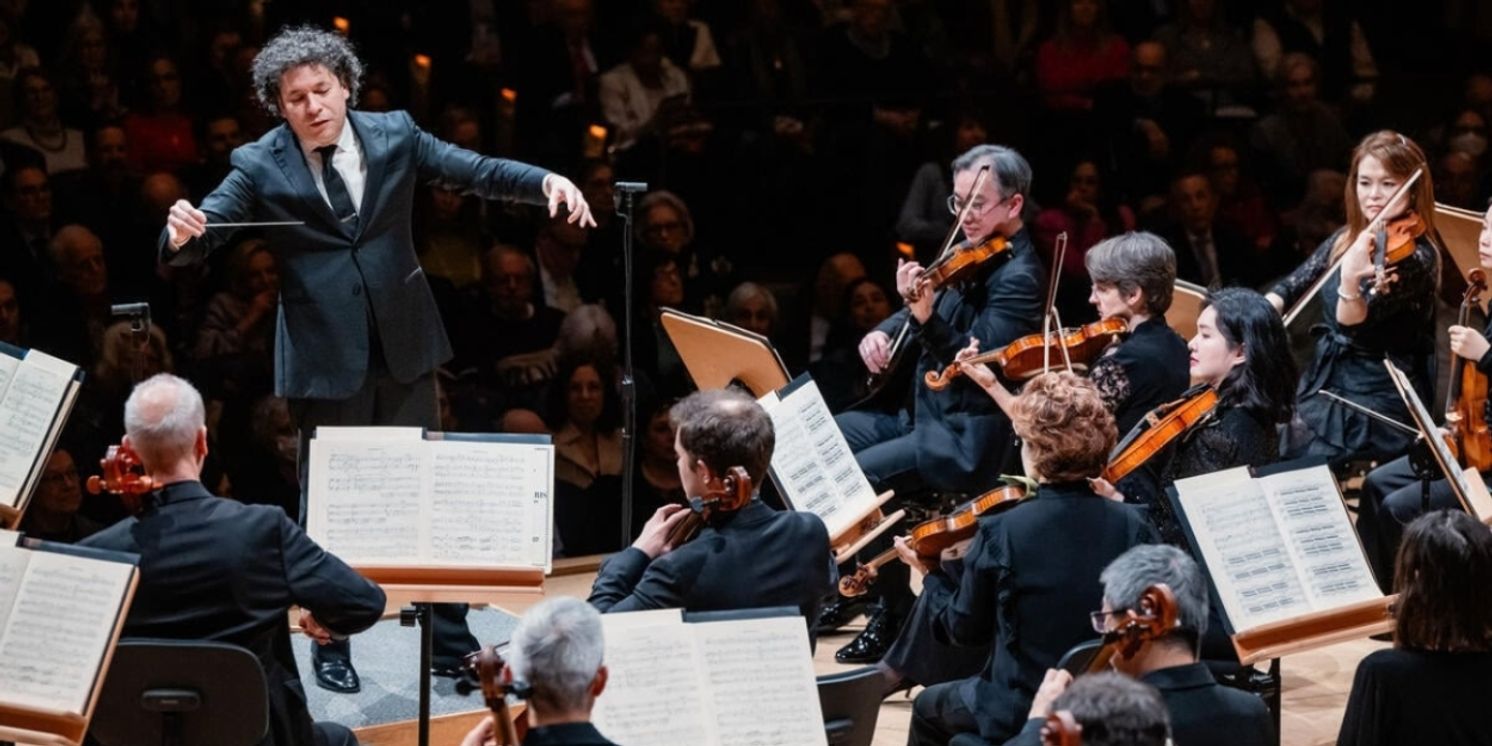
Gustavo Dudamel has formally taken command of the New York Philharmonic, beginning one of the most closely watched music directorships in the orchestra’s recent history.
The Venezuelan conductor, 45, becomes the Philharmonic’s 27th music director after 17 seasons leading the Los Angeles Philharmonic. His New York tenure opened with events beyond the conventional subscription series, including a Radio City Music Hall concert and a performance connected to the 25th anniversary of September 11.
A wider stage
Dudamel has described musical categories as barriers to be crossed rather than defended. That instinct is visible in a season that combines the standard orchestral repertory with premieres, popular collaborators and public programs.
His opening subscription program at David Geffen Hall paired Prokofiev’s Fifth Symphony with John Adams’s On the Transmigration of Souls and the world premiere of Zosha Di Castri’s Invisible House. The combination placed monument, memorial and new work in the same evening.
Dudamel arrives with unusual public recognition for a conductor and an established commitment to music education. He emerged from Venezuela’s El Sistema program and later founded Youth Orchestra Los Angeles with the LA Phil and community partners.
The larger question is what that charisma can do for an institution often forced to balance artistic ambition with the rituals of a legacy organization. The first answer comes not in a single gala but over a season: in programming, audiences and the sound he draws from the orchestra.
Coming up
Dudamel appears with Lin-Manuel Miranda in a public forum at the Delacorte Theater on September 23.
Sources: The Associated Press and Gustavo Dudamel’s official schedule.
A New York appointment
A music directorship at the New York Philharmonic is partly an artistic job and partly a civic one. The conductor has to shape an orchestra across seasons, not just concerts, while addressing an audience that ranges from devoted subscribers to people walking into David Geffen Hall for the first time. Dudamel arrives with unusual public visibility for a classical musician, which raises expectations well beyond the podium.
His Los Angeles years established the broad outline of his approach: canonical repertoire alongside contemporary work, large public projects and an emphasis on the orchestra as an institution with obligations beyond its regular concertgoers. New York will test how that philosophy changes when transplanted to an older orchestra in a different cultural ecosystem.
The timing matters. David Geffen Hall has already been remade, giving the Philharmonic a more intimate home than the old room and changing the relationship between stage and audience. A new music director now has the opportunity to define what should happen inside that architecture.
What to listen for
The temptation with a charismatic conductor is to watch the conductor. Dudamel’s physical style makes that especially easy. A more revealing test is to listen to the orchestra over time. Does the string sound change? How flexible are transitions? What happens to balance and color in familiar repertoire? Which composers recur often enough to become part of an argument rather than a one-night event?
Programming will matter just as much. An orchestra announces its priorities through repetition. A single contemporary premiere can be symbolic; sustained relationships with living composers, performers and communities are harder to dismiss as gestures. The same is true of education and public engagement. Their significance becomes clear over years, not opening weeks.
Dudamel also inherits the peculiar pressure attached to every New York cultural appointment. The city wants novelty and continuity at once. Audiences expect an institution to preserve traditions while demonstrating why those traditions deserve attention now. The Philharmonic has to be a great orchestra, but it also has to make a case for the orchestra.
That is why the beginning of a music directorship is best treated as an opening question rather than a verdict. Individual concerts will be praised and criticized. Programs will succeed unevenly. The meaningful story will emerge from accumulation: the repertoire Dudamel returns to, the musicians he brings into the institution and the audience he persuades to return with him.
For New Yorkers, that makes this a good season to listen longitudinally. Pick more than one concert. Hear something familiar and something you do not know. The Dudamel era will not be defined by a single ovation. It will be defined by what the orchestra sounds like after the excitement of arrival becomes routine.

