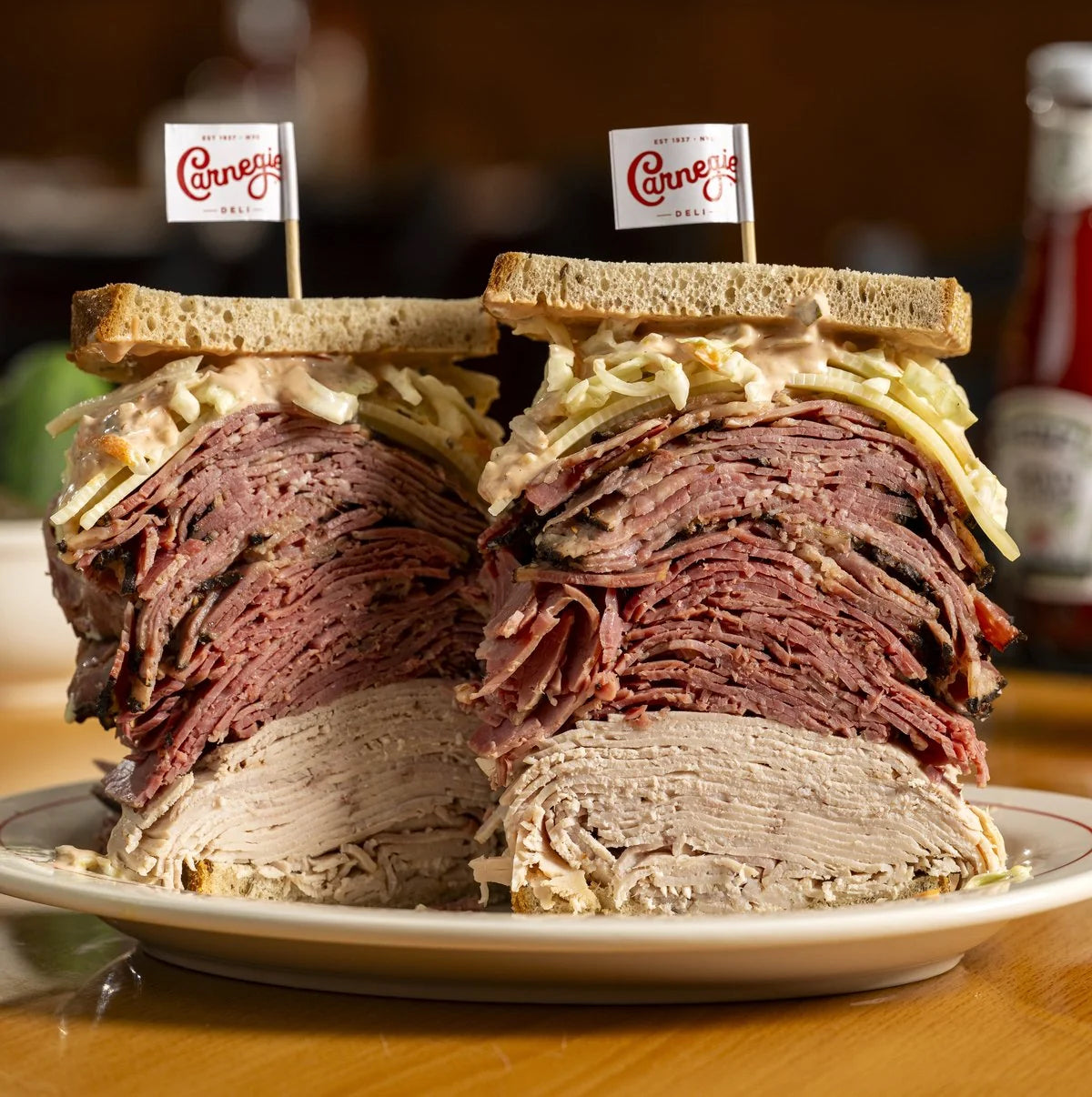
Ten years after its original Midtown dining room closed, Carnegie Deli has returned to Manhattan with the same central proposition: there is no respectable way to eat a sandwich this tall.
The new flagship opened September 15 at 834 Seventh Avenue, one block south of the deli’s former home near Carnegie Hall. Third-generation owner and chief executive Sarri Harper is overseeing the revival of a name that has been part of New York’s delicatessen mythology since 1937.
The old order
The menu restores the expected monuments: pastrami and corned beef on rye, potato knishes, matzo-ball soup, cheesecake and black-and-white cookies. It also adds newer dishes, including babka French toast and fried deli pickle chips.
The room leans into memory. Photographs of celebrity customers cover the walls, reestablishing the mixture of show-business shrine and high-volume lunch counter that made the original a tourist destination and a stubborn local landmark.
A reopening like this must negotiate an awkward question: whether New York wants the institution itself or merely the idea of it. Carnegie Deli’s answer is to put the enormous sandwich back on the table and allow diners to decide.
The details
- Where: 834 Seventh Avenue, near West 54th Street
- Opened: September 15, 2026
- Order: Pastrami on rye remains the essential test
Sources: Eater New York and Carnegie Deli.
Can a deli come back?
Carnegie Deli’s return is interesting because a New York institution is never merely a menu. The original restaurant belonged to a particular Midtown ecosystem: Broadway crowds, Carnegie Hall, hotels, office workers, tourists and a style of Jewish delicatessen that treated abundance as both hospitality and theater. A sandwich arrived not simply as lunch but as a sight gag made edible.
That theatricality explains why the deli survived so vividly in memory after the dining room closed. The celebrity photographs, brusque pace and overstuffed sandwiches were easy to caricature because they were already a form of self-caricature. Carnegie Deli understood that visitors wanted pastrami, but they also wanted a version of New York they could recognize immediately.
The challenge for the new restaurant is not to reproduce 2016, much less 1937. Midtown has changed, dining habits have changed and nostalgia is a poor substitute for a good sandwich. The more useful test is whether the revived Carnegie can make its old excess feel pleasurable rather than dutiful. A famous name gets people through the door once. The food has to justify a second visit.
Some of the menu additions acknowledge that reality. Babka French toast and fried pickle chips sit beside the canonical corned beef, pastrami and cheesecake. Purists may regard additions as unnecessary, but a living restaurant has always had to serve the people actually walking in, not just the people who remember an earlier room.
The location helps. Returning one block from the old address keeps Carnegie in the part of Manhattan that made the name legible. This is still a neighborhood where a deli can catch theatergoers before a show, tourists after a morning in Midtown and New Yorkers who suddenly decide that lunch requires half a pound of cured meat.
What to look for
For a first visit, resist the temptation to treat the menu like an archaeological document. Order what made the place famous and judge it as food now. The pastrami should carry the experience. Rye, mustard and meat leave very little room for disguise.
Then look around. The photographs and familiar dishes are not incidental decoration. They reveal the wager behind the entire reopening: that a restaurant can preserve enough ritual to feel continuous with its past while still operating in the present tense.
New York is ruthless about institutions that disappear and sentimental about them once they are gone. Carnegie Deli has been given the unusual chance to move from memory back into daily life. That is a heavier burden than even its sandwiches.
The revival also arrives in a city where Jewish delicatessen culture has become more self-conscious about preservation. The old landmarks were never museums, however, and Carnegie’s best chance is to resist becoming one. A deli earns affection through repetition: the same counter, the same order, the same argument about mustard, repeated until habit becomes tradition.
That process cannot be rushed by branding. It has to begin again with customers. The reopening supplies the name, recipes and visual cues. Whether the new room becomes part of New York rather than a replica of its own past will be decided one lunch at a time.

